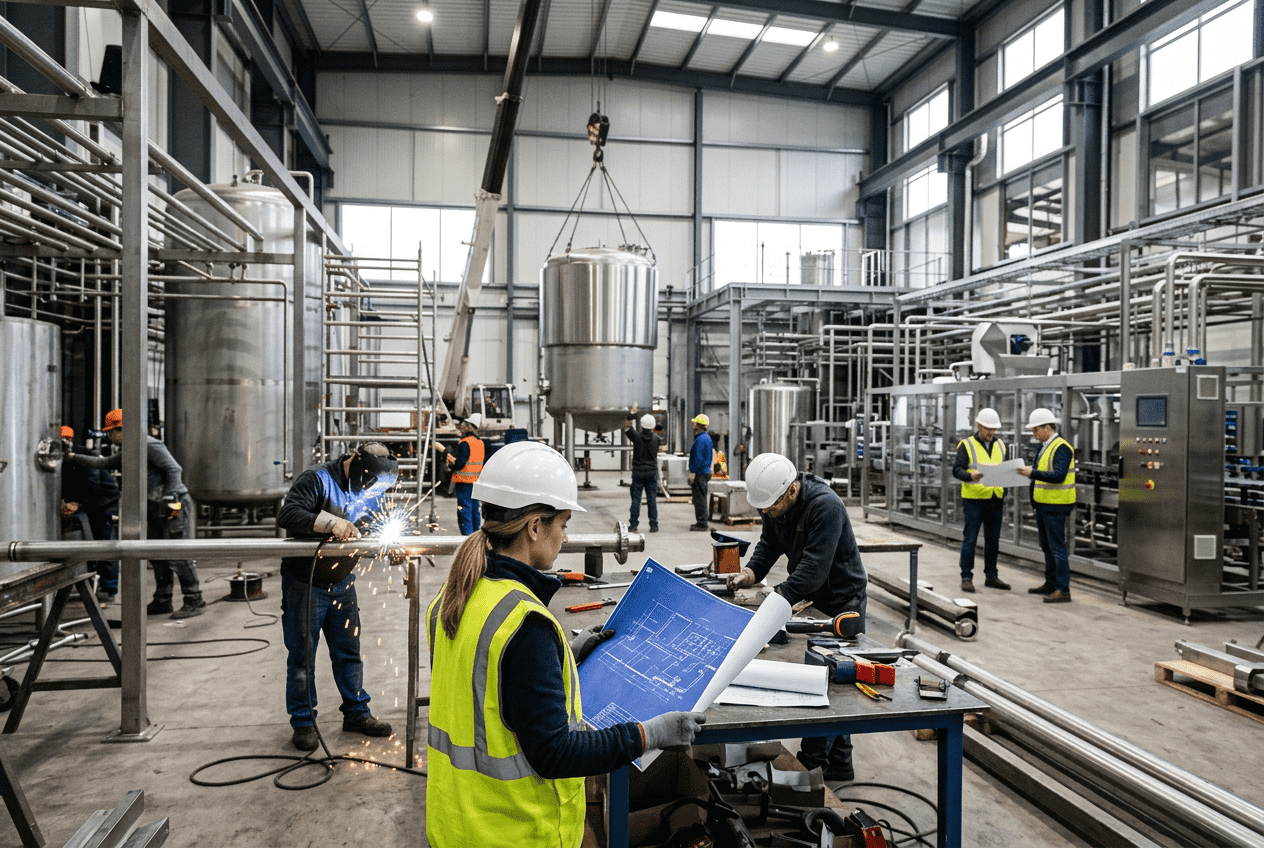
RTD Beverage Production Line Design
[trp_language language=”en_US”]
RTD Beverage Production Line Design for the United States Market
Ready-to-drink beverage producers in the United States need production lines that do more than simply fill cans or bottles. They need systems that connect formulation, blending, carbonation, sanitation, packaging, controls, and long-term capacity strategy into one reliable operating model. Whether the product is a canned cocktail, hard tea, functional beverage, sparkling water, dairy-based RTD, or non-carbonated wellness drink, the best line design starts with understanding product behavior, packaging goals, SKU complexity, utility demand, regulatory requirements, and future growth.
Across major beverage corridors such as Chicago, Dallas, Los Angeles, Atlanta, Charlotte, and the New Jersey distribution hub, manufacturers are investing in flexible lines that can handle multiple package formats while keeping changeover time low. In port-driven regions such as Long Beach, Houston, Savannah, and Newark, supply chain resilience also matters: the choice of depalletizer, filler, seam inspection, labeler, date coder, case packer, and palletizing logic directly affects labor, uptime, and speed-to-market.
For companies evaluating a new installation or expansion, the line should be designed around three realities: upstream process consistency, downstream packaging balance, and smart capital deployment. That means sizing tanks, pumps, fillers, conveyors, and controls based on both current sales and the next several years of expected growth, not just today’s forecast.
Quick Answer

A complete RTD production line in the United States typically includes raw ingredient receiving, water treatment if needed, batching and blending vessels, syrup or ingredient dosing, carbonation or deaeration depending on the product, buffer tanks, product feed systems, filling and closing equipment, inspection, coding, labeling, secondary packaging, palletizing, utilities, CIP, and plant-wide automation. The most effective designs match product characteristics and packaging format to target speed, sanitation requirements, SKU flexibility, and expansion plans.
For multi-SKU operations, the strongest line designs minimize downtime between can sizes, bottle types, closures, label formats, and flavor changes. For high-acid, alcoholic, dairy, or sensitive functional products, process integration becomes even more important because fill temperature, dissolved oxygen, carbonation level, mix accuracy, hygienic design, and cleaning validation all influence shelf life and product quality.
In practical terms, an RTD line should answer five questions before equipment is purchased:
- What products will run today and what products may be added in 24 to 60 months?
- Will the plant run cans, bottles, or both?
- What is the real sustained line speed, not just theoretical filler speed?
- How often will flavor, sweetener, or package changeovers occur?
- How will utilities, automation, sanitation, and material flow support future scale?
That is where a full-scope engineering partner matters. Disruptive Process Solutions works with beverage manufacturers across North America on profit-focused plant planning, line integration, and capital execution, helping teams avoid overspending on equipment that does not solve the real bottleneck.
Complete RTD Production Line Components: From Blending to Packaging

An RTD line is only as strong as its weakest link. Many facilities focus on the filler because it is visible and expensive, but overall performance depends on the full chain from blending through palletizing. A well-designed line balances hygienic processing, packaging efficiency, operator access, maintenance windows, and material staging.
Typical upstream components include ingredient receiving stations, liquid sugar or sweetener systems, powder induction, batching tanks, in-line blending skids, heat treatment where required, carbonation systems, product surge tanks, sanitary pumps, and product feed loops. Midstream equipment includes rinsers where applicable, fillers, seamers or cappers, and inspection tools. Downstream systems generally include warmers or tunnel pasteurization if required by the product, drying, labelers, coding, cartoning or tray packing, shrink wrapping, case packing, palletizing, and finished goods conveyance.
| Line Section | Main Equipment | Primary Function | Design Priority | Common Risk | Recommended Engineering Focus |
|---|---|---|---|---|---|
| Ingredient Handling | Unload stations, totes, pumps, filters | Receive and transfer raw materials | Traceability | Cross-contamination | Segregated flow paths and sanitary connections |
| Blending | Batch tanks, in-line mixers, dosing skids | Formulate product to spec | Accuracy | Brix or ABV variability | Recipe control and instrumentation |
| Conditioning | Carbonators, deaerators, chillers | Prepare fill-ready beverage | Product stability | CO2 loss or oxygen pickup | Temperature and pressure control |
| Filling and Closing | Filler, seamer, capper | Package product | Throughput | Leaks, seam defects, fill variance | Machine synchronization and QA checks |
| Secondary Packaging | Labeler, packer, coder, palletizer | Create shippable units | Line balance | Backups and microstops | Buffer design and conveyor logic |
| Sanitation and Utilities | CIP, compressed air, glycol, water | Support safe operation | Reliability | Underdesigned support systems | Peak load utility sizing |
The table above shows why line design must be holistic. A plant may buy an excellent filler and still struggle if syrup batching is inconsistent, CIP turnaround is slow, or the packer cannot keep up. In the United States, this is especially common in converted warehouse facilities where electrical service, drain layout, floor slope, and compressed air distribution were not originally designed for beverage production.
Market demand is also broadening. RTD categories now include cocktails, hard seltzers, hard coffee, energy drinks, hydration beverages, botanical infusions, protein beverages, and dairy-based products. Each category has different process and packaging sensitivities, so the equipment list should be product-led, not vendor-led.
The growth trend above reflects a realistic pattern seen in U.S. RTD investment: more capacity is being added, but with stronger emphasis on flexibility, lower labor dependence, and plant data visibility.
Line Design for Multi-SKU Flexibility: Can and Bottle Format Changeover

Many RTD plants are no longer single-product or single-format facilities. One shift may run 12-ounce sleek cans for a functional beverage, while the next runs 355 ml standard cans for a sparkling tea or PET bottles for a still product. Because of this, multi-SKU flexibility is often more important than peak nameplate speed.
Effective changeover design begins with identifying which components are truly format-dependent. These usually include infeed timing screws, guide rails, starwheels, neck handling parts, fill valves, lid feed components, cap sorters, labeler setup, packer tooling, and pallet patterns. Plants that run both cans and bottles should also consider whether a shared downstream section is practical or whether separate pathways reduce cumulative downtime.
In major co-packing regions such as Southern California, the Carolinas, and Texas, flexible format capability is often the deciding factor in winning new business. A line that changes quickly between SKUs can produce more billable hours than a faster line with long setup windows.
| Format Variable | Cans | Bottles | Changeover Impact | Best Practice | Expected Benefit |
|---|---|---|---|---|---|
| Container Diameter | High sensitivity | High sensitivity | Guide rail adjustment | Tool-less rail positioning | Faster setup |
| Closure Type | Ends and seams | Caps | Different closing systems | Dedicated closure management | Fewer defects |
| Label Style | Sleeve or pressure-sensitive | Wrap or pressure-sensitive | Recipe and sensor changes | Stored label recipes | Consistent application |
| Case Pack Pattern | Tray or wrap | Partition or carton | Packer tooling changes | Quick-release tooling | Shorter downtime |
| Container Height | Moderate sensitivity | High sensitivity | Elevations and timing | Servo-driven adjustments | Reduced operator error |
| SKU Frequency | Often high | Often moderate | Planning complexity | SMED-based scheduling | Higher OEE |
The table shows that format flexibility is not just a machine feature; it is an operating strategy. Plants should evaluate changeover by elapsed time, labor required, skill required, first-good-package timing, and quality loss during ramp-up. In many cases, the most profitable investment is not a bigger filler but a better change-parts strategy combined with operator training and digital setup recipes.
Facilities can also reduce disruptions by grouping similar package runs, designing mobile parts carts, color-coding tooling, and using barcode-based recipe confirmation. Those details matter when a plant is running six to twelve SKUs per week.
Upstream Process Integration: Blending, Carbonation, and Fill Preparation
Upstream integration determines whether the filler receives a stable, specification-ready product. If blend accuracy drifts, temperature rises, carbonation varies, or dissolved oxygen increases, packaging performance and shelf life will suffer. For alcoholic RTDs, tea-based drinks, juice blends, nutraceutical products, and dairy beverages, this section of the line is often where product quality is won or lost.
Core design factors include batch size, ingredient sequencing, shear requirements, hold time, agitation profile, cleanability, thermal sensitivity, carbonation setpoint, and fill pressure matching. Some products benefit from batch blending for traceability and formulation control. Others are better served by in-line blending to improve speed and reduce tank footprint.
DPS brings process engineering depth into this stage through capabilities that include blending and batching design, in-line Brix monitoring, carbonation and bright tank systems, water treatment, pasteurization options, and advanced controls integration. On projects where the process recipe and the packaging rate need to align tightly, this technical capability is critical because upstream variability often appears downstream as filler inefficiency.
| Product Type | Upstream Need | Key Instrumentation | Main Sensitivity | Recommended Tank Strategy | Special Note |
|---|---|---|---|---|---|
| Carbonated soft RTD | Stable CO2 and temperature | Pressure, temp, flow meters | Foaming | Insulated surge tank | Short product path to filler |
| Hard seltzer or cocktail | ABV consistency | Density, flow, temp | Tax and label compliance | Recipe-controlled batch tank | Closed transfer is preferred |
| Tea or botanical drink | Flavor and solids control | Brix, turbidity | Settling | Gentle agitation tank | Minimize hold time |
| Dairy-based RTD | Thermal and hygienic control | Temp, conductivity | Micro risk | Sanitary jacketed vessel | Often requires pasteurization |
| Protein beverage | Powder dispersion | Load cells, viscosity | Clumping | High-shear blend vessel | Validate CIP carefully |
| Still wellness beverage | Ingredient accuracy | Flow, pH, Brix | Flavor carryover | Small batch or in-line dosing | Frequent flavor changes common |
This table highlights why a universal upstream layout rarely works. In the United States, a producer serving retail chains in New York, Miami, Denver, and Seattle may have regional demand for entirely different product families. Designing a process room that can adapt to those categories improves asset utilization and reduces future retrofit cost.
For example, the fill-preparation system should not be isolated from packaging controls. If the packaging line is running at 220 cans per minute but the carbonator and product feed system only support 190 cans per minute under real conditions, the plant will experience chronic starvation and low efficiency. Integration prevents that mismatch.
Wild Goose Filling Systems and Canning Line Technology for RTDs
Wild Goose filling systems and similar modern canning technologies are frequently considered by RTD producers looking for dependable can line performance, compact layouts, and scalable throughput. For many beverage brands and co-packers, canning remains the dominant package format because it supports convenience, strong shelf presence, shipping efficiency, and excellent compatibility with carbonated and alcoholic products.
When evaluating canning technology, buyers should look beyond filler valve count and published maximum speed. Important factors include seam integrity monitoring, dissolved oxygen management, sanitation design, operator ergonomics, parts availability in the United States, remote support response time, lid handling reliability, and integration with depalletizers, conveyors, labelers, and case packers.
DPS supports equipment integration and complete line development, not just machine placement. That includes evaluating the canning system as part of the full production environment: utilities, automation, packaging balance, changeover logic, and growth planning. For clients that also need fabricated process equipment, custom equipment capabilities can complement third-party line machinery with tanks, CIP skids, and supporting process assets.
| Evaluation Factor | Why It Matters | Low-Speed Startup Plant | Mid-Speed Regional Plant | High-Growth Co-Packer | Engineering Recommendation |
|---|---|---|---|---|---|
| Filler Speed | Throughput target | Moderate | High | Very high | Match sustained not theoretical rate |
| Seamer Quality | Package integrity | Critical | Critical | Critical | Add seam inspection plan |
| Changeover Ease | SKU flexibility | High priority | High priority | Very high priority | Assess tooling and recipe storage |
| Footprint | Plant fit | Very important | Important | Important | Model future expansion zones |
| Support Network | Downtime response | Essential | Essential | Essential | Confirm U.S. parts and service |
| Integration Readiness | Total line performance | Important | Critical | Critical | Use common controls architecture |
The comparison above shows that the right canning solution depends on business model. A craft-scale brand entering grocery distribution near Charlotte or Phoenix may prioritize footprint and startup affordability. A contract manufacturer near Dallas-Fort Worth or Inland Empire may instead prioritize fast SKU changeovers and service support. Equipment choice should reflect margin structure, labor availability, and customer commitments.
The chart provides a realistic comparison profile for what U.S. buyers often value when benchmarking filler and canning line options. Quality assurance and service access usually rank near the top because downtime and packaging defects carry immediate commercial consequences.
Line Speed Optimization: Matching Filler Capacity to Labeler and Packer
A beverage line should be engineered around sustained balanced throughput, not isolated machine speed. One of the most common mistakes in RTD line projects is buying a filler that outpaces the rest of the packaging system. If the filler can run 300 containers per minute but the labeler averages 240 and the case packer dips to 220 during normal operation, the practical line speed will settle near the slowest stable point.
Line speed optimization uses machine data, accumulation modeling, package handling analysis, and real-world downtime assumptions to determine sustainable output. Small microstops across coding, labeling, orienting, pack formation, or discharge lanes can erase the benefits of a larger filler.
DPS approaches this from a profitability standpoint. Through its engineering and project execution model, the goal is not simply to install equipment, but to make sure capital is aimed at the actual bottleneck. That aligns with its broader service capability in capital planning, owner representation, process engineering, project management, and turnkey system integration. Companies can review broader project experience through selected case studies.
| Machine Zone | Nameplate Speed | Real Sustained Speed | Typical Loss Factor | Buffer Need | Optimization Action |
|---|---|---|---|---|---|
| Depalletizer | 320 CPM | 285 CPM | Can feed interruptions | Moderate | Improve infeed monitoring |
| Filler/Seamer | 300 CPM | 275 CPM | Product supply variability | Low | Stabilize upstream process |
| Labeler | 280 CPM | 245 CPM | Roll changes and alignment | High | Dual unwind and recipe setup |
| Date Coder | 300 CPM | 270 CPM | Print verification stops | Low | Vision integration |
| Case Packer | 260 CPM equivalent | 225 CPM equivalent | Pack collation issues | High | Servo timing refinement |
| Palletizer | 35 cases/min | 32 cases/min | Pattern change delays | Moderate | Automated recipe recall |
This table illustrates the concept of effective line speed. The filler may still be the most expensive machine, but it is not always the dominant limiter. Often, downstream packaging variations create the largest hidden losses. A layout with strategic accumulation can absorb short disturbances, but it cannot fix a chronically undersized packer.
The bar chart shows relative project demand by RTD category. Alcoholic and functional beverages are driving significant investment, which is why flexible line balancing has become essential for co-packers and branded manufacturers alike.
CIP System Design for RTD Production Lines with Frequent Changeovers
Frequent flavor rotation and multi-product scheduling make CIP design a major strategic issue in RTD manufacturing. A cleaning system that takes too long or uses excessive water, chemicals, and labor can materially reduce plant profitability. On the other hand, an undersized or poorly engineered CIP system can create hygiene risk, flavor carryover, and lost production time.
For plants producing cocktails, juices, teas, dairy beverages, or sweetened functional drinks, the sanitation challenge is different in each case. Sugar residues, proteins, botanicals, colors, and flavor oils may require different cleaning sequences, temperatures, chemical strengths, and verification methods.
DPS has strong capability in CIP engineering and supporting utilities, including custom CIP systems, process piping, controls, and integration with broader plant infrastructure. On the manufacturing side, the company also designs and supplies its own tanks and CIP-related process equipment, allowing sanitation strategy to be coordinated directly with process layout.
| CIP Design Factor | Why It Matters | Frequent Flavor Plant | Alcoholic RTD Plant | Dairy/Protein RTD Plant | Best Practice |
|---|---|---|---|---|---|
| Number of Circuits | Parallel cleaning capacity | High priority | Moderate | Very high | Separate critical circuits |
| Recovery Tanks | Chemical reuse | Useful | Useful | Useful | Validate with soil load profile |
| Flow Verification | Cleaning coverage | Critical | Critical | Critical | Use instrumented return data |
| Temperature Control | Cleaning effectiveness | Important | Important | Very high | Automate heat management |
| Recipe Automation | Repeatability | Very high | High | Very high | PLC-based CIP recipes |
| Validation Records | Audit and QA support | High | High | Very high | SCADA data logging |
The table emphasizes that CIP is both a sanitation system and a scheduling tool. When changeovers are frequent, CIP performance directly affects capacity. For example, a plant in the Midwest running six flavored SKUs plus one allergen-sensitive product may gain more annual output by improving clean-turnaround cycles than by increasing filler speed.
Water and wastewater considerations are also growing in importance in 2026 planning, particularly in regions with tightening utility costs such as California, Arizona, Colorado, and parts of Texas. Sustainable CIP design increasingly includes conductivity-based recovery, optimized rinse volumes, heat recovery, and digital verification to reduce unnecessary cycles.
Automation and SCADA Integration for RTD Manufacturing
Automation is no longer optional for competitive RTD plants in the United States. Even modest facilities benefit from integrated PLC controls, batch management, recipe handling, alarm tracking, OEE monitoring, and SCADA visualization. The reason is simple: labor is expensive, downtime is costly, and inconsistency multiplies across every shift.
Plant-wide automation should connect upstream processing, filling, packaging, utilities, CIP, and production reporting. Recipe selection should flow from blend preparation to labeler setup, coding logic, and pallet patterns where practical. Operators should be able to see the status of tanks, pumps, filler conditions, seam checks, utility alarms, and CIP completion from a central interface.
DPS has in-house controls engineering, PLC programming, automation, and SCADA capability as part of its technological service base. That matters because line automation should not be added after equipment arrives; it should be designed as part of the overall process, utility, and packaging architecture.
For RTD producers managing customer specifications, automation can also support traceability. Lot records, ingredient usage, critical process values, temperature history, and sanitation completion records become easier to retrieve for audits and investigations. This is especially relevant for operations serving national retail, club stores, and regulated alcoholic beverage channels.
The area chart shows the expected shift toward integrated plant controls. By 2026, more RTD facilities are expected to invest in connected automation not just for visibility, but for faster troubleshooting, easier compliance, and better labor utilization.
Future trends are also shaping automation choices. Cybersecurity requirements are rising, especially for larger manufacturers. Sustainability reporting is becoming more data-driven, requiring meter integration for water, steam, compressed air, and electrical use. AI-assisted maintenance and predictive downtime alerts are also moving from pilot projects into practical operations, particularly in higher-volume co-packing plants.
Capacity Planning: Equipment Sizing for Current and Future Volume Needs
Capacity planning is where engineering meets business strategy. A line should not be sized only for launch volume, but it also should not be overbuilt so severely that capital efficiency suffers. The right answer usually depends on forecast credibility, SKU mix, customer concentration, seasonal peaks, and whether the facility will act as a branded plant, co-packer, or hybrid operation.
In the United States, capacity planning often needs to reflect distribution geography. A plant shipping throughout the Southeast from North Carolina or Georgia may need different storage, staging, and line utilization assumptions than a West Coast producer serving California, Nevada, and the Pacific Northwest. Freight lanes, warehouse access, labor supply, and utility expansion options all influence sizing decisions.
DPS is particularly relevant in this phase because its service model combines capital planning, feasibility, design-build execution, owner representation, and full project management. Instead of treating equipment as a stand-alone purchase, the company works from a broader operational and financial view, helping clients align process design, utilities, construction, and phased expansion with profitability goals. More on these services can be found at engineering and project services.
| Planning Variable | Startup Plant | Growth Plant | National Co-Packer | Main Risk If Undersized | Main Risk If Oversized |
|---|---|---|---|---|---|
| Blend Tank Volume | Short runs | Moderate buffer | Large campaign production | Frequent interruptions | Long hold times |
| Filler Capacity | Match first contracts | Allow moderate headroom | High sustained throughput | Lost sales | Poor ROI |
| CIP Capacity | Single line support | Some parallel cleaning | Multi-circuit demand | Excess downtime | Idle asset cost |
| Compressed Air | Basic load | Expandable system | Redundant capacity | Machine instability | Energy waste |
| Warehouse Space | Limited staging | Balanced staging | High-volume inventory flow | Congestion | Unused overhead cost |
| Controls Architecture | Scalable PLC base | Integrated line systems | Plant-wide SCADA and reporting | Costly retrofit | Higher initial complexity |
The best equipment sizing plan is phased. Phase 1 should support current launch or contract demand. Phase 2 should be enabled in the layout, controls, utility headers, and floor space. Phase 3 should remain commercially justifiable but not fully purchased until market evidence supports it.
A strong example is a beverage co-packing facility designed to ramp from early-year volume into much larger full-capacity output over time. That kind of strategy requires utility infrastructure, syrup or blending systems, and production layouts that can scale without tearing out recently installed assets. This is where practical engineering discipline prevents expensive rework.
For buyers comparing suppliers, local presence and execution model matter as much as machine specifications. U.S. beverage plants often benefit from a partner that can manage process engineering, construction coordination, utilities, controls, and commissioning in one integrated framework rather than handing off responsibility between separate firms.
That integrated approach is a defining part of DPS’s value. Its manufacturing capability includes custom tanks up to 12,000 gallons, CIP systems, and other process equipment. Its technological capability includes process, mechanical, electrical, structural, and controls engineering. Its service capability includes capital planning, general contracting where licensed, installation management, owner advocacy, commissioning, and turnkey integration. For beverage producers trying to reduce project risk, that combination helps keep decisions aligned from concept through startup.
FAQ
What is the most important factor in RTD production line design?
The most important factor is alignment between product requirements, packaging format, and sustained throughput. A line that looks fast on paper but does not fit the product or changeover profile will underperform.
Should a new RTD plant choose cans, bottles, or both?
That depends on the product portfolio, retailer expectations, shipping economics, and capital budget. Cans dominate many RTD categories, but bottles remain important for still beverages, premium positioning, and certain closure needs.
How much flexibility should be designed into a line?
Enough to support the realistic 24- to 60-month SKU roadmap. Flexibility has value, but it should be targeted. The goal is not to prepare for every possible product, but to avoid costly retrofits for likely growth paths.
Why is upstream process design so critical?
Because blend accuracy, temperature control, carbonation consistency, and oxygen management determine what reaches the filler. Packaging performance depends heavily on stable upstream product preparation.
How do I know if my filler is too large or too small?
Compare the real sustained rate of the full line, not the filler nameplate alone. If the labeler, case packer, CIP turnaround, or product supply cannot support the filler, the extra speed may not create value.
What should I ask equipment suppliers during evaluation?
Ask about sustained speed, parts availability in the United States, sanitation design, changeover time, operator skill requirements, controls integration, and references for similar products and formats.
How important is SCADA for an RTD plant?
Very important, especially for plants with multiple SKUs, sanitation documentation needs, utility monitoring requirements, or co-packing customers demanding visibility and traceability.
What are the major RTD line trends for 2026?
Key trends include smarter changeover systems, wider use of SCADA and digital reporting, sustainability-driven CIP optimization, tighter utility metering, predictive maintenance, and stronger compliance around data, sanitation, and packaging quality.
Can DPS support both process and packaging line integration?
Yes. DPS supports engineering, installation, integration, project management, utilities, process systems, controls, and custom equipment as part of a broader design-build-manage model for food and beverage manufacturers across North America.
Where should a U.S. manufacturer start if planning a new RTD line?
Start with a feasibility and capacity study covering product mix, package formats, utility loads, sanitation requirements, line balance, labor model, and phased growth. That prevents capital from being spent in the wrong place.
For RTD producers in the United States, the right line design is ultimately a business decision supported by engineering. When blending, carbonation, filling, sanitation, packaging, controls, and future capacity are planned together, the result is not just a functioning line, but a more profitable operation.
[/trp_language]
Complete Company Portfolio

About the Author: Disruptive Process Solutions (DPS)
The DPS team combines process engineering expertise with real-world food and beverage manufacturing experience. Our content focuses on process optimization, production efficiency, facility improvements, and practical solutions that help manufacturers operate more effectively in a rapidly evolving industry.
Share

