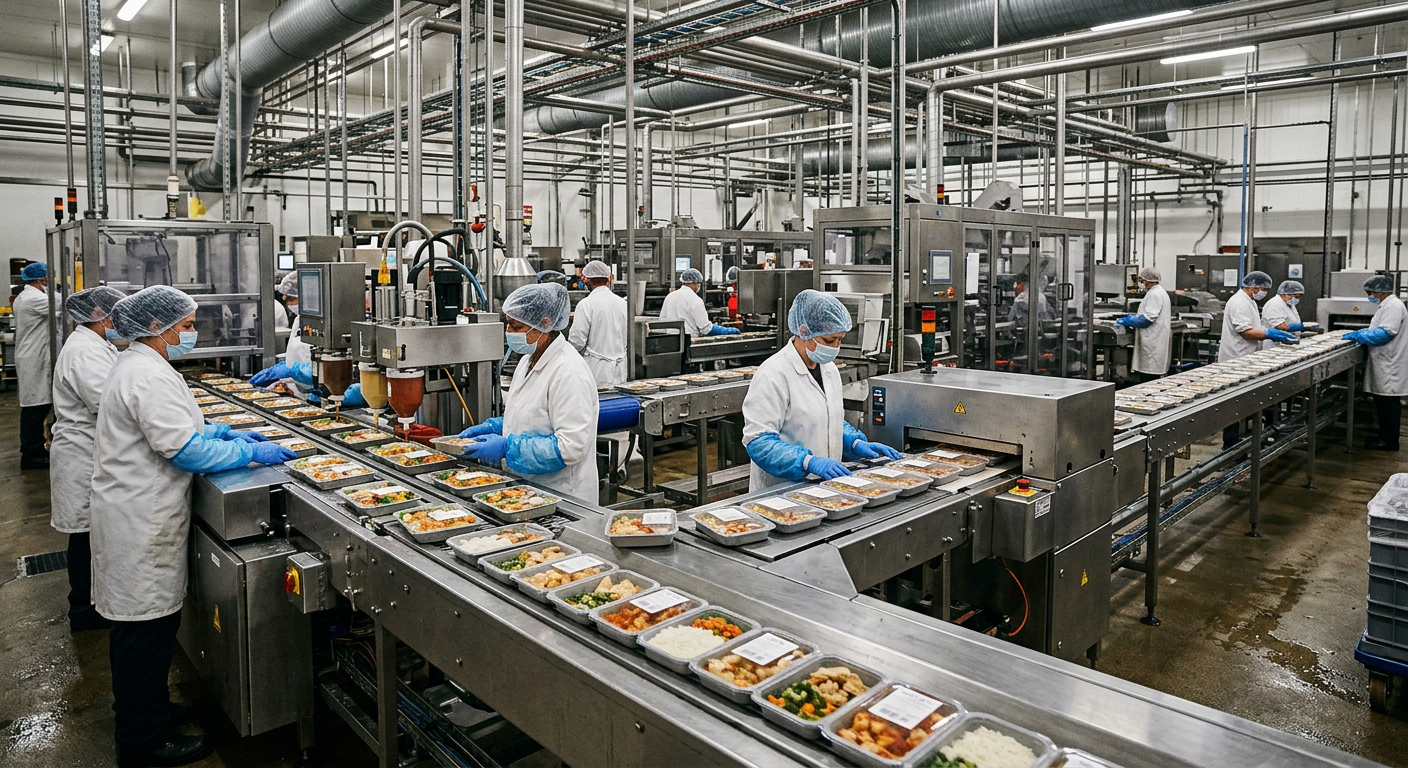
Salad Processing Line Design in 2026: Fresh-Cut Facility Engineering
[trp_language language=”en_US”]
Fresh-Cut Salad Processing Line Design for the United States in 2026
The best salad processing line design for 2026 combines gentle raw product handling, multi-stage washing, reliable foreign material detection, precise cutting, recipe-controlled blending, sanitation barriers, packaging flexibility, and a tightly engineered cold chain. In the United States, successful fresh-cut facilities are being designed around food safety, labor efficiency, water reuse strategy, data visibility, and the ability to run multiple pack formats such as pillow bags, bowls, and clamshells on one integrated platform. Whether a processor serves grocery retail in Chicago, club stores in Dallas, meal kit programs in Los Angeles, or foodservice hubs near Atlanta and New Jersey, the winning layout is the one that protects leaf quality while delivering profitable throughput.
The U.S. market for ready-to-eat leafy greens and mixed salad kits continues to favor operations that can scale across romaine, iceberg, spinach, kale, spring mix, cabbage, carrots, onions, cucumbers, proteins, toppings, and dressings. Engineers now have to consider not only production rate, but also FSMA expectations, retailer audit pressure, sanitation validation, sustainability metrics, utility cost, and future automation. This is why line design must start with process flow and risk reduction, not just equipment selection.
For processors planning new builds or retrofits, a practical approach is to align the process with local logistics realities. Facilities in California’s Salinas and Yuma seasonal supply network prioritize rapid inbound receiving and wash capacity. Plants shipping through distribution centers near Philadelphia, Columbus, Houston, or the Inland Empire need strong pallet movement and refrigerated dock design. Southeastern plants near Charlotte or Jacksonville often focus on mixed SKU flexibility for regional retail replenishment. In each case, engineering decisions should support shelf life, labor performance, and total landed cost.
Quick Answer

A salad processing line in the United States should be designed as a sequence of controlled zones: raw receiving, trim and prep, wash and flume transfer, dewatering and drying, optical inspection, cutting or slicing where needed, recipe weighing and blending, post-process sanitation controls, primary packaging, secondary packaging, cold storage, and refrigerated shipping. For 2026, the most competitive facilities emphasize four outcomes: lower microbial risk, less product damage, lower labor dependence, and higher line flexibility.
For most fresh-cut salad operations, the highest-value engineering priorities are:
- Gentle product conveyance to prevent bruising and reduce purge in the package.
- Validated wash chemistry and water turnover design to manage cross-contamination risk.
- Centrifugal or air-assisted drying tuned to specific leaf types and cut sizes.
- Optical sorting and foreign object detection for both whole-leaf and mixed ingredient streams.
- Recipe automation for accurate kit assembly and giveaway reduction.
- Fast sanitation access, hygienic zoning, and controlled personnel/material flow.
- Cold rooms, glycol or DX refrigeration, and dock staging designed around dwell time.
Buying advice for U.S. processors is straightforward: do not buy stand-alone machines first and then try to connect them later. Start with throughput targets, crop mix, sanitation plan, labor model, pack formats, and shelf-life objectives. Then create an integrated layout that includes utilities, controls, floor drainage, allergen separation if dressings or toppings are added, and room-by-room temperature strategy.
| Decision Area | Why It Matters | Typical U.S. Priority | Risk if Overlooked | 2026 Trend | Engineering Note |
|---|---|---|---|---|---|
| Raw Product Receiving | Controls temperature and incoming quality | Fast unloading with shaded or refrigerated staging | Field heat shortens shelf life | More digital receiving logs | Include QC hold space and sample table |
| Washing | Primary soil and microbial load reduction step | Multi-stage with monitored sanitizer levels | Cross-contamination events | More sensor-based dosing | Separate high-soil and final rinse zones |
| Drying | Reduces free water before pack | Centrifugal drying by leaf type | Wet packs and short shelf life | Energy-efficient drives | Balance g-force and product integrity |
| Inspection | Finds defects and foreign material | Vision systems plus metal detection or X-ray | Complaints and recalls | AI-assisted defect recognition | Provide reject validation points |
| Packaging | Defines output flexibility and OEE | Bag, bowl, and clamshell readiness | Frequent changeover losses | More recyclable film options | Design conveyors for modular expansion |
| Cold Chain | Preserves safety and freshness | 34-38°F room control | Respiration and spoilage increase | Smarter refrigeration monitoring | Link dock staging to shipping schedule |
The table above shows the practical issues that most directly affect profitability. In U.S. fresh-cut operations, failures usually come from interaction between steps, not from a single machine. That is why engineering discipline matters from day one.
Multi-Stage Washing and Centrifugal Drying System Design

Washing and drying are the heart of a fresh-cut salad line. A strong system usually starts with dumpers or receiving flumes that minimize leaf breakage. Product then moves through one or more wash stages, often beginning with heavy soil removal and followed by cleaner, controlled antimicrobial stages. Final rinse logic depends on product type, water quality goals, and the processor’s food safety program.
Leafy greens such as romaine, spinach, baby kale, and spring mix each behave differently in water. Spinach may trap more water and require gentler drying parameters. Romaine and iceberg can tolerate more robust handling but still suffer edge damage if transfers are too abrupt. U.S. plants serving premium retail often use product-specific recipes for flume velocity, sanitizer concentration, dwell time, and spin cycle intensity.
A good wash system also needs strong utility design: water supply pressure stability, chemical injection points, drain capacity, access for cleanout, and instrument visibility for operators. Facilities in drought-sensitive regions such as California increasingly evaluate water recirculation, filtration, and make-up water optimization. However, water reuse must always be engineered around food safety validation, not just conservation goals.
| System Parameter | Purpose | Typical Design Range | Product Impact | Food Safety Impact | Operator Focus |
|---|---|---|---|---|---|
| Initial Wash Stage | Remove field soil and debris | High-volume flume or immersion | Reduces abrasion in later stages | Lowers organic load upstream | Watch water turbidity |
| Sanitizer Dose Control | Maintain antimicrobial effectiveness | Continuous monitored dosing | Protects leaf quality when controlled | Critical to cross-contamination control | Verify sensors and manual checks |
| Water Turnover Rate | Keep process water clean | Depends on load and product type | Stabilizes wash performance | Supports consistent sanitation | Track incoming soil load |
| Transfer Conveyor Design | Move product with low damage | Perforated belts or shaker systems | Less bruising and tearing | Fewer niches if hygienically built | Inspect belt condition |
| Centrifugal Drying | Remove surface moisture | Short, product-specific cycles | Improves shelf life and pack appearance | Less free water in package | Avoid over-spin damage |
| Post-Dry Verification | Confirm target dryness | Visual and weight trend checks | Reduces wet mixes | Supports stable packaged environment | Record product changeovers |
The most common drying equipment choices are basket centrifuges, continuous centrifugal dryers, and air knife or vibration-assisted systems. In larger U.S. installations, hybrid drying is often used. For example, a processor may use spin drying for spinach and air-assisted finishing for mixed greens. This combination can improve throughput while protecting tender leaves.
Future design trends for 2026 include inline moisture analytics, predictive maintenance on dryer bearings and motors, and variable-speed automation that changes settings by product code. Plants aiming to reduce labor dependence are also adding automated tote handling between wash and dry zones.
Optical Sorting and Foreign Object Detection for Leafy Greens

After drying, inspection becomes a major control point. Optical sorting technology for leafy greens now goes beyond color separation. Modern systems can identify dark defects, yellowing, insect damage, stem load, and some non-product contaminants. In U.S. facilities handling high-volume baby leaf products, optical sorting helps reduce both consumer complaints and expensive over-trimming upstream.
Foreign object detection should be considered as a layered defense. Optical systems can catch plastics, wood, insects, and off-color material. Metal detection remains valuable for metallic risk. X-ray may be justified in select applications, especially where mixed kits include denser components or where customer standards demand broader detection capability. No single technology should be treated as a complete safeguard.
Line layout matters as much as sensor capability. The best inspection zone has stable product presentation, controlled feed depth, good lighting management, and an easy-to-verify reject path. If the product mat is too thick, defects can hide. If the feed is too sparse, throughput suffers. A strong engineering team balances width, belt speed, and throughput so detection performance remains realistic under production conditions.
Processors near major logistics corridors such as the I-5 route in California, the Midwest distribution network around Indianapolis, or the Northeast corridor near Newark and Philadelphia often see pressure from large retailers for detailed QA documentation. Inspection systems should therefore be integrated with production data capture, reject trending, and audit-friendly reporting.
| Detection Method | Best Use | Strength | Limitation | Best Placement | 2026 Upgrade Path |
|---|---|---|---|---|---|
| Color Optical Sorting | Leaf defects and discoloration | High-speed screening | Limited on hidden defects | After drying, before mixing | AI model refinement |
| Laser/Shape Inspection | Foreign matter and structure changes | Better differentiation | Higher system complexity | Primary inspection lane | Multi-sensor fusion |
| Metal Detection | Ferrous and non-ferrous metals | Established verification method | Only metal hazards | Before final case pack or after pack | Improved auto-reject logging |
| X-ray | Dense foreign material in mixed packs | Broader material detection | Cost and density dependence | Packaged product stage | Higher resolution software |
| Manual QC Station | Backup verification | Flexible and visual | Labor dependent | Before packaging | Digital checklists |
| Vision Data Reporting | Trend analysis | Supports continuous improvement | Requires disciplined use | Connected to SCADA or MES | Predictive defect mapping |
The explanation from this table is simple: foreign object control works best when technologies are layered and connected to plant operations. A processor that pairs intelligent inspection with disciplined upstream trimming and washing will usually outperform one that tries to solve all quality problems at the final package stage.
Cutting, Slicing, and Shredding Equipment for Salad Ingredients
Not every salad line is all-leaf. Many mixed kits include shredded cabbage, sliced carrots, chopped romaine, cucumber rounds, onions, radishes, and other value-added ingredients. Cutting systems must therefore be selected by ingredient behavior, not just desired throughput. Blade style, infeed stability, sanitation access, and cut consistency all influence yield and shelf life.
For cabbage and lettuce, shredders need to produce a clean cut with minimal fines. Carrot and cucumber lines often require strong wash-down construction and accurate feed alignment. Onion cutting demands attention to odor management, local exhaust, and room zoning so neighboring ingredients are not affected. Mixed facilities should consider whether ingredient prep happens in a separate room or a fully separated processing cell.
The buying advice here is to avoid over-sizing cutters without considering downstream blending and package fill. If the cutter can run faster than the wash, blend, or pack-out system, product will queue and quality will drop. Integrated line balancing is more valuable than peak machine speed.
| Ingredient | Preferred Equipment | Primary Objective | Common Challenge | Best Room Condition | Selection Tip |
|---|---|---|---|---|---|
| Romaine | Chopper or strip cutter | Uniform bite-size pieces | Edge browning | Cold, low dwell time | Choose gentle discharge design |
| Cabbage | Shredder | Consistent ribbon cut | Fines generation | High sanitation access | Evaluate blade change speed |
| Carrots | Slicer or shredder | Precise thickness or shred | Moisture and smear | Dedicated prep room | Confirm wash-down rating |
| Cucumber | Rotary slicer | Uniform rounds | Slippery infeed | Cold with drainage control | Test with actual product size range |
| Onions | Dicer or slicer | Controlled cut size | Odor spread | Separated air handling zone | Plan ventilation and room pressure |
| Kale/Herbs | Leaf cutter | Low bruising | Product wrapping on blades | Cool and dry transfer area | Use product-specific trials |
Across the United States, processors serving foodservice in cities like Las Vegas, Orlando, and Nashville often need a broader ingredient mix than retail-only salad plants. As a result, flexible prep rooms with mobile equipment, quick sanitation changeover, and modular conveyance are becoming more common. In 2026, expect more cutter systems linked to recipe scheduling software so line crews can switch SKUs faster with fewer setup errors.
Recipe Weighing and Blending Systems for Mixed Salad Kits
Mixed salad kits live or die on recipe accuracy. Giveaway hurts margin, while underweight packs trigger retailer penalties and consumer dissatisfaction. Effective recipe weighing and blending systems combine controlled ingredient dosing, low-drop transfer, and synchronized communication with packaging equipment.
For leafy base mixes, multi-head scales are not always the right answer. Many operations use linear weighers, volumetric feeders, or hybrid solutions that better protect product structure. Toppings such as croutons, seeds, cheese, dried fruit, or proteins may require separate lanes and allergen-conscious staging. Dressings and toppings can be inserted in the package or added as secondary components depending on format and customer expectation.
Blending should be gentle and short. Over-mixing damages leaves and creates fines that settle to the bottom of the bag. The best systems create distribution uniformity without tumbling product excessively. This is especially important for premium kits destined for high-turn grocery chains in markets such as New York, Seattle, Boston, and Minneapolis.
| Blend System Feature | Operational Benefit | Margin Benefit | Quality Benefit | Common Mistake | Recommended Practice |
|---|---|---|---|---|---|
| Recipe Control Software | Consistent SKU execution | Less giveaway | Uniform consumer experience | Manual overrides without review | Track changes by user and batch |
| Gentle Ingredient Feed | Stable flow to blend zone | Reduces waste | Less leaf damage | Steep drops between conveyors | Use low-drop transitions |
| Integrated Weighing | Accurate dose management | Controls overfill | Improves label compliance | Single setpoint for all products | Set product-specific tolerances |
| Topping Addition Module | Supports premium kits | Higher-value SKU capability | Better component separation | Poor allergen planning | Design segregated storage and handling |
| Short Blend Time | Maintains throughput | Less rework | Protects appearance | Overmixing for visual uniformity | Validate distribution vs. damage |
| Data Integration | Supports traceability | Faster root-cause analysis | Improves accountability | Standalone machine data silos | Link line controls to plant reporting |
The table highlights that weighing and blending are not only mechanical tasks; they are commercial controls. Small improvements in giveaway or rework can make a major difference when a plant runs millions of units annually.
UVC Treatment and Advanced Sanitation for Extended Shelf Life
As fresh-cut processors search for additional shelf-life support, UVC treatment and advanced sanitation tools are drawing more attention. UVC is not a substitute for a validated wash system, proper temperatures, or hygienic facility design. Instead, it can serve as one more hurdle in a broader contamination control strategy when properly validated for the product and the process environment.
In salad operations, advanced sanitation goes beyond equipment foam cleaning. It includes zoning of personnel and tools, drain strategy, hygienic air handling, boot sanitation, traffic control, dry storage separation for packaging materials, and validated clean-in-place or clean-out-of-place procedures where applicable. U.S. customers increasingly expect documented environmental monitoring and faster corrective action.
For 2026, several trends matter: more automated sanitation verification, greater use of ATP and environmental data trending, pressure to reduce water and chemical consumption, and stronger retailer focus on preventive controls. Sustainable sanitation is becoming a real engineering topic, especially in regions with rising utility costs.
Applications vary by plant type. A high-volume bagged leaf facility may use UVC in targeted conveyor or product presentation zones. A premium salad kit plant may focus more heavily on room segregation, utensil control, and rapid sanitation changeovers between allergen-bearing toppings. The right design depends on hazard analysis, throughput, and customer requirements.
Packaging Line Integration for Bags, Bowls, and Clamshell Containers
Packaging integration is where upstream process quality becomes commercial output. The 2026 U.S. market demands flexibility: value bags for club channels, premium stand-up pouches, single-serve bowls, and rigid clamshells for grab-and-go or higher-end merchandising. A well-engineered facility should accommodate current pack formats while leaving a clear expansion path.
Bag lines usually offer the highest throughput, but they require careful product feed control, seal integrity management, gas flush strategy where applicable, and smooth integration with coding, checkweighing, case packing, and palletizing. Bowl and clamshell lines generally require more footprint and more precise product placement, but they open the door to premium merchandising and higher average selling prices.
Facilities serving mixed channels often build one flexible packaging hall rather than isolated mini-lines. This can work well if changeover design, labor allocation, and material flow are carefully planned. The engineering challenge is to avoid crossover congestion between film rolls, rigid containers, finished packs, and QA hold areas.
| Package Format | Main Advantage | Main Constraint | Best Fit | Line Design Need | Profitability Consideration |
|---|---|---|---|---|---|
| Pillow Bag | High throughput | Lower visual premium | Retail volume programs | Fast VFFS integration | Strong cost efficiency |
| Stand-Up Bag | Better shelf presence | More packaging complexity | Premium salad kits | Accurate fill presentation | Higher value per unit |
| Bowl | Convenience and meal appeal | Larger footprint | Grab-and-go meals | Rigid container denesting | Supports premium pricing |
| Clamshell | Product visibility | Higher material cost | Leaf blends and toppings | Gentle placement and closing | Reduces crush risk |
| Multi-Component Kit Pack | SKU differentiation | More stations and timing | Retail branded kits | Topping and dressing insertion | Margin depends on recipe control |
| Foodservice Bulk Pack | Operational simplicity | Less retail-ready | Restaurants and institutions | Large-fill handling | Volume-driven economics |
When comparing packaging solutions, processors should assess not only speed but also OEE, labor per thousand units, material cost, rework rate, and customer mix. For many U.S. operators, a line that runs slightly slower but changes over quickly between bags and bowls creates better annual profitability than a rigid high-speed line dedicated to a single format.
Cold Chain and Refrigeration Design for Fresh-Cut Produce Facilities
Cold chain design is the final safeguard for freshness and shelf life. For fresh-cut produce, refrigeration must be treated as a process system, not simply a building utility. Room temperature targets, air distribution, loading patterns, product dwell time, and dock traffic all affect results. The goal is to limit respiration, maintain appearance, and preserve microbiological stability.
Most U.S. fresh-cut facilities operate key process rooms and storage areas in the mid-30s Fahrenheit range, with exact targets depending on product mix and stage. However, temperature alone is not enough. Engineers must address air balance, humidity, door management, evaporator selection, defrost strategy, and sanitation compatibility. Warm staging near docks is a common weak point, especially in hot climates such as Texas, Arizona, and Florida.
Facilities shipping nationwide through cold carriers or regional DC networks need strong pallet handling design. Finished goods should move quickly from packaging to blast pull-down or cold storage, then to dock staging timed to truck arrival. Excess dwell at the dock can erase gains made through careful upstream processing.
| Facility Zone | Typical Temperature Goal | Purpose | Risk if Too Warm | Engineering Control | Operational Note |
|---|---|---|---|---|---|
| Raw Receiving Hold | 36-40°F | Limit field heat | Early quality loss | Fast unload and pre-cooling logic | Separate inbound lots clearly |
| Wash/Prep Room | 36-38°F | Protect product during processing | Higher respiration | Insulated room and air balance | Manage floor wetness and drains |
| Cutting/Blending | 34-38°F | Maintain fresh-cut quality | Texture decline | Targeted air distribution | Minimize queue time |
| Packaging Hall | 34-38°F | Stable pack-out conditions | Condensation and seal issues | Room pressurization and air control | Coordinate with sanitation schedule |
| Finished Goods Cooler | 34-36°F | Hold before shipment | Shelf-life reduction | High-density pallet airflow design | Track lot rotation carefully |
| Refrigerated Dock Staging | 35-40°F | Protect product during shipping prep | Temperature abuse before loadout | Dock seals and quick turnover | Schedule trucks tightly |
The explanation from this table is that refrigeration must match actual product movement. Too many facilities design good coolers but weak transitions. In 2026, expect wider adoption of smart sensors, alarm dashboards, and energy optimization tied to occupancy and door-opening patterns.
About Our Company
Disruptive Process Solutions supports food and beverage manufacturers across the United States and Canada with practical engineering built around profitability, execution, and long-term operating success. Rather than acting like a traditional contractor that only installs what is requested, the company approaches projects as a strategic partner focused on helping clients make better capital decisions and build systems that perform in the real world.
From a technological capability standpoint, DPS brings process, mechanical, electrical, structural, plumbing, and controls expertise into one coordinated model. That matters in salad line design because washing, drying, conveyors, inspection devices, recipe control, utilities, and refrigeration must work as one operating system. Clients looking for integrated planning can review the company’s broader engineering and project support approach here: food manufacturing engineering services.
From a manufacturing capability standpoint, DPS also develops and supplies selected process equipment and integrates third-party technologies into complete operating lines. This is useful for fresh-cut plants that need custom skids, utility modules, tanks, CIP support elements, or application-specific equipment interfaces. More on available equipment capabilities can be seen at process equipment solutions. In salad facilities, this manufacturing mindset helps when standard equipment needs to be adapted to room constraints, sanitation requirements, or utility realities.
From a service capability standpoint, DPS works across planning, design, installation, integration, project management, and execution oversight. Its Design Build Manage model is especially relevant for processors who want one accountable partner from concept through startup. For companies evaluating fit, background and operating philosophy are available at about Disruptive Process Solutions. Examples of real project execution and field results are available through these project case studies.
For U.S. fresh-cut produce facilities, the value of this model is speed with discipline. A project may involve hygienic room layout, wash system utility planning, controls integration, packaging expansion, dock refrigeration improvements, or a plant-wide retrofit phased around live production. In each case, the objective is not just to install equipment, but to engineer a profitable operating result.
FAQ
What throughput should a new salad line be designed for?
Design for realistic daily and peak seasonal demand, then check whether sanitation time, labor availability, and packaging capacity support that target. A line rated only on machine nameplate speed is often misleading.
How many wash stages are usually needed?
It depends on product mix, soil load, and food safety strategy. Many U.S. processors prefer at least a staged approach with early debris removal and a controlled antimicrobial step, followed by final rinse logic where validated.
Is centrifugal drying always necessary?
Not always, but for many leafy greens it remains one of the most effective ways to reduce free moisture before packaging. Product trials are essential because some tender mixes need gentler settings or hybrid drying.
Should a processor choose bags, bowls, or clamshells?
Choose based on customer channel, price point, shelf presentation, case cube, labor model, and line flexibility goals. Many facilities now need a combination rather than a single format.
How important is optical sorting for leafy greens?
It is increasingly important for retail-quality consistency and foreign material reduction. However, it works best as part of a full quality system that includes good wash design, trimming, and final verification.
What are the biggest 2026 trends in salad facility engineering?
More automation, stronger sanitation data systems, sustainability-driven water and energy design, recyclable packaging adaptation, AI-supported inspection, and smarter refrigeration monitoring are the biggest shifts.
What local supplier factors matter in the United States?
Processors should evaluate field service coverage, spare parts access, installer availability, and response time by region. Support needs look different in Salinas, Phoenix, Chicago, or Raleigh, especially during peak production windows.
How should a company compare suppliers?
Use a scoring model that weighs hygienic design, service support, integration experience, controls compatibility, total cost of ownership, and proof of performance with similar ingredients.
| Supplier Evaluation Factor | Why It Matters | What to Ask | Good Sign | Warning Sign | Best for U.S. Buyers |
|---|---|---|---|---|---|
| Regional Service Reach | Reduces downtime | Where are technicians located? | Documented coverage map | Remote-only support promise | Important for multi-state operations |
| Hygienic Design Quality | Supports sanitation | How is equipment cleaned and inspected? | Open access and sanitary details | Hidden niches and hard-to-clean frames | Critical for leafy greens |
| Integration Experience | Improves startup success | Can the machine connect to upstream and downstream logic? | Reference projects with full lines | Standalone machine mindset | Essential for new plants |
| Controls Compatibility | Supports data flow and troubleshooting | Which PLC/HMI standards are supported? | Flexible communication options | Proprietary isolation | Useful for expansion planning |
| Spare Parts Strategy | Protects uptime | What parts should be stocked onsite? | Clear critical spares list | Long lead items with no plan | Very important in seasonal peaks |
| Total Cost of Ownership | Measures real value | What are energy, labor, and maintenance implications? | Transparent lifecycle estimate | Low price, unclear operating cost | Best basis for final decision |
For companies planning a new fresh-cut plant or a targeted retrofit in the United States, the strongest results come from engineering the entire process around product protection, verifiable sanitation, packaging flexibility, and cold-chain discipline. That is the practical path to better shelf life, better retailer performance, and better returns on capital in 2026.
[/trp_language]
Complete Company Portfolio
About the Author: Disruptive Process Solutions (DPS)
The DPS team combines process engineering expertise with real-world food and beverage manufacturing experience. Our content focuses on process optimization, production efficiency, facility improvements, and practical solutions that help manufacturers operate more effectively in a rapidly evolving industry.
Share