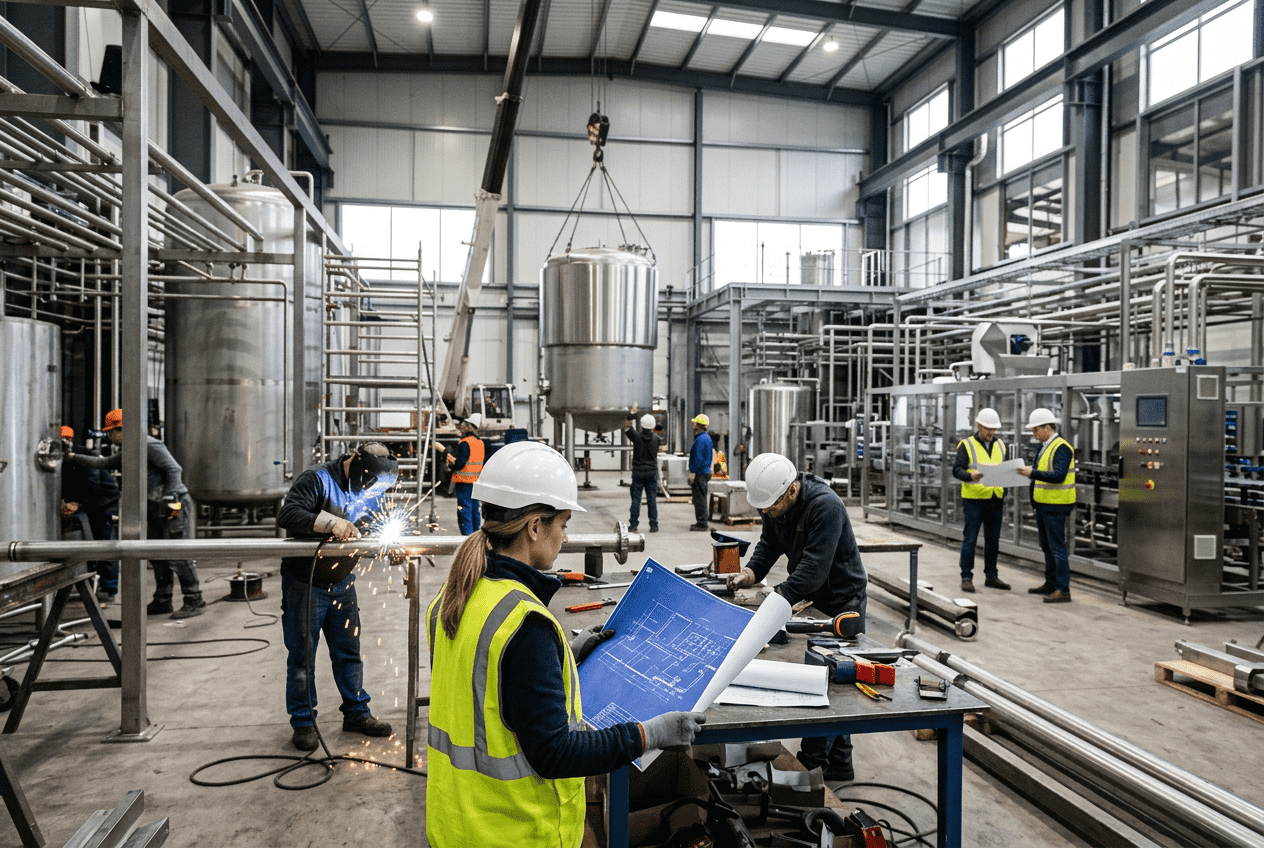
Sauce Cooking Kettles for Production Plants
[trp_language language=”en_US”]
Sauce Kettle Systems for Production Plants in the United States
For U.S. food manufacturers, the right sauce kettle is not just a cooking vessel. It is a heat transfer, mixing, food safety, and throughput decision that affects yield, flavor consistency, packaging uptime, utility costs, and changeover speed. Whether a plant is making tomato sauce, queso, barbecue sauce, hot sauce, fruit glaze, curry base, salsa, or heavy paste products, the best production kettle is usually one that combines controlled heating, scraper agitation, sanitary construction, and line integration with upstream batching and downstream filling.
In the United States, demand is especially strong among prepared foods, co-packers, refrigerated dips, shelf-stable sauces, and aseptic processors. Plants in Chicago, Dallas, Los Angeles, Atlanta, Houston, New Jersey, and California’s Central Valley often need equipment that handles variable recipes, seasonal demand swings, and strict allergen protocols. For that reason, many processors move beyond simple open kettles and choose engineered systems with automated recipe controls, CIP readiness, load cell batching, and transfer connections to holding tanks, cooling systems, and packaging lines.
This guide explains how to choose a sauce kettle system for real production conditions in the U.S. market, with practical advice on agitation, viscosity, metallurgy, heating methods, sizing, automation, cleanability, and expansion planning.
Quick Answer

The best sauce kettles for production plants are sanitary, jacketed cooking vessels designed for even heat transfer, controlled agitation, repeatable temperature ramps, and fast cleaning. For most U.S. sauce applications, a steam-jacketed kettle with scraper agitation, variable-speed drive, 316L product-contact surfaces for acidic formulas, and CIP-capable design offers the strongest balance of quality, scalability, and operating efficiency.
If your product is thin, such as a vinegar-based hot sauce, a lower-torque mixer and gentle recirculation may be enough. If your product is thick, sticky, particulate, or sugar-rich, such as pasta sauce, cheese sauce, mole, glaze, or fruit preparation, scraper agitation becomes critical to prevent burn-on and maintain uniformity. Kettle size should match not only batch volume but also filler speed, changeover pattern, dwell time, and future expansion plans. Integration matters as much as the vessel itself.
For companies that need engineering depth as well as equipment, Disruptive Process Solutions works with food and beverage manufacturers across North America on capital projects that prioritize throughput, sanitary design, and long-term profitability rather than one-off equipment sales alone.
| Decision Area | Recommended Choice | Best For | Main Benefit | Common Risk if Ignored | U.S. Plant Impact |
|---|---|---|---|---|---|
| Heating method | Steam jacketed | Most medium to high-volume sauce plants | Even heat and control | Scorching and slow response | Better batch consistency |
| Agitation | Scraper agitator | Tomato, cheese, sugar, starch, heavy sauces | Prevents burn-on | Localized overheating | Less rework and waste |
| Material | 316L stainless steel | Acidic sauces | Corrosion resistance | Pitting and shorter equipment life | Lower maintenance cost |
| Controls | Recipe-based automation | Multi-SKU plants | Repeatability | Operator variability | Improved QA compliance |
| Cleaning | CIP-ready sanitary design | Allergen and flavor changeover | Shorter downtime | Cross-contact risk | Higher OEE |
| Integration | Transfer to holding/filling system | Continuous packaging operations | Smoother flow to fillers | Packaging starvation | Higher line utilization |
The table above summarizes the core buying logic. In practice, the right system depends on product rheology, utility availability, sanitation standards, and the commercial goals of the plant.
Why Sauce Kettles Need Scraper Agitation: Preventing Burn-On & Ensuring Uniformity

Scraper agitation is one of the most important features in sauce processing because many sauces do not behave like simple liquids. Tomato solids settle. Sugar phases can overheat. Dairy proteins stick. Starches thicken rapidly. Spices and particulates stratify. A standard propeller mixer may create bulk movement in the center of the vessel while leaving a thin film of product on the heated wall. That wall film is where burn-on starts.
A scraper agitator continuously wipes the kettle wall while moving product away from the hot surface and back into the batch. This improves heat transfer, reduces fouling, and keeps temperature distribution more uniform. In products such as ketchup, enchilada sauce, cream sauce, and fruit fillings, scraper agitation often means the difference between a clean flavor and a scorched note that causes a full batch hold.
In larger U.S. plants running multiple shifts, scraper design also affects labor and sanitation. Less burn-on means easier cleanup, shorter turnaround, and lower water and chemical usage. Plants near major throughput hubs like Houston and Memphis that rely on tight production windows often gain more from reduced downtime than from any energy savings alone.
| Sauce Type | Risk of Burn-On | Need for Scraper | Typical Agitation Goal | Quality Risk Without Scraper | Recommended Control Feature |
|---|---|---|---|---|---|
| Tomato pasta sauce | High | Very high | Wall sweeping and particulate suspension | Scorch flavor and dark specks | Variable speed with timed ramp |
| Cheese sauce | High | Very high | Gentle but thorough heat distribution | Protein sticking and separation | Torque monitoring |
| Hot sauce | Moderate | Medium | Uniform blending of solids and acid | Settling and uneven heating | Recipe setpoints |
| BBQ sauce | High | High | Sugar-rich wall cleaning | Caramelized burn-on | Jacket temperature limit |
| Salsa with chunks | Moderate | Medium to high | Uniform movement without particle damage | Broken particulates or cold spots | Dual-speed agitation |
| Fruit glaze | High | High | Prevent gel sticking | Texture defects and cleanup delays | Step heating profile |
Plants selecting scraper agitation should also look at blade material, spring loading, wall contact pressure, shaft sealing, gearbox serviceability, and access for inspection. In high-acid recipes or premium sauce lines, design details that look minor during quoting can become major reliability factors after six months of continuous operation.
Viscosity Considerations: From Thin Liquids to Heavy Paste & Chunky Sauces

Viscosity is the foundation of kettle selection. A thin liquid transfers heat differently than a heavy paste, and a chunky sauce behaves differently than a homogeneous emulsion. If viscosity changes during cooking, which is common in starch-thickened or reduction-based products, the agitation system must perform across the full process window, not just at the start of the batch.
Thin products such as pepper sauce, vinegar dressing base, or light marinades may only need modest agitation and careful deaeration control. Medium-viscosity products such as pizza sauce, wing sauce, and gravy need more wall movement and better bottom turnover. Heavy products such as refried bean sauce, concentrated cheese blend, paste-based curry, or reduced fruit filling require strong torque, close-clearance mixing, and heat control that does not create hot spots.
Chunky products add another layer of complexity. Kettles must move particulates like diced tomato, onion, peppers, beans, or meat inclusions without shredding them. Impeller geometry, agitator speed, and discharge valve design all matter. A system that handles smooth queso may not be suitable for salsa or stew base.
| Viscosity Range | Example Products | Preferred Agitation | Heating Concern | Discharge Concern | Recommended Kettle Feature |
|---|---|---|---|---|---|
| Low | Hot sauce, vinegar blends | Propeller or gentle sweep | Overheating due to fast transfer | Foaming | Accurate temperature control |
| Low-medium | Gravy, wing sauce | Sweep agitator | Minor wall buildup | Splashing | Variable-speed mixer |
| Medium | Pasta sauce, salsa base | Scraper agitation | Solid settling | Particle separation | Bottom-designed flow pattern |
| Medium-high | BBQ sauce, queso | Close-clearance scraper | High burn-on risk | Slow emptying | Heated outlet and larger valve |
| High | Paste, fillings, curry bases | Heavy-duty scraper and anchor | Poor convection | Residual hold-up | High-torque drive |
| Chunky | Salsa, stew base | Gentle scraper with particulate handling | Uneven temperature pockets | Ingredient damage | Low-shear design |
In buying decisions, many U.S. processors underestimate how wide their recipe envelope really is. If a co-packer in New Jersey or a prepared foods plant in Ohio expects to run both a smooth cheese sauce and a chunky tomato salsa in the same vessel, the kettle must be selected around the most difficult product and the fastest required changeover.
Steam Jacketed vs. Gas-Fired: Best Heating Methods for Sauce Production
For commercial sauce production, steam-jacketed kettles are generally preferred over direct gas-fired systems because they provide more even heat transfer, better control, easier sanitation, and stronger integration with plant automation. Steam jackets transfer heat through the vessel wall and support gentle, controllable heating curves. This is especially important for sauces containing sugars, proteins, starches, or high solids.
Gas-fired kettles can still have a place in smaller operations or locations with limited boiler infrastructure, but they are less common in larger sanitary process environments. Direct flame introduces more risk of hot spots and can complicate washdown, ventilation, and operator access. In large U.S. production plants where repeatability and QA documentation matter, steam is typically the better long-term choice.
The utility decision should also consider site-wide capital planning. If the plant already uses boilers for CIP, pasteurization, blanching, or other thermal systems, adding steam-jacketed kettles often fits naturally into the utility strategy. If a greenfield plant is being built near logistics corridors like Dallas-Fort Worth, Inland Empire, or Savannah distribution networks, the steam system may be justified by future line expansion even if initial sauce volumes are modest.
The line chart shows a realistic upward trend in U.S. demand for more automated and integrated sauce kettle systems. Growth is being driven by labor pressure, SKU proliferation, food safety compliance, and co-packer demand for flexible equipment.
| Heating Method | Best Fit | Temperature Control | Sanitary Suitability | Energy/Utility Consideration | Typical U.S. Use Case |
|---|---|---|---|---|---|
| Steam jacketed | Most production plants | Excellent | Excellent | Requires boiler/steam system | Large prepared foods lines |
| Hot water jacketed | Gentle heating applications | Very good | Excellent | Lower top-end temperature | Dairy and delicate sauces |
| Direct gas-fired | Basic operations | Moderate | Lower | No central steam needed | Smaller plants |
| Electric jacketed | Niche and smaller capacities | Good | Good | Higher electrical load | R&D and specialty batches |
| Scraped-surface loop system | Very difficult products | Excellent | Excellent | Higher capital cost | High-viscosity premium products |
| Hybrid utility design | Expansion-minded plants | Very good | Excellent | More engineering upfront | Multi-line new facilities |
When comparing options, plants should look beyond burner efficiency or initial equipment price. The more important metric is total cost per saleable pound after accounting for yield loss, rework, sanitation labor, utility integration, and filler uptime.
316L Stainless Steel for Acidic Tomato, Vinegar & Citrus-Based Sauces
Acidic sauces create a demanding corrosion environment. Tomato products, vinegar-based barbecue sauces, hot sauces with low pH, citrus glazes, and fermented pepper sauces can all challenge lower-grade stainless over time. For those products, 316L stainless steel is often the preferred material for product-contact surfaces because it offers stronger resistance to corrosion, pitting, and chemical attack than 304 stainless.
In practical terms, 316L can improve equipment longevity, help preserve product integrity, and reduce maintenance headaches. That matters for plants running around the clock, especially where aggressive cleaning chemicals are also used. A kettle exposed to acidic product plus frequent caustic and acid wash cycles needs metallurgy that supports long service life.
Material selection should cover more than the shell. Processors should check agitator components, valve internals, pump housings, instrument fittings, and weld quality. A single weak point can become the first failure point. In export-oriented U.S. facilities shipping through ports like Los Angeles, Newark, or Houston, consistent product quality and reduced contamination risk are important not just operationally but commercially.
| Material Choice | Corrosion Resistance | Best Product Types | Relative Cost | Maintenance Outlook | Recommendation |
|---|---|---|---|---|---|
| 304 stainless | Good | Neutral pH sauces | Lower | Moderate | Use for less aggressive formulas |
| 316L stainless | Very high | Tomato, vinegar, citrus, fermented sauces | Higher | Lower long-term risk | Preferred for acidic lines |
| Duplex alloys | Very high | Special environments | High | Strong durability | Usually unnecessary for standard sauce plants |
| Coated carbon steel exterior only | Not for product contact | Frames and support structures | Moderate | Depends on washdown | Acceptable outside wet product zone |
| Elastomer seals, standard grade | Variable | Utility service | Low | Potential flavor pickup | Verify compatibility carefully |
| High-grade sanitary seal package | High | Acidic and allergen-sensitive sauces | Moderate | Better reliability | Strongly recommended |
For processors planning long asset life, spending more on metallurgy at the start often saves more than it costs. This is especially true for multi-SKU facilities where one vessel may run tomato basil in the morning, citrus glaze in the afternoon, and a vinegar reduction at night.
Temperature Profiling: Controlled Heating Cycles for Complex Sauce Recipes
Good sauce processing is rarely about hitting one final temperature. It is about following the correct thermal path. Some recipes need ingredient hydration before full heat. Others need a staged addition to protect particulates, preserve volatile spices, or avoid protein shock. Reduction-based sauces may need a long hold at a controlled range, while dairy or starch systems often need tightly managed ramps to achieve target texture without overcooking.
Temperature profiling uses automation to control ramp rates, hold times, agitation speed changes, and ingredient addition points. This improves consistency across shifts and reduces dependence on operator memory. It also helps QA teams document that the product followed the intended process, which matters in regulated and audited environments.
Modern systems may include PLC-driven recipe management, SCADA visibility, jacket control valves, inline temperature feedback, and integration with load cells or ingredient batching. These are areas where the technological capabilities of DPS are relevant. The company supports process engineering, controls integration, PLC programming, and supervisory systems that help manufacturers turn a kettle into a repeatable production asset rather than a manual cooking station. More on those capabilities can be found through DPS process engineering and integration services.
The area chart reflects a broad trend across North American food manufacturing: more plants are moving from manual temperature judgment to recipe-controlled thermal processing. By 2026, this shift is expected to accelerate due to labor constraints, audit pressure, and demand for tighter SKU consistency.
| Recipe Stage | Typical Objective | Control Need | Agitation Adjustment | Risk if Uncontrolled | Automation Benefit |
|---|---|---|---|---|---|
| Initial charge | Blend base liquids | Moderate | Low to medium speed | Foaming or poor dispersion | Repeatable startup |
| Hydration phase | Wet starches, gums, seasonings | High | Increase turnover | Fish-eyes and lumps | Improved texture |
| Protein or dairy addition | Avoid shock and sticking | High | Gentle scraper action | Curdling or burn-on | Lower reject rate |
| Reduction hold | Develop flavor and solids | High | Continuous wall sweep | Scorching | Consistent viscosity |
| Particulate addition | Protect particle integrity | Moderate | Lower shear mode | Ingredient damage | Better appearance |
| Finish and transfer | Meet fill temperature target | High | Transfer speed coordination | Filler interruption | Smoother packaging flow |
Plants that process premium sauces often gain measurable value from thermal profiling because flavor development, sheen, viscosity, and fill behavior become more consistent from batch to batch.
Kettle Sizing: Matching Batch Volume to Filling Line Speeds & Demand
Kettle sizing is not simply a gallons question. It is a production economics question. A kettle must be large enough to support packaging demand, but not so oversized that it creates long residence times, difficult partial batches, or poor thermal response. The correct size depends on batch yield, filler speed, SKU schedule, hold time, downstream accumulation, and how quickly the vessel can be cleaned and restarted.
For example, a plant filling hot sauce into small bottles at high speed may need less batch volume than a plant filling pasta sauce into glass jars with slower handling and more frequent label changeovers. A co-packer in California serving multiple regional brands may need smaller, faster-turning kettles. A high-volume Midwest processor supplying national retail might prefer larger vessels feeding buffer tanks and multiple fillers.
It is also wise to size for demand growth. The U.S. market continues to see private label growth, foodservice rebound, and regional brand expansion. A system that fits only today’s minimum demand can become a bottleneck quickly.
The bar chart highlights relative production demand by sauce category in the United States. Tomato and salsa applications remain strong, while cheese and specialty sauces are growing where convenience foods and prepared meal channels are expanding.
| Filling Scenario | Typical Batch Strategy | Kettle Size Logic | Key Constraint | Best Add-On | Common Mistake |
|---|---|---|---|---|---|
| Single filler, one SKU | Large repeated batches | Match shift output with cleaning window | Downtime between batches | Hold tank | Underestimating transfer loss |
| Single filler, many SKUs | Smaller flexible batches | Favor changeover efficiency | Frequent wash cycles | CIP automation | Buying oversized vessel |
| Two fillers, same product | Large batch with buffer | Support combined line draw | Transfer rate | Insulated surge tank | Ignoring pump sizing |
| Glass jar hot fill | Steady thermal batches | Maintain fill temperature window | Packaging pace variability | Jacketed hold tank | No buffer planning |
| Pouch filling | Shorter responsive batches | Account for pouch line speed | Viscosity drift | Inline recirculation | Not modeling residence time |
| Co-packing seasonal demand | Mixed batch sizes | Design for flexibility and quick resets | Schedule volatility | Recipe automation | Specifying one-size-fits-all vessel |
A good sizing study should include yield assumptions, operator staffing, CIP duration, utility capacity, and a practical future-state model. This is where front-end planning often saves more money than negotiating a lower purchase price.
Integration With Holding Tanks, Cooling Systems & Packaging Lines
No sauce kettle should be evaluated in isolation. In production reality, the kettle is one node in a larger process system. Upstream, it depends on ingredient delivery, dry addition methods, liquid metering, and utility stability. Downstream, it must feed a hold tank, cooling system, aseptic buffer, hot-fill line, retort prep area, or direct packaging line without starving equipment or damaging product quality.
Integration is especially important for temperature-sensitive sauces. A batch may leave the kettle at the correct viscosity but lose performance if held too long, cooled too slowly, or pumped with excessive shear. Product transfer pumps, line diameters, valve manifolds, hold times, and insulation all influence final quality.
From a manufacturing standpoint, DPS supports not only individual vessels but complete processing system integration, including storage and processing tanks, CIP systems, utilities, controls, and installation coordination. Manufacturers looking at broader system options can review available process equipment solutions in the context of full-line design rather than stand-alone hardware.
Plants in strong distribution corridors such as Atlanta, Indianapolis, and the I-35 Texas corridor often benefit from integrated systems because their customer commitments depend on packaging uptime. A kettle that performs well in a stand-alone demo but cannot stay synchronized with the plant’s filler, retort, or cooler will not deliver value in live production.
The comparison chart shows why integrated designs generally outperform stand-alone kettles in throughput and consistency. The highest scores usually come from systems engineered around flow, hold, control, and packaging demand together.
| System Component | Purpose | When Needed | Main Design Concern | Benefit | Typical U.S. Application |
|---|---|---|---|---|---|
| Jacketed hold tank | Buffer between cooking and filling | Packaging pauses or multi-line feed | Residence time | Reduces filler starvation | Pasta sauce and queso |
| Scraped-surface cooler | Controlled cooling | Chilled sauces and dips | Viscosity increase in transfer | Protects texture | Refrigerated dressings |
| Positive displacement pump | Move viscous product | Medium-high viscosity | Shear and particulates | Stable transfer | BBQ and cheese sauces |
| Valve matrix | Route product/CIP safely | Multi-SKU plants | Cross-contact prevention | Cleaner operations | Co-pack facilities |
| Inline metal detector or screen | Product protection | High-quality assurance programs | Pressure drop | Risk reduction | Retail sauce packaging |
| Recipe control platform | Coordinate all equipment | Complex plants | User permissions and data logging | Repeatability | National brand manufacturing |
Well-integrated lines usually produce the strongest ROI because they reduce hidden losses between unit operations. The biggest gains often come from what does not happen: no filler starvation, no excess hold time, no avoidable recirculation, and no confused operator handoffs.
Cleanability: CIP-Ready Design for Allergen Control & Flavor Changeover
For sauce plants, cleanability is a production issue as much as a sanitation issue. Allergen changeovers, strong flavor carryover, visible spice residues, and sugar burn-on can all increase downtime and create QA risk. A CIP-ready kettle design helps plants clean faster, validate more confidently, and return to production with less manual intervention.
Key features include spray devices with verified coverage, sloped drainable surfaces, sanitary welds, minimal dead legs, gasket compatibility, cleanable agitator seals, and valve arrangements that support full circulation. If the vessel is expected to run allergen and non-allergen products, or sharply different flavor profiles such as garlic-heavy marinara followed by mild cream sauce, the design should be evaluated around the most difficult cleanup scenario.
This is also where service capabilities matter. DPS approaches projects through an engineer-build-manage model that combines planning, installation oversight, and execution management. That matters when CIP skids, utilities, automation, and vessels must all work together. Companies that need system-level support can explore project examples and field execution through selected processing case studies.
From a local supplier perspective, U.S. buyers should look for partners that can support fabrication quality, sanitary standards, commissioning, and after-installation troubleshooting. A low-cost importer may offer a vessel, but not necessarily the engineering support required to make it perform inside a live sauce plant in North Carolina, California, Wisconsin, or Texas.
| Cleanability Feature | Why It Matters | Allergen Benefit | Flavor Changeover Benefit | Downtime Impact | Priority Level |
|---|---|---|---|---|---|
| Full-drain vessel geometry | Reduces residue hold-up | High | High | Shorter rinse time | Critical |
| Validated spray coverage | Improves repeatable cleaning | High | High | Less manual wash | Critical |
| Sanitary weld finish | Limits harborage points | High | Medium | Lower inspection burden | Critical |
| Seal and gasket compatibility | Prevents product retention | Medium | High | Fewer re-cleans | High |
| CIP automation | Controls cycle repeatability | High | High | Predictable turnaround | High |
| Accessible manual inspection points | Supports verification | Medium | Medium | Faster release to production | High |
By 2026, cleanability expectations are likely to tighten further as labor remains expensive, audit scrutiny increases, and sustainability metrics push plants to reduce water and chemistry use without compromising food safety.
FAQ
What industries use production sauce kettles in the United States?
Prepared foods, condiment manufacturing, salsa and dip processing, dairy-based sauce production, meat and poultry further processing, ethnic foods, co-packing, aseptic processing, and institutional foodservice manufacturing all use sauce kettles.
What product types are commonly made in these kettles?
Tomato sauces, barbecue sauces, gravies, queso, Alfredo, curry bases, fruit glazes, hot sauces, salsas, marinades, dressings, chili bases, fillings, and reduced concentrates are common applications.
Is steam always better than gas?
For most medium to large sanitary production plants, yes. Steam usually offers better control and product quality. Gas may still be acceptable for smaller or less complex operations, but it is usually less attractive for scalable food manufacturing.
Do all sauces need scraper agitation?
Not all, but many do. Thin, low-solids products may not need heavy scraping. Thick, sticky, acidic, sugar-rich, dairy, or particulate sauces generally benefit greatly from scraper agitation.
Why is 316L stainless often recommended?
Because many sauces are acidic and cleaning regimes are aggressive. 316L provides stronger corrosion resistance and is often the better long-term choice for product-contact surfaces.
How should a buyer compare suppliers?
Compare sanitary design, utility requirements, mixing performance, material specifications, controls capability, validation support, service responsiveness, and ability to integrate with the full line. Do not compare only vessel price.
What should U.S. buyers ask before purchase?
Ask for heat-up time estimates, agitation torque ranges, batch uniformity data, CIP approach, metallurgy details, controls architecture, spare parts strategy, and references for similar products. Also ask how the kettle will interact with your filler, hold tank, cooling step, and utility systems.
What are the main 2026 trends?
More recipe automation, stronger traceability, reduced water and energy use, tighter allergen controls, expansion-ready modular systems, smarter utility management, and greater demand for integrated cook-hold-fill cells. Policy and market pressure will continue to favor designs that improve labor efficiency, sustainability reporting, and documented process control.
What should a plant look for in a project partner?
Look for a company that can align process engineering, equipment selection, utilities, controls, installation, and execution management. DPS is positioned in that space, combining technology, manufacturing know-how, and project delivery support for food and beverage processors throughout the United States and Canada.
How can a plant reduce project risk?
Start with a clear process definition, realistic throughput model, utility review, and sanitation strategy. Then select a partner that understands not only vessels but the business case behind the line. That approach often avoids overspending on the wrong capacity or underbuilding a system that becomes a bottleneck within a year.
In summary, the best sauce kettle for a production plant is the one that matches product behavior, sanitary requirements, and commercial goals. U.S. manufacturers that treat the kettle as part of a full processing system usually achieve better yield, lower downtime, faster changeovers, and more reliable growth.
[/trp_language]
Complete Company Portfolio

About the Author: Disruptive Process Solutions (DPS)
The DPS team combines process engineering expertise with real-world food and beverage manufacturing experience. Our content focuses on process optimization, production efficiency, facility improvements, and practical solutions that help manufacturers operate more effectively in a rapidly evolving industry.
Share

