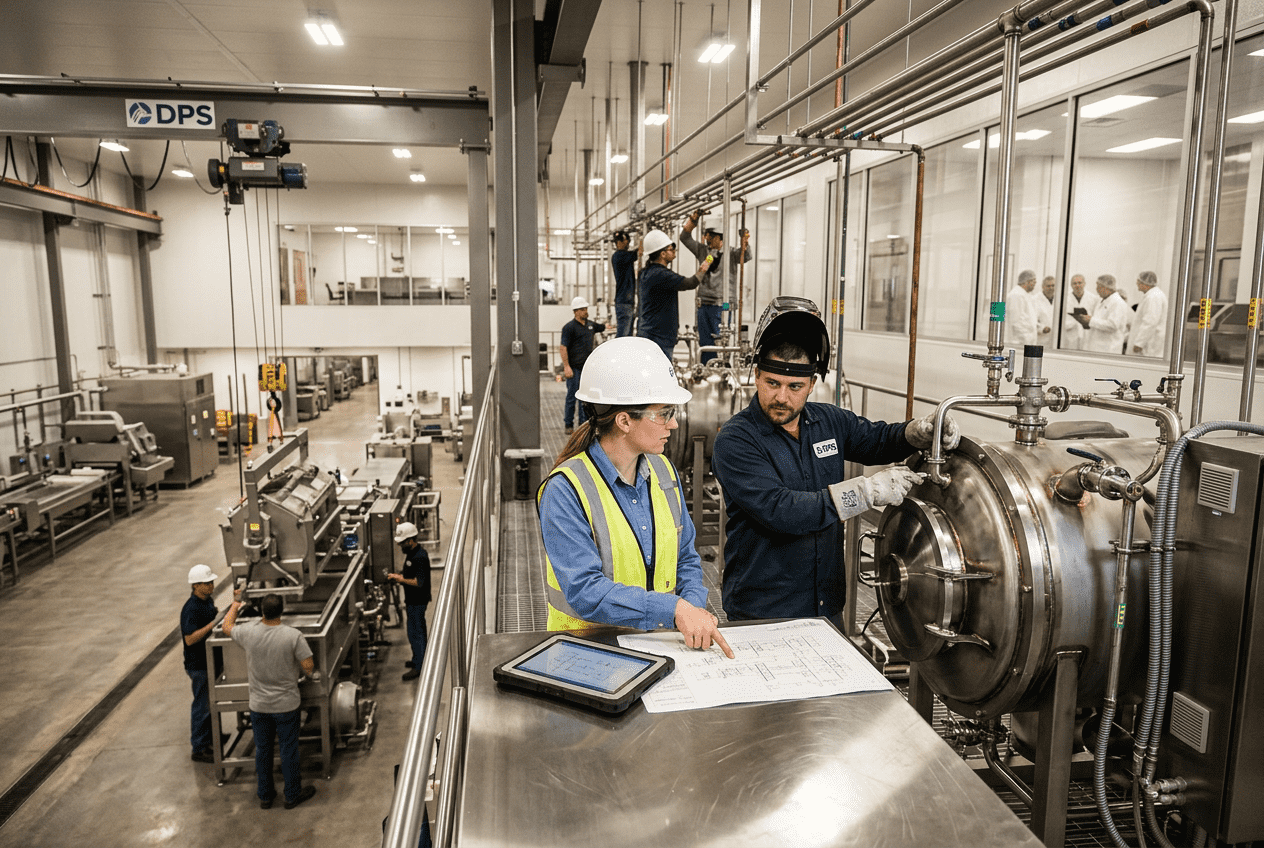
Sauce Processing Systems
[trp_language language=”en_US”]
Sauce Processing Systems for U.S. Food Manufacturers
Sauce processing systems are the integrated vessels, thermal technologies, pumps, mixers, controls, and packaging interfaces used to produce products such as pasta sauce, salsa, barbecue sauce, cheese sauce, hot sauce, gravies, marinades, and dressings at commercial scale. In the United States, the right system must do more than cook a recipe. It must protect flavor, maintain particle integrity, control viscosity, support food safety, clean effectively, and scale from pilot work to dependable production. For manufacturers operating in hubs such as Chicago, Los Angeles, Houston, Atlanta, and the Research Triangle in North Carolina, the practical question is not whether to automate sauce production, but how to choose a process line that matches product behavior, plant utilities, labor realities, and growth targets.
Demand for higher throughput, cleaner labels, better consistency, and faster changeovers is pushing processors to modernize lines across the country. Whether products move through retail, foodservice, club, private label, or co-manufacturing channels, a well-designed sauce line can reduce giveaway, shorten cook cycles, lower utility consumption, and improve first-pass quality. That is especially important near major distribution corridors and ports such as the Port of Los Angeles, Port Houston, Savannah, and New York/New Jersey, where production schedules often tie directly to freight windows and customer service commitments.
Quick Answer

The best sauce processing system depends on five factors: product viscosity, particle size, required cook profile, fill format, and target throughput. Smooth products like hot sauce or cheese sauce often benefit from continuous processing with inline mixing, thermal treatment, and automated filling. Chunky products like salsa or bolognese frequently require gentler pumping, larger passageways, and batch control to protect particulates. Core equipment usually includes jacketed kettles or continuous cookers, low- or high-shear mixing, heat exchangers, transfer pumps, hold tubes where needed, surge tanks, fillers, and a sanitary CIP system. In U.S. plants, the winning design is usually the one that balances product quality, operational flexibility, food safety compliance, and long-term profitability rather than simply maximizing equipment size.
Buyers should evaluate not only recipe needs, but also utility availability, floor space, future SKUs, labor skill level, changeover frequency, and sanitation complexity. For many producers, especially those moving from a kitchen model to industrial production, the biggest gains come from process integration: connecting ingredient handling, thermal processing, controls, filling, and cleaning into one coordinated system.
Sauce Processing System Components: Kettles, Mixers, Heat Exchangers, and Fillers

A commercial sauce line is typically built around a few critical process blocks. The first is the cooking or blending vessel. Jacketed kettles remain common for flexible batch processing because they allow heating, agitation, ingredient additions, and visual observation in one unit. For higher volumes, processors may use continuous blend systems feeding tubular or scraped surface heat exchangers. Mixers vary by product: anchor agitators for gentle movement, sweep agitators for heat transfer, high-shear mixers for powder incorporation, and emulsifying systems for oil-water stability. Heat exchangers then control the product temperature during cooking, cooling, pasteurization, or hot-fill preparation. Finally, fillers must match viscosity, particulates, and package format, whether the product is going into pouches, jars, tubs, jugs, drums, or bag-in-box containers.
In U.S. manufacturing environments, sauce lines also depend heavily on support systems such as sanitary pumps, inline strainers, mass flow devices, load cells, recipe controls, steam systems, hot water loops, compressed air, and CIP skids. When these utilities are undersized or poorly coordinated, the process often becomes unstable even if the primary equipment is sound.
| Component | Primary Function | Best For | Key Design Concern | Typical U.S. Use Case | Buyer Note |
|---|---|---|---|---|---|
| Jacketed kettle | Batch cooking and blending | Flexible recipes and short runs | Heat transfer rate | Regional pasta sauce plant | Excellent for R&D to mid-scale growth |
| High-shear mixer | Powder wet-out and dispersion | Starches, gums, emulsions | Aeration control | Cheese sauce and creamy dressings | Important where lumps or fisheyes occur |
| Scraped surface heat exchanger | Heating or cooling viscous products | Thick sauces with solids | Fouling management | Barbecue sauce and gravies | Useful when tubular systems plug |
| Tubular heat exchanger | Efficient thermal processing | Smooth, pumpable sauces | Particle limitations | Hot sauce and marinades | High efficiency for continuous lines |
| Positive displacement pump | Gentle transfer | Viscous and chunky products | Shear sensitivity | Salsa and pizza sauce | Match clearances to particle size |
| Piston or servo filler | Package filling | Accurate viscous fills | Valve geometry | Glass jars and wide-mouth tubs | Critical for chunk retention and accuracy |
The table above shows why sauce lines are rarely one-size-fits-all. A processor making smooth wing sauce for national distribution from a facility in Dallas may prioritize continuous thermal efficiency and automated CIP. A salsa producer serving grocery chains from Southern California may instead prioritize gentle particle handling, rapid recipe changeovers, and flexible filling for multiple jar sizes.
Batch vs Continuous Sauce Production: Choosing the Right Approach

Batch and continuous systems both have a strong place in the U.S. market. Batch processing is often preferred by companies with many SKUs, seasonal formulations, short production runs, or recipes requiring staged ingredient additions. It offers strong operator control and usually lower entry cost. Continuous systems excel when demand is steady, formulas are standardized, and the business case rewards high throughput, reduced labor per pound, and tighter process repeatability.
There is no universal winner. A multi-SKU prepared foods company in New Jersey serving foodservice and retail may gain more from versatile batch kettles with automation overlays than from a fully continuous line. By contrast, a high-volume shelf-stable sauce producer near Memphis or Kansas City may justify continuous blending, thermal treatment, and filler feeding because freight efficiency and retailer service levels depend on long runs.
| Factor | Batch Production | Continuous Production | Best Fit | Main Advantage | Main Limitation |
|---|---|---|---|---|---|
| SKU variety | High flexibility | Lower flexibility | Private label and specialty brands | Easy changeovers | More labor per pound |
| Throughput | Moderate | High | National brands | Scalable output | Higher capital cost |
| Recipe staging | Strong control | More fixed sequence | Complex formulations | Operator visibility | Cycle time variability |
| Consistency | Operator dependent | Highly repeatable | Large repetitive volumes | Tighter process control | Less forgiving during upset |
| Footprint | Can be compact | Often longer line layout | Urban retrofit plants | Lower initial complexity | Capacity ceiling |
| Expansion path | Add more kettles | Add parallel modules | Growth-stage producers | Phased investment options | Integration planning needed |
Many processors ultimately adopt a hybrid model. They batch-blend base product, then use continuous pasteurization, deaeration, or filling. This can be an excellent solution for U.S. manufacturers who want recipe flexibility without sacrificing downstream efficiency. It also supports co-pack operations that must move quickly between customers while still achieving strong line utilization.
The growth trend above reflects a realistic market direction: more processors are investing in automation, thermal efficiency, and packaging flexibility as labor costs rise and customers demand better consistency. By 2026, lines with integrated recipe control, utility monitoring, and advanced sanitation verification are expected to attract more capital across the United States.
Cooking and Reduction: Steam Injection, Jacketed Kettles, and Vacuum Evaporation
Cooking and reduction are where sauce quality is either built or damaged. Some recipes need caramelization and flavor development; others need only rapid heat-up and microbial control. Steam injection can provide very fast heating and works well where dilution is acceptable or can be managed. Jacketed kettles provide broad flexibility and are especially useful when reduction, sauté-like cooking, and ingredient staging matter. Vacuum evaporation supports lower-temperature concentration, which can help protect color, aroma, and heat-sensitive ingredients.
In tomato-based applications, reduction strategy directly affects color, mouthfeel, and yield. In cream sauces, aggressive heating can destabilize proteins and alter texture. In sugar-containing barbecue sauces, local burn-on becomes a major concern. For that reason, equipment selection should always reflect the thermal behavior of the actual formulation, not just generic sauce categories.
| Method | How It Works | Advantages | Risks | Best Product Types | Operational Note |
|---|---|---|---|---|---|
| Direct steam injection | Steam enters product stream | Very rapid heat-up | Potential dilution | Thin sauces and bases | Requires condensate impact review |
| Jacketed kettle | Heat transfers through vessel wall | Flexible and visible process | Longer cycle time at scale | Pasta sauce and gravies | Ideal for recipe staging |
| Vacuum evaporation | Reduces boiling point under vacuum | Protects color and flavor | Higher system complexity | Premium sauces and concentrates | Useful for heat-sensitive SKUs |
| Scraped surface cooker | Continuously scrapes heat surface | Handles viscous products | Mechanical wear | Cheese sauce and thick gravy | Reduces fouling risk |
| Tubular cooker | Product moves through heated tubes | Efficient continuous operation | Particle size limitations | Hot sauce and dressings | Strong for standard formulas |
| Hybrid cook-hold system | Batch cook with controlled hold | Balances flavor and safety | More controls integration needed | Premium retail sauces | Good for scale-up from pilot recipes |
When processors in the Midwest or Southeast expand from artisanal production to regional distribution, the temptation is often to overspecify heat input and shorten cooks aggressively. That can create product scorching, unpredictable reduction rates, and cleanup headaches. A better approach is to characterize heat transfer, target solids, and hold requirements before final equipment sizing. This is where process engineering has a direct impact on margin.
Thickening and Stabilizing: Starch Hydration, Gum Dispersion, and Emulsification
Many sauce problems begin with poor powder incorporation and unstable phase behavior. Starches need complete hydration. Gums must be dispersed without clumping. Oil phases must be emulsified at the right shear level and order of addition. If these steps are inconsistent, the result may be fisheyes, phase separation, thin body, over-thickening after fill, or texture drift during shelf life.
For U.S. manufacturers using clean-label starches, xanthan, guar, modified starches, dairy solids, or protein systems, the process window can be narrow. A gum system that works in a benchtop beaker may fail in a 2,000-gallon kettle if powder eduction, shear, hydration time, and temperature profile are not engineered properly. This is why inline powder induction, recirculation loops, and controlled shear mixing are often worth the investment.
Emulsification is equally important in sauces containing oil, cheese, dairy, or egg-based components. Over-shearing can damage texture or increase viscosity unexpectedly. Under-shearing can produce visible oiling off. The ideal design uses the minimum effective shear to achieve stable dispersion and desired mouthfeel.
As 2026 approaches, formulation trends in the United States are pointing toward lower-sodium, lower-sugar, and cleaner-label products. That shift makes process discipline even more critical because formulators have fewer traditional stabilizers available to mask poor mixing or thermal abuse. Equipment and control strategy increasingly replace brute-force additive use.
The area chart highlights a broader trend: process design is becoming a competitive advantage. Plants that can hydrate powders efficiently, minimize rework, and hold emulsions consistently are better positioned to serve premium retail, foodservice chains, and co-manufacturing contracts.
Particle Handling in Chunky Sauces: Salsa, Bolognese, and Specialty Varieties
Chunky sauces present a unique challenge because the process must transport, heat, and fill the product without turning visible ingredients into mush. Salsa, bolognese, enchilada bases with peppers, chutneys, queso with particulates, and specialty regional sauces all require careful control of pump selection, valve geometry, pipe sizing, residence time, and agitation style.
In many retrofitted U.S. plants, the product formula is not the true problem. The issue is that the line was originally designed for smooth dressings or beverage syrups, then adapted for chunks. Small clearances, sharp elbows, restrictive valves, and high pump speeds cause physical damage, inconsistent fill ratios, and consumer complaints. Particle-sensitive sauces usually need full-port valves, short transfer paths, low-shear positive displacement pumping, and fillers designed for suspended solids.
| Product Type | Typical Particles | Main Process Risk | Preferred Equipment Feature | Filling Consideration | Quality Goal |
|---|---|---|---|---|---|
| Salsa | Tomato, onion, pepper cubes | Particle breakup | Gentle PD pumping | Wide-path filler valves | Visible fresh-cut appearance |
| Bolognese | Ground meat and vegetable bits | Settling and smearing | Sweep agitation | Hot-fill consistency control | Even meat distribution |
| Chunky queso | Pepper and vegetable pieces | Fat separation | Controlled shear mixing | Temperature-managed filler | Stable creamy texture |
| Chutney | Fruit pieces | Overcooking and collapse | Vacuum or gentle batch cook | Low-drop filling | Distinct fruit identity |
| Pizza sauce with diced components | Tomato pieces and herbs | Pump shear | Large line passages | Jar or pouch valve clearance | Uniform particulate ratio |
| Specialty ethnic sauces | Seeds, peppers, vegetable strips | Bridging and inconsistent fill | Custom hopper and transfer geometry | Recipe-specific fill setup | Authentic appearance and texture |
The explanation is straightforward: particle survival is a systems issue, not just a pump issue. Buyers should test the full line path from cooker to filler. A product may look excellent in the kettle but fail after recirculation, holding, and packaging. In markets like California and Texas, where fresh-style and Hispanic-inspired sauces continue to grow, this distinction matters commercially.
Viscosity Control and Inline Measurement Technology
Viscosity control determines whether a sauce pumps well, fills accurately, and meets consumer expectations on the shelf. It influences heat transfer, particulate suspension, deposit behavior, and package appearance. Traditional quality systems often rely on off-line viscosity checks, but modern processors increasingly use inline sensors, density feedback, temperature compensation, and recipe automation to stabilize the line in real time.
For example, tomato sauces may thicken with concentration, while starch-thickened systems may continue hydrating after initial mixing. Cheese and dairy sauces can shift quickly with temperature. Inline measurement technologies help operators catch these changes before they create underfills, clogged valves, or package variation.
| Technology | What It Measures | Best Use | Benefit | Limitation | Implementation Tip |
|---|---|---|---|---|---|
| Inline viscometer | Apparent viscosity | Continuous consistency monitoring | Real-time correction | Needs calibration to product | Validate against lab method |
| Mass flow meter | Flow rate and density trends | Recipe control | Improves batching accuracy | Cost | Use with automation logic |
| Temperature sensor array | Thermal profile | Heat-sensitive sauces | Supports stable viscosity | Does not measure body directly | Place at critical transfer points |
| Load cells | Ingredient addition mass | Batch kettles | Reduces formulation drift | Requires stable vessel support | Integrate with recipe software |
| Brix or solids monitoring | Concentration | Tomato and sweet sauces | Controls reduction endpoint | Product dependent accuracy | Pair with lab solids checks |
| Vision-based fill inspection | Package fill level | Packaging quality assurance | Protects customer compliance | Downstream only | Use as final verification layer |
In practical terms, inline measurement is most effective when linked to automation. A line that senses viscosity but does not adjust agitation, dilution, or recirculation rate still leaves too much to operator judgment. Plants investing in PLC and SCADA integration gain the most value because the process can respond before waste is created.
This demand profile mirrors what many suppliers and integrators are seeing in the United States: strong ongoing need for tomato-based lines, continued growth in salsa and hot sauce, and steady investment in cheese and barbecue applications driven by foodservice and convenience channels.
CIP Design for Sauce Processing: Managing Sticky and Oily Residues
Clean-in-place design is often underestimated during capital planning, yet it strongly affects uptime, labor, allergen management, and audit performance. Sauces leave behind sugars, oils, proteins, starch films, spice carryover, and burnt-on residues. If the line is difficult to clean, the plant loses production hours, consumes excess water and chemicals, and risks cross-contact events.
Effective CIP for sauce systems requires attention to circuit velocity, return temperatures, spray coverage, dead-leg elimination, drainability, valve matrix logic, and material compatibility. A sticky teriyaki glaze and an oily queso do not challenge the system in the same way. The design should reflect the residue profile, not generic sanitation assumptions.
| CIP Focus Area | Why It Matters | Common Failure Mode | Recommended Practice | Impact on Operations | Buyer Question |
|---|---|---|---|---|---|
| Drainability | Prevents standing residue | Pooling in low points | Design for complete slope and drain | Shorter cleanup time | Does every branch fully drain? |
| Spray coverage | Cleans vessel interior | Shadow zones | Validate spray device placement | Fewer manual interventions | Has riboflavin or coverage testing been done? |
| Velocity | Removes films and solids | Insufficient turbulence | Size pumps and lines correctly | Better cleaning repeatability | What flow is delivered at worst case circuit? |
| Temperature control | Improves soil removal | Chemical loop cools too quickly | Monitor supply and return temperatures | Lower rerun risk | How is thermal loss compensated? |
| Chemical concentration | Ensures cleaning efficacy | Under-dosed cycles | Automate concentration verification | Reduced sanitation variability | Is conductivity tracked and recorded? |
| Allergen and flavor carryover | Protects product changeovers | Residual oil, dairy, or spices | Segment circuits and validate swabs | Supports flexible scheduling | Which SKUs require dedicated or verified cleaning? |
The explanation behind this table is simple: a sauce line that is easy to run but hard to clean is not truly efficient. Plants across the United States are increasingly evaluating total cost of sanitation, not just production capacity. Water stewardship, wastewater costs, and ESG reporting are also becoming part of the investment decision, especially for larger enterprises with public sustainability goals.
Sauce Line Integration: From Kitchen to Full-Scale Production
Scaling from kitchen work to a full production line is where many sauce brands encounter the biggest surprises. A formula that tastes right in a stockpot may respond very differently in a steam-jacketed kettle, a high-shear recirculation loop, or a continuous thermal system. Scale-up must account for ingredient order, thermal lag, evaporation rate, hold time, and shear history. It also must align with packaging speed, case packing, palletizing, and utility constraints.
The most successful projects begin with a clear production model. That includes annual volume, peak-week demand, package mix, sanitation windows, utility loads, labor plan, and room for future line extensions. It is also important to connect process design with commercial logic. A line that can theoretically produce more than the market requires may still be a poor investment if it creates high fixed costs, excessive changeover complexity, or poor first-year utilization.
For manufacturers looking for an integrated partner, Disruptive Process Solutions operates as a food and beverage engineering firm focused on profitable capital execution, not simply equipment placement. In practice, that means helping processors in the United States think through the operating model first, then building the process scope around the business case.
From a technological capability standpoint, DPS supports process, mechanical, structural, plumbing, electrical, and controls engineering, including automation, PLC programming, and SCADA integration. Those skills matter in sauce processing because recipe control, utility sequencing, heat transfer, viscosity management, and line synchronization are tightly linked. A sauce system works best when equipment, utilities, and automation are designed as one operating system rather than separate purchases.
From a manufacturing capability standpoint, DPS also supplies proprietary process equipment such as tanks, cooking vessels, and custom CIP systems. That can be valuable for sauce processors needing integrated vessel geometry, utility coordination, and sanitation design rather than disconnected equipment packages. Processors evaluating options can review broader process equipment capabilities to understand how vessel fabrication and line integration can support sauces, prepared foods, and related applications.
From a service capability standpoint, DPS provides engineering, feasibility, capital planning, owner’s representation, project management, installation coordination, and turnkey integration. For a sauce manufacturer, this can reduce the common gap between recipe development, equipment purchase, field installation, controls startup, and production ramp-up. More details on these execution models are available through its engineering and integration services.
Local context matters in integration. A new sauce plant near Charlotte may have different steam, wastewater, and labor considerations than a retrofit in Southern California or a co-pack expansion near Chicago. Freight lanes to major retailers, labor availability, local trade support, and municipal utility constraints all affect the right design. That is why line integration should be site-specific, not copied from a generic layout.
| Stage | Primary Objective | Key Data Needed | Main Risk | Recommended Action | Success Metric |
|---|---|---|---|---|---|
| Bench development | Confirm flavor and texture | Formula, pH, solids, target viscosity | Unscalable mixing assumptions | Document exact process order | Repeatable pilot-ready recipe |
| Pilot testing | Evaluate thermal and shear response | Cook profile and ingredient behavior | Texture drift | Run multiple processing scenarios | Stable product under scaled conditions |
| Process design | Match equipment to product | Throughput and package mix | Oversized or undersized assets | Build mass and utility balances | Capex aligned with demand |
| Installation | Connect line and utilities | Site conditions and trade sequencing | Field delays | Coordinate trades and FAT/SAT plans | On-time mechanical completion |
| Commissioning | Prove performance | Controls logic and sanitation validation | Startup variability | Run water, CIP, and product trials | Target rate and quality achieved |
| Optimization | Improve profitability | Downtime, yield, labor, utilities | Missed margin gains | Fine-tune recipes and automation | Higher OEE and lower cost per pound |
A practical buying strategy is to define what the line must do in year one and what it must be capable of by year three. That keeps capital disciplined while preserving a realistic expansion path. Processors can also learn from prior implementations and facility transitions by reviewing selected project case examples that illustrate how execution quality affects long-term operating results.
This comparison highlights why many U.S. buyers are moving away from piecemeal purchasing when products are complex. Standalone assets can work well for simple upgrades, but integrated engineering generally performs better when the line must manage viscosity, particulates, sanitation, and future expansion together.
FAQ
What is the most important equipment in a sauce processing line?
There is no single most important asset. For flexible batch plants, the kettle and agitator system often drive product quality. For high-volume operations, thermal processing, pumping, and filling integration may be more critical. In every case, sanitation design and controls are as important as the primary vessel.
When should a manufacturer choose batch processing over continuous processing?
Choose batch when you run many SKUs, need frequent recipe changes, require staged additions, or are scaling from smaller production. Choose continuous when volumes are steady, formulas are repeatable, and labor efficiency and throughput are top priorities.
How do processors protect particles in chunky sauces?
They use gentle pumps, larger line clearances, full-port valves, low-drop transfers, suitable agitation, and fillers designed for suspended solids. The entire path from cooker to package must be evaluated.
Why does viscosity change between the kettle and the filler?
Common reasons include ongoing starch hydration, temperature shift, shear history, water loss, oil separation, and hold-time variation. Inline monitoring and tighter recipe control can reduce these swings.
Is CIP really that important for sauce systems?
Yes. Sauces often leave sticky, oily, protein-rich, or spice-heavy residues. A poor CIP design increases downtime, labor, water use, allergen risk, and inconsistent startup quality after cleaning.
What should U.S. buyers ask before purchasing a new sauce system?
Ask about actual throughput at your target viscosity, maximum particle size, utility demand, sanitation cycle time, automation scope, fill accuracy, expansion options, and whether the design has been validated for products similar to yours.
How do 2026 trends affect sauce processing investments?
Three themes are shaping investment decisions in the United States: smarter automation, sustainability, and regulatory readiness. More plants are adopting tighter data capture, energy-conscious heating systems, water-efficient CIP, and designs that better support traceability, allergen management, and food safety documentation.
Can one line produce both smooth and chunky sauces?
Sometimes, but only if the line is designed for the most demanding product. That usually means choosing pumps, valves, fillers, and thermal systems that can handle particles without compromising smooth SKU efficiency. The economic tradeoff should be reviewed carefully.
For manufacturers across the United States, the right sauce processing system is not simply a collection of kettles and fillers. It is a profit-driving production platform that must support product quality, sanitation, throughput, labor efficiency, and future growth. The best outcomes come from aligning recipe behavior, equipment design, facility realities, and business strategy from the start.
[/trp_language]
Complete Company Portfolio

About the Author: Disruptive Process Solutions (DPS)
The DPS team combines process engineering expertise with real-world food and beverage manufacturing experience. Our content focuses on process optimization, production efficiency, facility improvements, and practical solutions that help manufacturers operate more effectively in a rapidly evolving industry.
Share

