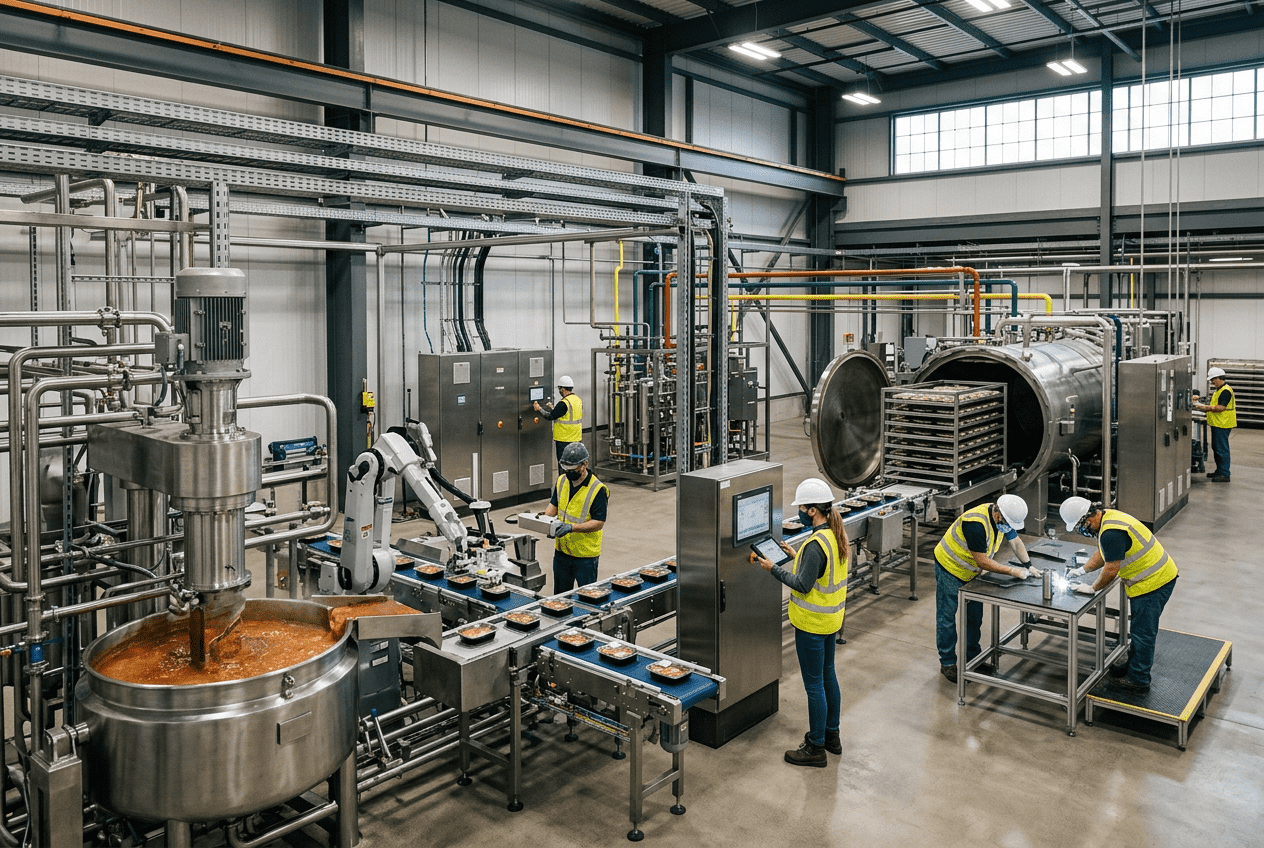
SCADA for Food Manufacturing
[trp_language language=”en_US”]
Food manufacturers in the United States use SCADA to gain real-time visibility into production, automate critical controls, improve traceability, protect product quality, and support compliance with FDA FSMA and HACCP requirements. In practical terms, a modern SCADA platform helps plants monitor temperatures, pressures, pH, flow, batch steps, utility usage, downtime, and alarms from one central interface. For processors handling proteins, dairy, sauces, beverages, aseptic systems, or prepared foods, this visibility can reduce waste, shorten response time, and improve throughput without sacrificing food safety.
For plants operating in major manufacturing regions such as North Carolina, Texas, California, Wisconsin, Illinois, Georgia, and Pennsylvania, SCADA has become more than a controls tool. It is now a production management layer that connects field devices, PLCs, historians, operators, maintenance, QA, and plant leadership. Whether the facility ships through logistics hubs near the Port of Los Angeles, the Port of Houston, Savannah, Chicago rail corridors, or Northeast cold-chain distribution centers, the same business need applies: produce consistent product at scale, document every critical event, and keep operations audit-ready.
Many food plants still rely on disconnected spreadsheets, operator clipboards, legacy HMIs, and siloed machine data. That approach creates blind spots. When a retort cycle drifts, a jacketed vessel overheats, a CIP phase runs long, or a filler starves upstream, teams lose precious time finding the root cause. A properly designed SCADA system closes that gap by organizing live production data into actionable screens, trends, alarms, batch records, and performance dashboards. For U.S. food and beverage companies seeking a stronger digital foundation, SCADA often becomes the bridge between plant-floor automation and broader operational excellence.
Quick Answer

SCADA for food manufacturing is a supervisory software and controls architecture that allows processors to monitor, control, record, and optimize production and utility systems in real time. In U.S. food plants, it is commonly used for cook systems, blending and batching, pasteurization, retort operations, CIP, refrigeration, water treatment, packaging lines, and energy systems.
The strongest SCADA deployments deliver value in five areas:
- Live process visibility across multiple lines, shifts, and utilities
- Automatic collection of quality and food-safety data
- Batch and recipe consistency across operators and production runs
- Better downtime analysis and OEE improvement
- Faster compliance reporting for audits and customer requirements
For companies evaluating new automation or plant upgrades, the buying decision should not focus only on screens and alarms. The better question is whether the SCADA system supports your process architecture, sanitation strategy, regulatory burden, expansion goals, and labor reality. That is especially important in industries like dairy, proteins, ready-to-drink beverages, fermented products, sauces, and aseptic processing, where critical parameters and traceability expectations are high.
| Plant Area | Typical Variables | Main Risk Without SCADA | Operational Benefit | QA Benefit | Typical Payback Driver |
|---|---|---|---|---|---|
| Receiving and ingredient handling | Lot ID, weight, temperature | Weak ingredient traceability | Faster material verification | Improved lot genealogy | Recall readiness |
| Blending and batching | Flow, Brix, pH, agitation | Recipe variation | More consistent runs | Electronic batch records | Reduced rework |
| Thermal processing | Time, temperature, pressure | Safety deviation | Automatic control response | Critical limit documentation | Fewer quality holds |
| CIP systems | Conductivity, temp, flow, phase time | Ineffective cleaning or excess utility use | Shorter cycles | Validated sanitation records | Water and chemical savings |
| Packaging | Line speed, rejects, downtime | Hidden micro-stops | Higher line efficiency | Better code-date accountability | OEE lift |
| Utilities | Steam, compressed air, refrigeration, kWh | Rising energy cost | Load optimization | Support for sustainability reporting | Lower utility spend |
This table shows why SCADA decisions should be tied to business outcomes. Plants rarely invest in SCADA just to “see data.” They invest to reduce unplanned events, protect product, standardize operations, and create faster decision-making at both line and plant level.
How SCADA Transforms Food Manufacturing: Real-Time Visibility and Control

In food manufacturing, speed without control creates risk, while control without visibility slows the operation. SCADA solves both problems by collecting live signals from PLCs, VFDs, instruments, skids, and utility systems, then displaying them in one coordinated environment. Operators can see whether a fermenter is stable, whether a pasteurizer is meeting hold conditions, whether a CIP loop has reached target conductivity, and whether a packaging line is losing performance due to upstream starvation.
Real-time visibility matters most when production networks are complex. A plant in California producing juice and functional beverages may need to coordinate blending, HTST, aseptic filling, and cold storage. A protein facility in the Midwest may track cook-chill tunnels, marination lines, grinders, mixers, and metal detection. A dairy plant in Wisconsin may require precise temperature and homogenization control along with lot segregation and allergen management. In each case, SCADA becomes the operations nerve center.
Modern platforms also support remote awareness. While cybersecurity and access control must be carefully managed, supervisors, maintenance managers, and engineering teams can often review trends, downtime events, and alarm history without being physically at the panel. For multi-site companies with facilities across the United States, this makes benchmarking and standardization far easier.
Another important transformation is alarm discipline. Legacy systems often flood operators with nuisance alarms. Better SCADA design prioritizes abnormal situations, suppresses irrelevant notifications during maintenance or CIP phases, and guides operators toward corrective action. In food plants where one delay can affect product quality, labor scheduling, and shipping windows, alarm clarity matters.
The chart above illustrates a realistic adoption pattern: food manufacturers are steadily increasing SCADA investment as labor pressure, audit expectations, utility costs, and digital reporting needs grow. Looking toward 2026, demand is especially strong in retrofit projects where plants want measurable gains without fully replacing existing processing assets.
Process Monitoring: Temperature, Pressure, pH, and Critical Control Points

Process monitoring is the foundation of SCADA in food plants. Many products depend on narrow operating windows that affect safety, shelf life, texture, flavor, and yield. Temperature, pressure, pH, conductivity, flow rate, level, viscosity indicators, Brix, and dissolved oxygen can all be tied into the SCADA layer depending on the process.
Critical Control Points, or CCPs, deserve particular attention. In HACCP-driven environments, CCP monitoring should be automatic wherever possible. When thermal processing, acidification, refrigeration hold, or allergen changeover rules apply, electronic data capture provides far stronger evidence than paper logs alone. SCADA allows plants to set high and low limits, record deviations, acknowledge alarms, and preserve an audit trail.
Examples across product categories include:
- Protein processing: cook temperatures, smokehouse humidity, chill rates, metal detector status
- Dairy: pasteurization temperatures, separator conditions, homogenization pressure, vat temperatures
- Beverages: inline Brix, carbonation, blend ratios, tunnel pasteurizer zones
- Sauces and dressings: pH, agitation speed, jacket temperatures, fill temperatures
- Aseptic systems: sterilization time and temperature, sterile zone pressure, filler interlocks
- Retort foods: venting, come-up time, process hold, cooling phases, batch identity
| Variable | Why It Matters | Typical Product Types | Operator Action | Audit Value | 2026 Trend |
|---|---|---|---|---|---|
| Temperature | Food safety and quality consistency | Dairy, proteins, beverages, sauces | Adjust heating/cooling response | CCP record support | More predictive temperature analytics |
| Pressure | Equipment protection and process stability | HTST, homogenization, filtration, aseptic | Validate system operating window | Deviation tracking | Remote diagnostics integration |
| pH | Acidification and product safety | Sauces, beverages, dressings | Correct recipe additions | Electronic batch proof | Inline sensor accuracy improvements |
| Flow | Recipe ratio and CIP effectiveness | Batching, CIP, liquid transfer | Check pump and valve performance | Cleaning validation data | Digital twin flow modeling |
| Conductivity | CIP phase verification | Dairy, beverage, aseptic systems | Advance or hold cleaning cycle | Sanitation recordkeeping | Higher automation in recovery loops |
| Level | Tank inventory and overflow prevention | Blending, syrup rooms, storage | Control transfer logic | Mass balance support | Improved inventory reconciliation |
This table highlights how SCADA converts raw instrument data into control decisions and compliance evidence. In well-designed systems, operators do not just watch numbers move; they receive context, alarm thresholds, trend views, and guided responses that reduce human error.
Quality Assurance and Traceability: Lot Tracking from Ingredients to Finished Goods
Traceability is no longer optional for serious food manufacturers in the United States. Retailers, co-manufacturing partners, foodservice buyers, and regulators expect fast access to lot genealogy. A strong SCADA strategy can support ingredient receipts, staging, weighing, batching, intermediate storage, packaging, and finished-goods release by time-stamping events and associating them with batch or lot data.
When integrated correctly, SCADA does not replace every enterprise function, but it becomes the most reliable source of process truth. It documents what actually happened on the floor: which ingredient lot was consumed, which vessel was used, whether the process followed approved steps, when alarms occurred, and what packaging line produced the final unit.
This matters in recall scenarios. If a supplier issue affects a spice blend, dairy component, or packaging input, manufacturers want to narrow exposure quickly. Traceability through SCADA can reduce the search window, identify impacted batches, and support targeted holds rather than overbroad waste. For facilities shipping into national distribution networks from hubs like Dallas-Fort Worth, Atlanta, Chicago, or the Inland Empire, the speed of that response has direct financial and brand implications.
Plants that want deeper digital traceability should connect SCADA with ERP, MES, LIMS, label systems, and warehouse management tools. That architecture creates a more complete chain from inbound material to outbound shipment.
| Stage | Data Captured | Common Devices | Main Benefit | Risk Reduced | Best Practice |
|---|---|---|---|---|---|
| Ingredient receiving | Supplier lot, temperature, quantity | Scanners, scales, probes | Inbound verification | Unknown material status | Digital receipt validation |
| Staging and storage | Location, hold/release status | Barcode readers, tank level sensors | Material control | Wrong ingredient use | Electronic material authorization |
| Batch preparation | Weighments, additions, timing | Scales, HMIs, PLC logic | Recipe conformance | Formulation errors | Forced sequence checks |
| Processing | Time-temperature profile, alarms | Sensors, historians | Proof of processing | Undocumented deviations | Secure historical archiving |
| Packaging | Date code, line, run time | Vision systems, encoders | Finished lot identity | Mislabeled goods | Code verification integration |
| Finished goods release | QA status, shipment link | ERP/MES connection | Full genealogy | Broad recall scope | Automated lot closure workflow |
The practical takeaway is simple: traceability works best when it is built into process execution instead of added afterward through manual reconstruction.
Recipe and Batch Management Integration in SCADA Systems
Recipe and batch management is one of the clearest ROI areas for SCADA in food and beverage manufacturing. Many processors run multiple SKUs across the same equipment: flavors, fat levels, salt profiles, packaging sizes, sweetener systems, allergen variants, or seasonal formulations. Without structured recipe control, operator variability increases, start-ups take longer, and rework risk rises.
A batch-capable SCADA system can store approved recipes, control sequence steps, verify ingredient additions, manage setpoints, enforce hold conditions, and record every action. This is valuable in beverage blending, dairy standardization, prepared foods, sauces, marinades, cultured products, and other operations where consistency and timing matter.
Recipe integration also simplifies scale-up. A manufacturer moving from a pilot process to a commercial line in North Carolina or Texas may need to lock down sequence logic before national rollout. SCADA helps by making recipe governance repeatable across shifts and sites.
Good batch management should include version control, electronic signoff, exception handling, and links to sanitation status. It should also prevent accidental execution of outdated recipes. In co-packing environments, where customer-specific formulas and confidentiality are central, role-based recipe access becomes critical.
The area chart reflects an industry-wide trend: by 2026, more U.S. processors are expected to digitize recipe execution due to labor turnover, customer documentation demands, and tighter quality standards.
OEE Optimization: Availability, Performance, and Quality Metrics
Many food manufacturers talk about OEE, but fewer capture it accurately. SCADA improves OEE by pulling real machine and process status into a structured model of availability, performance, and quality. Instead of relying on end-of-shift estimates, plants can identify exact downtime windows, line speed losses, reject patterns, and recurring constraints.
Availability focuses on whether equipment is ready and running. In food plants, losses often come from sanitation delays, changeovers, utility interruptions, waiting on ingredients, mechanical failures, or upstream/downstream imbalance. Performance measures whether the line runs at expected speed. Quality tracks whether output meets standards the first time. SCADA can support all three, especially when connected to packaging systems, utilities, and process skids.
A common mistake is measuring OEE too broadly. The better approach is to define the right production cell. For example, a dairy filler may need OEE tracking that includes buffer tanks and capper performance. A prepared-food line may require cook, cool, fill, and package interaction. A brewery or RTD site may need blending, carbonation, and canning views together.
| OEE Component | Typical Loss | How SCADA Detects It | Common Root Cause | Improvement Action | Business Impact |
|---|---|---|---|---|---|
| Availability | Unplanned downtime | Machine state transitions | Mechanical failure | Predictive maintenance triggers | More runtime |
| Availability | Extended changeovers | Step timing and operator prompts | Poor standard work | Digital checklists | More production hours |
| Performance | Micro-stops | Short duration stop counting | Sensor faults, jams | Targeted line tuning | Higher line speed |
| Performance | Running below design rate | Actual versus target throughput | Feed starvation | Upstream balancing | More cases per hour |
| Quality | Startup rejects | Quality event tagging | Unstable settings | Recipe lock-in | Lower waste |
| Quality | Out-of-spec product | Alarm-linked quality data | Process drift | Faster intervention | Reduced rework and holds |
As an example, a processor might think its main issue is packaging downtime, while SCADA shows the real problem is an upstream process bottleneck or control logic limitation. That distinction is important because the right solution may be software optimization, sequencing changes, or utility stabilization rather than new capital equipment.
This segment comparison reflects the especially strong need for SCADA modernization in beverages and aseptic systems, where product variability, speed, and documentation demands are high.
Regulatory Compliance: FDA FSMA, HACCP, and Audit-Ready Reporting
In the U.S. market, compliance is one of the most compelling reasons to implement or modernize SCADA. FDA FSMA expectations, HACCP programs, environmental monitoring coordination, sanitation documentation, and customer audits all require reliable records. SCADA helps build audit-ready reporting by automatically capturing process conditions, alarm events, operator actions, batch history, and exception logs.
For FDA-regulated facilities, documented preventive controls and rapid data retrieval are essential. For USDA-inspected environments, operational discipline and documented execution are equally important. Plants certified to SQF or BRC also benefit from digital records that support verification, corrective actions, and trend review.
Audit readiness improves when reports are easy to retrieve by batch, lot, line, date, CCP, or equipment tag. Rather than searching binders from multiple departments, quality teams can access data directly. This shortens audit prep and reduces the chance of missing or conflicting records.
By 2026, policy and customer pressure are likely to push more plants toward digitally connected records, stronger cyber governance, and better supplier-to-finished-goods traceability. That trend will particularly affect co-packers, aseptic processors, and multi-site brands with national retail exposure.
| Compliance Area | SCADA Contribution | Example Record | Plant Function Helped | Audit Advantage | Implementation Note |
|---|---|---|---|---|---|
| FDA FSMA | Preventive control evidence | Temperature trend with alarms | QA and operations | Fast retrieval | Secure data retention policy required |
| HACCP | CCP monitoring and deviations | Pasteurization hold record | Food safety team | Objective proof | Critical limits must be configured correctly |
| SQF | Documented process verification | CIP completion log | Sanitation and QA | Supports system consistency | Link to SOPs where possible |
| BRC | Traceability and corrective action support | Batch genealogy report | Quality management | Better recall readiness | Integrate with lot coding systems |
| USDA environments | Cook/chill documentation | Smokehouse cycle history | Protein operations | Consistent evidence | Review calibration discipline |
| Customer audits | Performance and quality reporting | Batch exception summary | Commercial and QA teams | Improved trust | Design reports around buyer needs |
Plants considering a new system should make report design part of the initial scope, not an afterthought. The best compliance dashboards are built around how QA managers, auditors, and operations leaders actually search for evidence.
Energy Management and Sustainability Monitoring
Energy costs have become a larger strategic issue for food manufacturers, especially where steam, chilled water, refrigeration, compressed air, wastewater, and hot water loads are significant. SCADA can monitor utility demand in real time, compare usage by line or shift, identify abnormal peaks, and link energy performance to production output.
In many U.S. plants, sustainability efforts fail because teams can see utility bills but not process-level drivers. SCADA closes that gap. It can show whether a CIP loop is overusing water, whether refrigeration loads spike during poor scheduling, whether compressed air losses suggest leaks, or whether boilers run inefficiently during idle periods.
This becomes more valuable for manufacturers in regions with high utility rates or water constraints, including parts of California, the Southwest, and some urban production zones. It also supports ESG reporting and customer sustainability scorecards, both of which are likely to matter more in 2026 purchasing and capital planning decisions.
For plants upgrading utilities, SCADA should cover not just production but the full support ecosystem: boilers, glycol systems, cooling towers, wastewater pretreatment, compressed air, refrigeration, process water, and CIP recovery. That integrated view often reveals savings that individual utility panels miss.
Companies seeking plantwide improvement often benefit from a partner that understands both process operations and utility infrastructure. Disruptive Process Solutions brings that kind of cross-functional view, combining controls and SCADA knowledge with broader process and utility integration experience for food and beverage facilities across the United States and Canada. Their work spans systems such as CIP, water treatment, refrigeration support, blending, thermal processing, and automation architecture, allowing energy monitoring to be tied directly to production realities rather than handled in isolation.
Case Study: 15% Production Throughput Boost with Modern SCADA Platform
A realistic case scenario for the U.S. market involves a mid-sized manufacturer producing sauces and ready-to-drink products across multiple SKUs. The facility had recurring line starvation, inconsistent batch timing, and weak downtime visibility. Operators used paper notes for exceptions, and engineering suspected that capacity limits required new equipment.
After a SCADA modernization project, the plant integrated batch sequencing, tank status visibility, line state monitoring, and utility alarms. Historical trends showed that the true bottleneck was not vessel size but poor transition timing between batching, transfer, and packaging. The system also revealed frequent short stops caused by permissive logic and delayed operator response to upstream conditions.
By redesigning the operator interface, improving alarm hierarchy, tightening batch handoff logic, and giving supervisors live performance dashboards, the facility improved throughput by 15% over baseline. Product giveaway dropped, CIP timing became more consistent, and QA gained cleaner electronic records for review. Most importantly, the plant postponed unnecessary capital spending because the first gains came from better control and visibility.
This type of result is consistent with what experienced engineering and integration firms often find: not every capacity problem requires a major equipment purchase. Sometimes the bottleneck sits in controls, sequencing, recipe execution, or operator visibility. That mindset aligns with the business-focused approach used by Disruptive Process Solutions, a Cary, North Carolina-headquartered food and beverage engineering firm that emphasizes profitable projects over overspending. Instead of pushing a one-size-fits-all solution, the company is known for evaluating where control logic, system architecture, or project scope can create stronger returns for the client.
From a manufacturing standpoint, DPS supports a wide range of product categories across North America, including proteins, prepared foods, dairy, sauces, beverage systems, fermentation, distillation, aseptic applications, and co-packing environments. That breadth matters when designing SCADA because recipe structure, sanitary design, thermal processing, and lot traceability expectations differ sharply by product. Their experience with processing vessels, CIP systems, cooking equipment, mixing, filling support, and utility integration helps ensure the control strategy reflects how the plant actually runs.
On the service side, DPS operates with an end-to-end project model spanning engineering, installation oversight, integration, capital planning, owner representation, project management, and commissioning support. Manufacturers exploring upgrades can review those capabilities through their food and beverage engineering services. For facilities that need hardware as part of a broader modernization effort, DPS also provides specialized process equipment through its process equipment portfolio, making it easier to align physical assets with automation goals.
The comparison chart reflects what many buyers now prioritize: not just software knowledge, but a supplier or integration partner with real food process understanding, utility depth, compliance fluency, and execution capability.
For local supplier evaluation in the United States, food manufacturers should compare integrators and engineering partners against a consistent checklist:
- Can they design for your specific product category and sanitation needs?
- Do they understand thermal processing, CIP, utilities, and batch logic?
- Can they support brownfield integration with existing PLC platforms?
- Do they provide documentation suitable for FDA, USDA, SQF, or BRC environments?
- Can they manage field installation and commissioning, not just software?
- Will they challenge unnecessary capital spending if a controls fix solves the issue?
That last point is especially important. The best partners protect capital by identifying the true bottleneck, whether that is logic, visibility, instrumentation, utility imbalance, or workflow design. Buyers can review additional project examples through the company’s case study library.
FAQ
What is the difference between SCADA and a basic HMI in food manufacturing?
An HMI usually serves a machine or skid locally. SCADA provides supervisory visibility across multiple systems, centralized alarms, historian data, reporting, and broader process coordination.
Is SCADA only useful for large food plants?
No. Mid-sized facilities often see strong returns because they are large enough to suffer from data gaps but still agile enough to benefit quickly from better control and visibility.
Which industries benefit most from food SCADA systems?
Dairy, protein processing, beverages, prepared foods, sauces, cultured products, aseptic operations, and co-packing all benefit significantly due to quality, traceability, and compliance demands.
Can SCADA improve traceability during a recall?
Yes. When integrated properly, it helps connect ingredient lots, batch records, process conditions, and packaging outputs so the affected scope can be identified faster and more accurately.
How does SCADA support HACCP programs?
It can monitor and record CCP data automatically, generate alarms on deviations, preserve audit trails, and provide reports that support verification and corrective action review.
Will a SCADA upgrade always require new equipment?
Not always. Many plants improve performance by upgrading controls, adding instrumentation, refining logic, and improving operator interfaces without replacing core process assets.
What should U.S. buyers ask before choosing a SCADA partner?
Ask about experience in your product category, integration with your PLC base, food safety documentation, cybersecurity approach, utility knowledge, startup support, and post-commissioning service.
How does SCADA help with sustainability goals?
It makes utilities measurable at process level, enabling better control of water, steam, refrigeration, electricity, and compressed air while supporting internal and customer-facing sustainability reporting.
What trends should food manufacturers watch for in 2026?
Expect stronger demand for digital records, AI-assisted alarm analysis, tighter integration between SCADA and MES/ERP, cybersecurity upgrades, predictive maintenance, and more detailed sustainability monitoring tied to production KPIs.
When is the right time to invest?
Usually when a plant faces recurring quality deviations, weak lot visibility, rising downtime, utility cost pressure, audit complexity, or expansion that current manual systems cannot support.
In summary, SCADA transforms food manufacturing in the United States by connecting process control, quality assurance, compliance, energy management, and performance improvement into one practical operating system. When the platform is designed around real process needs rather than generic dashboards, it can increase throughput, reduce waste, strengthen traceability, and help plants make smarter capital decisions for 2026 and beyond.
[/trp_language]
Complete Company Portfolio

About the Author: Disruptive Process Solutions (DPS)
The DPS team combines process engineering expertise with real-world food and beverage manufacturing experience. Our content focuses on process optimization, production efficiency, facility improvements, and practical solutions that help manufacturers operate more effectively in a rapidly evolving industry.
Share

