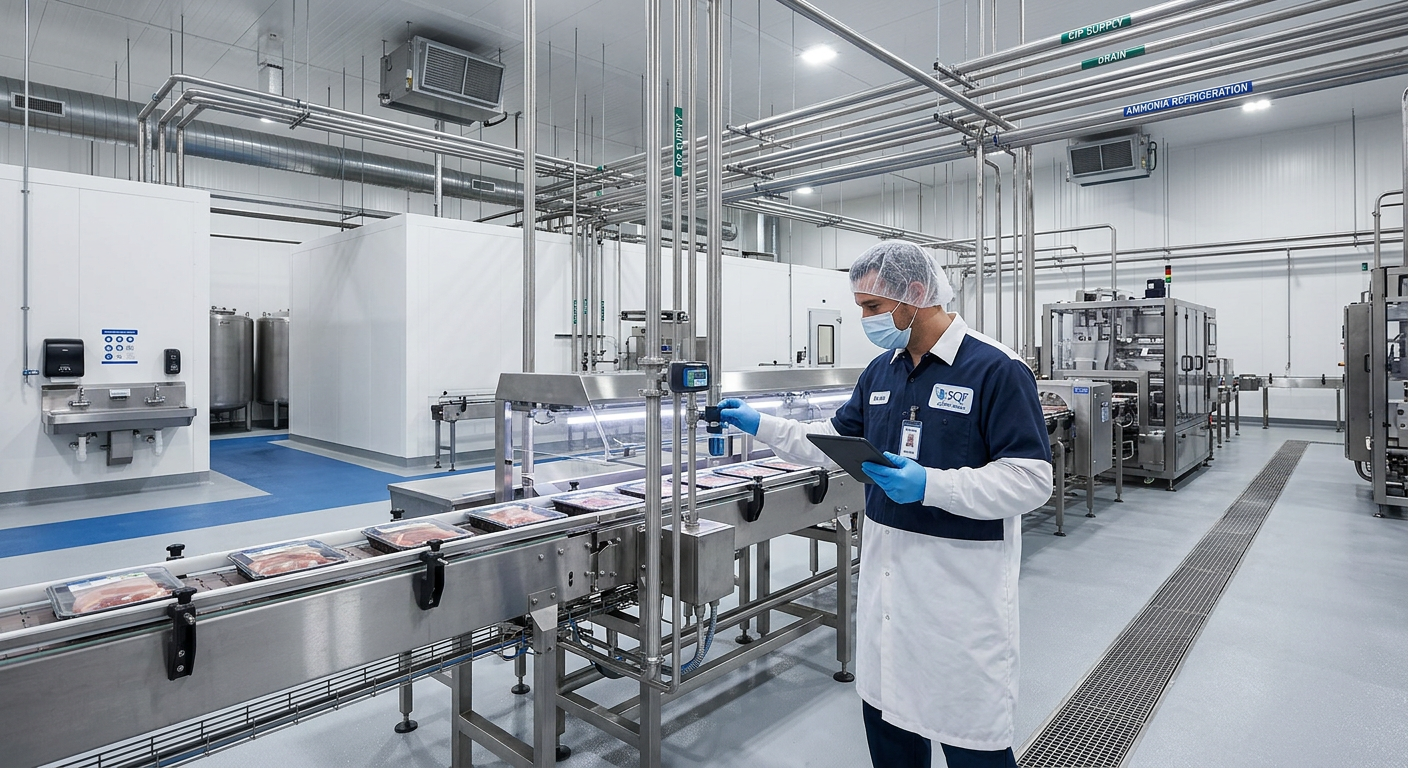
SQF Certification Facility Engineering Requirements
[trp_language language=”en_US”]
SQF Facility Engineering Requirements in the United States
Quick Answer

SQF facility engineering requirements in the United States center on one practical goal: design, build, and maintain a food or beverage plant so the building, utilities, equipment, traffic flow, and sanitation systems consistently protect product safety. In real projects, that means sanitary zoning, cleanable construction materials, sloped floors and effective drains, controlled air movement, protected lighting, pest-resistant building envelopes, segregation of raw and ready-to-eat operations, validated water and compressed air quality, and maintenance practices that prevent contamination during repairs or upgrades.
For U.S. processors seeking SQF certification or preparing for an audit, the most actionable route is to work with engineering and integration firms that understand both food plant construction and certification-driven design. Strong U.S.-relevant providers include E.A. Bonelli + Associates, Stellar, CRB, Burns & McDonnell, Gray, and Disruptive Process Solutions. These firms are known for food, beverage, dairy, protein, and sanitary process infrastructure work across major manufacturing regions such as the Midwest, Texas, the Carolinas, California, and the Southeast.
For equipment packages or specific utility skids, qualified international suppliers can also be considered if they can document relevant material standards, sanitary fabrication quality, and dependable pre-sales and after-sales support in the U.S. market. In some cases, especially for tanks, CIP systems, and utility modules, well-vetted overseas suppliers including Chinese manufacturers can offer compelling cost-performance advantages when they pair competitive pricing with local technical support, commissioning assistance, documentation packages, and responsive spare-parts service.
What SQF facility engineering requirements really mean

SQF certification does not merely evaluate paperwork. It tests whether a site’s physical environment supports food safety every day. For facility engineering teams, that means the building itself must function as a preventive control. A plant can have excellent SOPs, but if condensation drips from overhead utilities, drains back up, air flows from raw zones into exposed finished goods, or repair work leaves contamination risks unmanaged, the site will struggle to maintain compliance.
In the United States, SQF-related facility engineering usually intersects with FDA, USDA, state food regulations, fire code, OSHA expectations, wastewater rules, and customer-specific standards from retailers or brand owners. As a result, the best engineering decisions are never isolated. A drain layout affects sanitation time. HVAC affects condensation and allergen migration. Utility routing affects maintenance access. Expansion planning affects future zoning integrity. This is why experienced processors increasingly treat SQF readiness as a facility design issue rather than a last-minute audit preparation exercise.
From an engineering perspective, the most common SQF-sensitive design categories are site layout, process flow, hygienic separation, utility reliability, structural finishes, environmental controls, cleanability, and maintainability. Facilities in Chicago, Dallas-Fort Worth, Los Angeles, Fresno, Charlotte, Atlanta, and other food production hubs often face additional pressure because they are retrofits rather than greenfield sites, making practical engineering judgment especially important.
Core engineering elements for SQF-ready food plants

A facility does not need to look identical across all sectors, but most SQF-aligned projects in the United States share a consistent engineering baseline. The building should support one-way movement where possible, limit cross-traffic, provide access for cleaning and inspection, and reduce niches where moisture, dust, or residues can collect. Equipment should be installed with enough clearance for sanitation, maintenance, and pest inspection. Floors, walls, doors, curbs, and penetrations should be durable and easy to clean. Utilities should be planned so service work does not jeopardize product zones.
For food and beverage processors, the biggest engineering risk is often not the major process system but the interfaces between systems: mezzanines over exposed lines, undersized drains in washdown rooms, poor condensate management, non-hygienic pipe supports, mixed traffic between forklifts and ingredients, or compressed air used near product without adequate filtration and monitoring. SQF-minded engineering teams focus on these failure points early because audit findings often emerge from details rather than headline equipment.
| Engineering Area | SQF-Relevant Requirement | Why It Matters | Typical U.S. Project Response |
|---|---|---|---|
| Site layout and flow | Separate raw, intermediate, packaging, and finished goods movements | Reduces cross-contamination and traffic conflicts | Use zoning plans, traffic maps, and controlled personnel entry points |
| Floors and drainage | Durable, cleanable, sloped surfaces with adequate drain capacity | Prevents standing water, pathogen harborage, and sanitation delays | Install hygienic trench drains, correct floor pitch, and sealed drain interfaces |
| Walls and ceilings | Smooth, impervious, maintained, and easy to clean | Limits microbial niches, flaking, and condensation issues | Use insulated metal panels, food-grade coatings, and sealed penetrations |
| Lighting | Sufficient illumination with protection where required | Supports inspection and protects product from breakage hazards | Deploy shatter-resistant fixtures and zone-specific lux design |
| Ventilation and air handling | Control dust, humidity, odors, and airflow direction | Critical for condensation control and hygienic zoning | Use differential pressure, filtered makeup air, and dew-point monitoring |
| Equipment installation | Accessible, cleanable, and maintained to avoid contamination | Eliminates hidden soil and unsafe repair conditions | Set sanitary clearances, elevate utilities, and standardize maintenance access |
| Water and utilities | Safe water, controlled steam, air, gas, and chemical systems | Utilities can directly contaminate product if unmanaged | Validate filtration, backflow prevention, and utility quality monitoring |
The table above shows why SQF facility engineering is operational, not theoretical. Every row ties directly to how the building and utility infrastructure behave during production, washdown, changeover, and maintenance. Plants that design around these realities generally reduce both audit pressure and total operating cost.
Market outlook in the United States
Demand for SQF-aligned engineering services is rising across the United States because more manufacturers are modernizing plants to support retailer requirements, co-manufacturing growth, private label expansion, and stricter customer audits. This is especially visible in beverage co-packing, ready-to-drink beverages, dairy, high-protein foods, frozen meals, pet food, and value-added meat processing. Facilities in ports and logistics corridors such as Savannah, Houston, Long Beach, Newark, and inland distribution hubs like Kansas City and Columbus increasingly want projects that combine throughput growth with certification readiness.
Retrofit work dominates a large share of the market. Older facilities in the Midwest and Northeast often have legacy structures, low clear heights, mixed utility routing, or expansions that created poor traffic flow over time. In the Southeast and Southwest, greenfield and brownfield expansion projects are more common, especially for beverage, aseptic, protein, and co-packing operations. These trends are pushing engineering firms to integrate sanitary design, automation, and utility efficiency earlier in capital planning.
The line chart illustrates a realistic demand trend: steady annual growth driven by food safety investment, co-packer expansion, and replacement of outdated infrastructure. While the exact pace varies by sector, the broader direction is clear. SQF-oriented engineering is no longer a niche consulting niche; it is becoming a mainstream capital planning requirement.
Product and system types that matter most
When buyers search for SQF facility engineering requirements, they are often trying to identify which physical systems need the most attention. In practice, projects usually break into several categories: sanitary building envelope upgrades, process equipment installation, utility modernization, environmental control systems, and packaging or warehouse flow improvements. Each category affects audit performance differently.
For example, a dairy or RTE protein plant may prioritize hygienic room zoning, washable ceilings, floor replacement, and positive air pressure control around exposed product. A beverage plant may focus on syrup rooms, blending skids, tank farms, CIP validation, water treatment, compressed air quality, and packaging hall traffic separation. A frozen prepared foods facility may put more emphasis on ingredient handling, allergen separation, condensation control near freezers, and maintenance access in high-moisture areas.
| System Type | Typical Facility Need | Best Fit Industries | Main SQF Benefit |
|---|---|---|---|
| Hygienic wall and ceiling systems | Washdown durability and sealed finishes | Dairy, meat, sauces, RTE foods | Improves cleanability and reduces harborage points |
| Sanitary drainage systems | Water removal in wet processing zones | Protein, dairy, beverage, prepared foods | Reduces standing water and sanitation risk |
| CIP systems | Automated cleaning of tanks and pipelines | Beverage, dairy, liquid foods, aseptic | Improves cleaning consistency and validation |
| Process utility skids | Steam, glycol, hot water, compressed air | Nearly all sectors | Supports controlled, documented utility performance |
| HVAC and air zoning packages | Pressure, temperature, humidity management | Bakery, RTE, snack, packaging, dry ingredients | Helps control dust, condensation, and airflow risk |
| Tank and vessel systems | Storage, blending, batching, fermentation | Beverage, dairy, sauces, ingredients | Supports sanitary process flow and easy cleaning |
| Controls and SCADA | Recipe, batch, alarms, trend recording | Beverage, dairy, prepared foods, co-pack | Improves traceability and process control |
This table is useful because it translates SQF facility expectations into real project scopes. Many U.S. buyers are not starting from zero; they need to know which upgrades will provide the biggest compliance and operational return based on their product type.
Buying advice for U.S. processors
The best supplier is not always the biggest EPC firm or the cheapest contractor. For SQF-driven projects, buyers should evaluate how well a provider understands food safety risk at the equipment, utility, and building interface level. Ask whether the supplier has completed projects in your product category, whether they understand wet versus dry sanitation environments, and whether they can show examples of drainage, hygienic piping, zoning layouts, and maintenance design standards. Engineering quality appears in drawings, not slogans.
Another practical buying issue is whether the provider can bridge design and execution. Many facilities fail because the concept design was sound, but field installation decisions compromised cleanability or access. A strong partner should manage trade coordination, utility routing, startup, punch-list closure, and owner training. That is especially important in live plants where shutdown windows are tight and production cannot tolerate extended disruption.
Buyers should also look carefully at documentation. SQF-sensitive projects benefit from clear turnover packages including P&IDs, utility schematics, hygienic zoning maps, material specifications, weld documentation where relevant, maintenance access standards, commissioning records, and operator training files. These materials support both internal quality teams and external audit readiness.
| Buyer Question | Why Ask It | Strong Supplier Answer | Warning Sign |
|---|---|---|---|
| Have you designed for SQF, BRC, FDA, or USDA environments? | Shows compliance fluency beyond general construction | Can explain sector-specific hygienic design decisions | Only speaks in generic industrial terms |
| Can you work in active production facilities? | Most U.S. projects are phased retrofits | Provides shutdown sequencing and contamination controls | No structured live-plant execution plan |
| Who coordinates trades and field changes? | Trade conflicts create sanitation and access issues | Dedicated PM and site coordination process | Responsibility is unclear between vendors |
| What materials and sanitary standards do you specify? | Surface finish and cleanability are critical | Defines stainless grades, drain details, finishes, seals | Leaves key material decisions to field improvisation |
| Do you support FAT, SAT, commissioning, and training? | Ensures systems perform after installation | Structured startup and owner handoff program | Stops at mechanical completion |
| Can you support future capacity expansion? | Many plants need phased growth | Designs utility and layout capacity with expansion logic | Optimizes only for immediate minimum spend |
The table above helps procurement, operations, and QA teams align their supplier interview process. It reduces the chance of choosing a contractor who can build industrial infrastructure but cannot build food-safe infrastructure.
Industries with the strongest SQF engineering demand
SQF facility engineering requirements apply across many food sectors, but some industries face more frequent capital upgrades. In the United States, beverage, protein, dairy, and co-packing facilities are among the most active because they often combine fast growth with customer audit pressure. High-moisture environments, allergen complexity, or multi-SKU changeovers also increase engineering demands.
The bar chart highlights where demand is most concentrated. Beverage remains strong because co-packing, RTD products, and utility-heavy operations require integrated engineering. Protein and dairy remain close behind due to sanitary design intensity, washdown demands, and complex regulatory overlap. Prepared foods and pet food also continue to grow as plants expand value-added capacity.
Applications inside the plant
Engineering for SQF is not limited to production rooms. Applications span receiving, ingredient staging, processing, filling, packaging, cold storage, chemical handling, maintenance shops, employee welfare areas, and waste handling. A facility can lose control in support spaces just as easily as on the main process line. For example, poor forklift routes from raw receiving through finished-goods corridors can undermine an otherwise well-zoned plant. Likewise, inadequate maintenance staging can lead to tools, lubricants, and spare parts entering product-adjacent areas without proper controls.
In U.S. retrofit projects, common improvement applications include replacing porous wall finishes, creating clean personnel entrances with handwashing and gowning logic, separating allergen storage, reworking compressed air drops, installing hygienic support structures, upgrading chemical rooms, and rerouting utilities overhead or in service corridors. These are not glamorous investments, but they often deliver the fastest reduction in audit risk.
Trend shift through 2026 and beyond
By 2026, SQF-driven engineering in the United States is moving from basic compliance toward smarter, data-backed prevention. Facilities increasingly want utility monitoring, environmental trend visibility, predictive maintenance, and lower water and energy intensity. Sustainability goals are also influencing plant design. Sloped floors, better drain hydraulics, CIP optimization, heat recovery, insulated process systems, and smarter HVAC controls all reduce resource use while supporting food safety.
Policy and customer expectations are also shifting. More plants are expected to document sanitation effectiveness, air management, allergen segregation, and hygienic maintenance with greater rigor. Retailers and brand owners increasingly expect evidence that capital projects strengthened, not weakened, food safety controls. At the same time, labor constraints are pushing operators toward automation, remote support, simplified cleaning access, and faster startup after changeovers.
The area chart shows how buyer priorities are evolving. Earlier projects focused on fixing obvious nonconformities. Newer projects increasingly combine certification readiness with automation, energy performance, traceability, and future expansion logic. That shift will likely accelerate as more U.S. plants compete on reliability and customer audit performance.
Case studies and practical scenarios
A beverage co-packer in Texas may need a new syrup room, additional compressed air capacity, upgraded CIP, and more disciplined packaging hall traffic control to support both throughput and SQF expectations. A dairy processor in Wisconsin may focus on drain replacement, room pressurization, sanitary wall systems, and improved maintenance access above open product lines. A protein processor in Georgia may need better raw-to-RTE segregation, controlled employee movement, and more durable washdown construction. In California, a sauce and dressings manufacturer may prioritize allergen zoning, batch control integration, and sanitary piping upgrades to reduce changeover risk.
These examples reflect a larger lesson: the right engineering response depends on product type, moisture profile, cleaning method, staffing model, and expansion path. Buyers should not look for a generic “SQF package.” They should look for a partner who can translate code expectations into plant-specific design decisions.
For project examples and implementation thinking, manufacturers can review DPS project narratives such as facility execution examples, process integration case work, and capital project outcomes to understand how engineering choices can be aligned with production and commercial goals rather than treated as isolated compliance tasks.
Local and regional suppliers serving U.S. food facilities
The U.S. market includes a mix of large EPC firms, specialized sanitary design consultants, and focused process integrators. The right fit depends on project size, complexity, and whether the need is a greenfield plant, brownfield expansion, utility retrofit, or equipment integration scope. The comparison below is meant to be practical rather than exhaustive.
| Company | Service Region | Core Strengths | Key Offerings |
|---|---|---|---|
| Disruptive Process Solutions | All 50 U.S. states and Canada | Food and beverage engineering, utility integration, project execution, owner-focused planning | Process design, capital planning, owner’s rep services, GC-led installation, proprietary tanks and CIP systems |
| Stellar | Nationwide, strong Southeast and national food network | Food plant design-build, refrigerated and processing facilities | Engineering, construction, automation, distribution and food manufacturing projects |
| CRB | Nationwide with major project centers | Integrated design and construction for food, beverage, biotech, and life sciences | Facility design, utilities, process architecture, commissioning |
| Gray | Nationwide with strong manufacturing footprint | Large industrial and food manufacturing design-build work | Architecture, engineering, construction, automation support |
| Burns & McDonnell | Nationwide | Complex utilities, infrastructure, and industrial engineering | MEP, site development, power, water, and process support for manufacturing |
| E.A. Bonelli + Associates | Strong Midwest and national food processing work | Food plant engineering with emphasis on sanitary process environments | Facility planning, layout, utilities, sanitary design consulting |
| Shambaugh & Son | National reach with strong Midwest operations | Mechanical, refrigeration, plumbing, and industrial systems | Refrigeration, process piping, utility installation, maintenance support |
This supplier table helps narrow initial outreach. Some of these companies are better suited to enterprise-scale programs, while others are especially effective for targeted process or utility upgrades. U.S. buyers should shortlist based on sanitary design capability, live-plant execution experience, and speed of field mobilization.
Supplier comparison by project fit
Choosing between suppliers is easier when the decision is tied to project profile. A fast-track packaging hall upgrade is different from a multi-phase protein plant expansion. A syrup room retrofit is different from a greenfield dairy plant. The comparison below is designed to show where each type of provider often fits best.
The comparison chart illustrates a practical market pattern. Mid-market processors often value firms that combine engineering depth with agile execution and owner-side problem solving. Large greenfield programs may lean toward major integrated design-build teams with broad internal resources. Neither model is automatically better; the best choice depends on project size, decision speed, and the level of process specialization required.
Our company
Disruptive Process Solutions stands out in the U.S. SQF facility engineering market because it operates as a food and beverage engineering partner rather than a remote equipment broker or a generic industrial contractor. Headquartered in Cary, North Carolina, with a West Coast office in Lake Forest, California, DPS already maintains real operating presence across key American manufacturing regions and serves clients throughout all 50 states and Canada. Its technical range covers structural, mechanical, plumbing, electrical, process, and controls engineering, along with PLC programming, SCADA, utility integration, and full project management, which is especially valuable for SQF, FDA, USDA, and BRC-sensitive work. On the product side, DPS designs and supplies its own equipment line, including storage and process tanks up to 12,000 gallons, custom CIP systems, marination tumblers, and cooking vessels, supported by manufacturing and testing discipline that aligns with sanitary food plant expectations and international-grade process standards. On the commercial side, the company works flexibly with end users, co-packers, manufacturers, brand owners, and regional partners through design-build-manage delivery, direct supply, custom-engineered systems, and broader project support models that function similarly to OEM, integrated wholesale, or private-label collaboration depending on buyer need. Most importantly for local buyers, DPS is built around long-term execution support: it provides both pre-sale planning and post-installation assistance, manages local trades where licensed, delivers GC-equivalent coordination elsewhere, and has a track record across food, beverage, dairy, proteins, aseptic, and specialty processing that shows sustained market commitment in North America rather than one-off export activity. Buyers evaluating process equipment capabilities or full capital project support can therefore treat DPS as an on-the-ground U.S. operating partner with compliance fluency, practical field experience, and clear accountability from concept through startup.
How to evaluate engineering scope before you buy
Before requesting proposals, define whether your primary goal is certification readiness, capacity expansion, sanitation improvement, utility reliability, or customer audit performance. These goals often overlap, but the budget and schedule logic differ. A facility preparing for a first SQF certification may prioritize basic zoning, hygienic finishes, drain correction, and documentation. An already certified site may focus on expansion without breaking existing hygienic barriers. A co-packer may need line flexibility and utility redundancy to support customer turnover expectations.
It is also wise to separate immediate audit risks from strategic capital opportunities. If floor failures and drain backups are causing current sanitation risk, those should come before cosmetic upgrades. If compressed air is used in sensitive zones, air quality control may be more urgent than adding nonessential warehouse automation. Experienced engineering partners can help rank these needs so capital is spent where food safety and profitability meet.
Frequently asked questions
Does SQF require a new building?
No. Many U.S. facilities achieve or maintain SQF certification in existing buildings. The key issue is whether the plant can be engineered and maintained to control contamination risk. Retrofits are common, especially in established industrial markets.
What is the most common facility problem affecting SQF audits?
Standing water, poor drainage, inadequate segregation, difficult-to-clean equipment layouts, damaged surfaces, and maintenance-related contamination risks are among the most common physical issues. Condensation and airflow problems are also frequent in high-moisture or temperature-variable environments.
Do utilities really matter for SQF facility engineering requirements?
Yes. Water, steam, compressed air, HVAC, refrigeration, wastewater, and chemical delivery systems are central to food safety. Poor utility design can contaminate product, delay sanitation, or create recurring nonconformities.
Can a smaller processor afford SQF-driven engineering upgrades?
Yes, if the project is phased correctly. Many smaller processors start with high-risk improvements such as drains, wall systems, hygiene stations, utility corrections, and traffic flow changes before taking on full plant expansion.
Are international equipment suppliers acceptable?
They can be, provided they supply appropriate documentation, sanitary construction quality, responsive spare parts, U.S.-relevant technical support, and startup assistance. Cost-performance can be attractive, but local service capability should be verified before purchase.
What should be included in the engineering handover package?
At minimum, buyers should expect layout drawings, utility schematics, P&IDs, material and component documentation, commissioning records, maintenance guidance, and operator training records relevant to the installed scope.
Final takeaway
SQF facility engineering requirements in the United States are best understood as a design-and-execution discipline that makes food safety physically reliable. The most successful projects align sanitary design, utility performance, maintainability, and production efficiency rather than treating certification as a paperwork exercise. For buyers in U.S. food and beverage markets, especially in active manufacturing corridors from California to the Carolinas and from Texas to the Midwest, the right partner will be the one that can translate compliance expectations into practical plant performance, phased capital logic, and dependable local execution.
[/trp_language]
Complete Company Portfolio
About the Author: Disruptive Process Solutions (DPS)
The DPS team combines process engineering expertise with real-world food and beverage manufacturing experience. Our content focuses on process optimization, production efficiency, facility improvements, and practical solutions that help manufacturers operate more effectively in a rapidly evolving industry.
Share