-
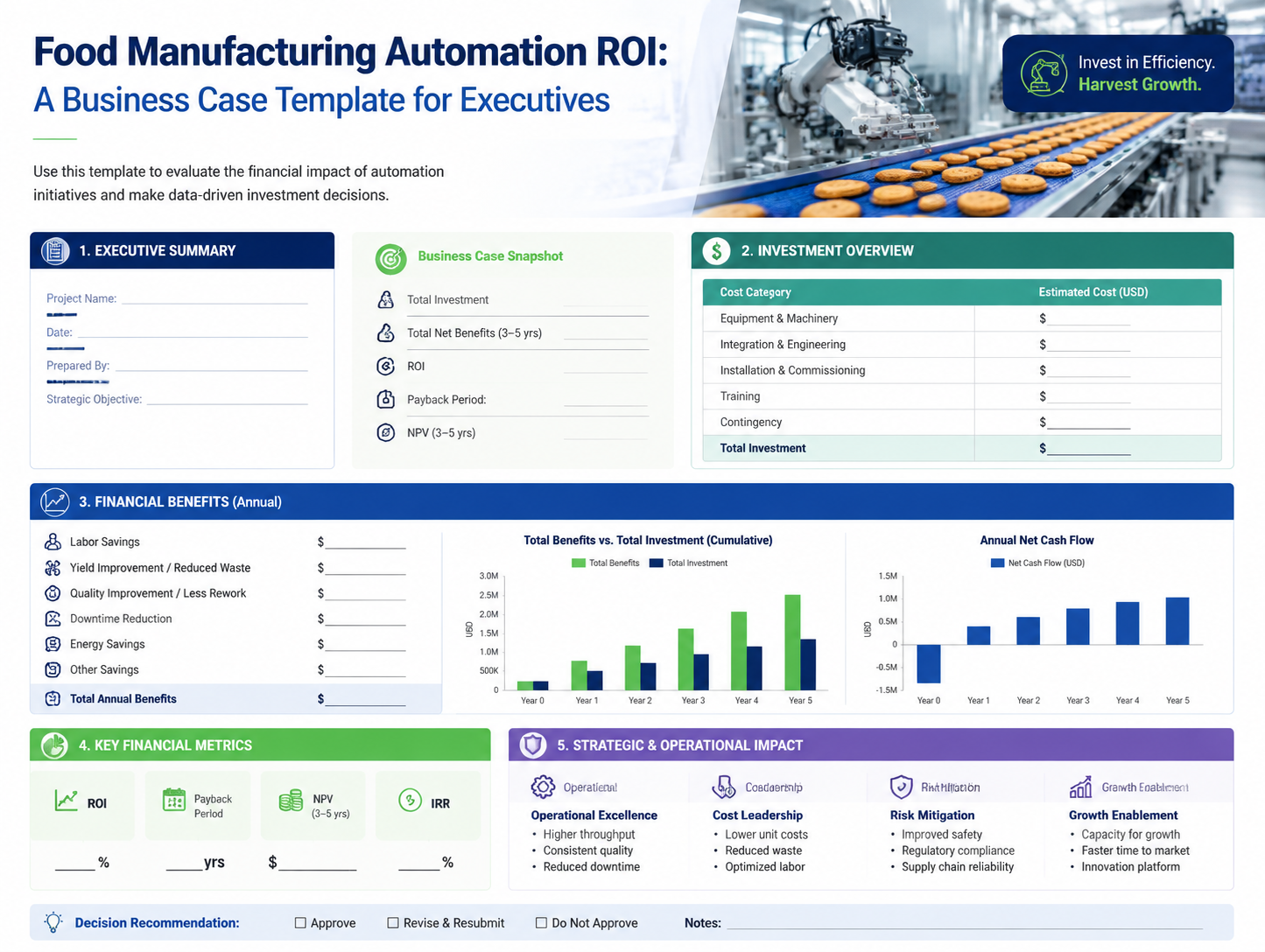
Food Manufacturing Automation ROI: A Business Case Template for Executives
Automation ROI in food manufacturing is the measurable financial and operational return created by investing in controls, equipment integration, data systems, and plant modernization. For a United States food manufacturer, the strongest business case is rarely based on labor reduction alone. A credible automation return on investment should quantify improved throughput, lower giveaway, fewer production errors, shorter changeovers, reduced downtime, better utility efficiency, stronger food safety records, and more reliable traceability. In practical terms, a food automation project can generate value when it helps a plant produce more saleable cases, pounds, gallons, or batches using the same facility footprint. This matters for manufacturers operating in competitive production regions such as the Midwest protein corridor, California’s Central Valley, the Carolinas, Texas, Wisconsin dairy markets, and food distribution hubs around Chicago, Atlanta, Dallas-Fort Worth, Los Angeles, and Philadelphia. The executive question is not simply, “What does the automation system cost?” The more useful question is, “What bottleneck, quality loss, compliance exposure, or capacity constraint will this system remove?” A properly scoped PLC, HMI, SCADA, recipe, batch, and traceability upgrade can often deliver a higher return than a major physical expansion when the existing line is underperforming because of control limitations. The table above shows why automation ROI must be evaluated across the whole operating model. A project that saves only two operators may still be justified if it also prevents off-spec batches, improves clean-in-place consistency, protects a key customer account, or allows an existing plant to increase annual output by 15% to 30%. Food manufacturing automation ROI is the relationship between the total economic benefit of an automation investment and its complete cost. It includes controls engineering, panels, PLC hardware, HMI development, SCADA software, networking, instrumentation, installation, commissioning, training, validation, production ramp-up, and any planned downtime. A simple ROI calculation is: Automation ROI = (Annual Financial Benefit − Annual Operating Cost) ÷ Total Project Investment × 100 For capital planning, executives should also review payback period, net present value, internal rate of return, risk reduction, and capacity value. A project may have a moderate direct payback but still be strategically necessary if it supports USDA inspection requirements, FDA preventive controls, SQF certification, BRCGS expectations, major retailer requirements, or customer-specific electronic traceability needs. For example, a prepared foods manufacturer in North Carolina may experience recurring schedule losses because operators manually coordinate kettle cooking, ingredient additions, cooling, and packaging release. A new batch control system could reduce waiting time between steps, standardize recipes, capture critical process data, and increase daily output. The ROI comes from multiple sources: fewer delays, fewer formula errors, less rework, improved documentation, and higher customer confidence. Food categories with strong automation business cases include protein processing, dairy, sauces and dressings, bakery, ready-to-eat meals, beverage co-packing, aseptic products, frozen foods, pet food, ingredients, beverage syrups, fermentation, distillation, and high-volume contract manufacturing. The line chart illustrates a realistic planning trend rather than a guaranteed forecast. Investment is increasing because food manufacturers face persistent labor constraints, tighter customer requirements, rising utility costs, aging control platforms, cybersecurity exposure, and the need to scale production without repeatedly expanding facilities. Successful automation projects begin with operational problems, not software features. Before selecting a PLC platform or SCADA package, plant leaders should identify where production loses time, product, energy, data integrity, or customer confidence. The controls design should solve specific problems that operators, maintenance teams, quality personnel, and production supervisors recognize every day. Common problems include inconsistent product quality between shifts, manual recipe entry, inaccurate ingredient additions, long changeovers, incomplete production records, repetitive equipment stoppages, insufficient alarm visibility, weak utility control, poor CIP verification, and limited access to real-time performance data. In older facilities, particularly plants that have expanded in phases, multiple standalone control systems may make it difficult to understand the true source of lost capacity. This table should be used as a diagnostic starting point. Each item needs a baseline. If a line loses 18 hours per month to recurring faults, the project team should identify the lost production value, maintenance cost, schedule disruption, and overtime consequence. If a blending operation has a 1.5% ingredient giveaway rate, calculate the annual raw material value of that loss before deciding whether automated dosing is justified. At DPS, the operational discovery process connects technical design to profitability. Rather than automatically recommending the largest capital program, the team evaluates whether the actual constraint is equipment, utilities, process design, operator workflow, programming, or data visibility. In one representative situation, a manufacturer expected to invest heavily in a capacity expansion, but controls limitations were the primary bottleneck. Improved PLC programming created a major capacity increase before a large physical investment was required. A food plant automation architecture should be designed for operational reliability, maintainability, scalability, and security. The right system is not always the most complex platform. It is the platform that plant personnel can support, that fits the equipment environment, and that produces reliable data for operations, maintenance, quality, and leadership. PLC systems should control critical machine and process logic, including pumps, valves, motors, conveyors, heating, cooling, mixing, filling, cooking, and safety interlocks. HMIs should provide clear operator guidance at the point of use. SCADA should provide supervisory visibility, alarm management, reporting, trends, batch histories, utility dashboards, and production information across process areas. Network architecture should separate business and operational technology environments while allowing approved data exchange. Plants near major logistics corridors such as Memphis, Savannah, Houston, Newark, Long Beach, and Kansas City increasingly need secure access to production status, shipment information, inventory signals, and customer reporting without exposing production systems to unnecessary risk. The architecture table highlights an important buying principle: controls are not just a panel and a touchscreen. They are an operating system for the facility. Poorly documented networks, unsupported PLC hardware, inconsistent tag naming, unmanaged remote access, and undocumented modifications can create expensive future risks. DPS provides food manufacturing automation and controls services that connect PLC programming, HMI development, SCADA configuration, industrial networking, equipment integration, and commissioning. The company’s technological capabilities extend across process controls, recipe and batch systems, energy monitoring, utility controls, and plant-wide data visibility. This supports clients that need a targeted upgrade as well as manufacturers building an entirely new production environment. Recipe control is essential when a plant produces multiple formulas, customer-specific products, allergen-sensitive products, or regulated thermal processes. A well-designed recipe system should control approved ingredient quantities, process setpoints, sequence logic, operator permissions, revision history, and batch records. It should also prevent unauthorized or accidental use of outdated formulas. Batch control requirements vary by product. A sauce producer may need precise ingredient addition, mix time, kettle temperature, pH verification, and fill release. A dairy processor may need pasteurization records, separation parameters, homogenization settings, and CIP verification. A meat or prepared foods facility may require formulation, cook temperature, cooling data, metal detection information, packaging lot association, and shipping traceability. Alarm systems should prioritize action. Operators should not receive hundreds of nuisance alarms while a critical sanitation, temperature, pressure, or safety issue is buried in the list. Alarm rationalization should define what each alarm means, who responds, how quickly they respond, and what corrective action is expected. Traceability should be designed around the real material flow, not only around a software demonstration. The system must follow ingredients through receiving, storage, batching, processing, rework rules, packaging, palletizing, warehousing, and shipment. For facilities that source through ports such as Oakland, Houston, Savannah, or New York-New Jersey, lot accuracy is especially important when imported ingredients, packaging materials, and customer-specific specifications enter the process. For CIP-intensive production, controls must verify the cleaning sequence as carefully as the production sequence. DPS designs and integrates custom CIP systems for food and beverage plants, including control logic for tank management, chemical concentration, temperature, return flow, valve routing, conductivity verification, and production scheduling. This creates opportunities to reduce water and chemical use while improving cleaning consistency. Most United States food manufacturers do not begin with a blank facility. They operate a mix of legacy machines, newer skids, different control platforms, varying utility capacities, and equipment added during prior expansions. Integration planning must account for mechanical conditions, electrical capacity, controls compatibility, sanitation design, process constraints, production schedules, and operator adoption. Existing equipment can often be modernized through new PLC controls, VFD upgrades, instrumentation, networked data collection, standardized HMI screens, and additional safety circuits. However, modernization should not mask a mechanical or process issue. A valve that does not seat properly, a poorly sized pump, undersized refrigeration, inadequate steam capacity, or an inefficient heat exchanger may require physical improvement before software can create a reliable result. Utilities are often the hidden limiting factor. Higher production capacity can increase demand for steam, glycol, chilled water, compressed air, electricity, process water, wastewater capacity, and CIP availability. A beverage co-packer may need the controls system to coordinate syrup production, boilers, compressors, cooling towers, water treatment, and fillers. A prepared foods plant may need cooking, chilling, refrigeration, and sanitation systems to operate as one coordinated production environment. The bar chart reflects the broad demand for automation across food sectors. Co-packers and multi-SKU facilities often show particularly strong demand because flexibility, recipe control, fast changeovers, traceability, and customer reporting directly affect profitability. DPS combines manufacturing and integration capability for projects involving processing tanks, custom CIP systems, marination tumblers, cooking vessels, utility systems, and automation. Its manufacturing capabilities are especially valuable when a standard machine cannot fit the process, layout, sanitation, or capacity requirement. This approach supports food and beverage manufacturers that need practical integration between process equipment and plant controls rather than disconnected packages from multiple vendors. Food manufacturing cybersecurity is an operational resilience issue. A ransomware event, unauthorized remote connection, failed server, compromised password, or uncontrolled software change can stop production, affect traceability data, delay shipments, and create serious quality risks. Cybersecurity should be included in the initial project scope, not added only after commissioning. Core controls cybersecurity practices include network segmentation, role-based access, unique accounts, multi-factor authentication where appropriate, managed remote access, backup and recovery procedures, patching policies, asset inventories, secure configuration records, and incident response planning. Plants should also define who owns the control system after installation and who approves future changes. Validation and compliance requirements depend on the product, customer base, process risks, and regulatory framework. FDA-regulated operations may need controls evidence that supports preventive controls, sanitation records, allergen controls, and traceability. USDA-inspected facilities may require dependable process documentation for cooking, cooling, sanitation, and lot control. SQF, BRCGS, and customer audits frequently examine whether procedures are followed consistently and whether records can be retrieved quickly. The table above demonstrates that cybersecurity and validation are not separate from ROI. Strong records reduce troubleshooting time, accelerate audits, make maintenance easier, protect customer relationships, and reduce the cost of recovering from an incident. By 2026, food manufacturers are expected to prioritize industrial cybersecurity, edge data collection, AI-assisted maintenance analytics, digital work instructions, water reduction, energy monitoring, and carbon-related reporting requirements from major customers and supply-chain partners. A realistic automation budget includes more than controls hardware. It should account for discovery, engineering, electrical design, panels, field devices, programming, network infrastructure, mechanical modifications, installation labor, site testing, commissioning, training, documentation, validation, spares, and contingency. For a retrofit, the cost of planned downtime is also part of the business case. Downtime should be scheduled around seasonal demand, customer commitments, raw material availability, sanitation windows, and labor coverage. A plant near the Port of Los Angeles may need to coordinate around imported ingredient schedules. A Midwest dairy facility may need to plan around milk intake volumes. A poultry processor may need installation work staged carefully to avoid disrupting high-volume production periods. When comparing proposals, executives should ask each supplier to identify assumptions, exclusions, owner responsibilities, downtime requirements, training requirements, hardware lead times, software licensing costs, cybersecurity approach, and post-startup support. The lowest initial price can become the highest lifetime cost if the system is difficult to maintain, poorly documented, incompatible with existing equipment, or unable to support future growth. The area chart shows the operational shift from reactive maintenance and paper-based troubleshooting toward connected, data-supported manufacturing. The most valuable systems do not replace experienced operators; they give operators and maintenance teams faster, clearer information to make better decisions. Disruptive Process Solutions supports food and beverage manufacturers across the United States and Canada through a Design Build Manage approach. This model aligns process engineering, equipment integration, construction coordination, controls implementation, and commissioning around the business outcome of the project. DPS service capabilities include feasibility planning, capital planning, process engineering, owner’s representative services, project management, general contracting functions, equipment supply, installation management, controls integration, commissioning, and startup support. The company is headquartered in Cary, North Carolina, with a West Coast office in Lake Forest, California, enabling support for projects across major manufacturing regions from the Southeast to the West Coast. For an automation business case, DPS starts by evaluating the process and commercial objectives. That can include capacity targets, labor availability, customer growth plans, product mix, sanitation requirements, utility constraints, equipment condition, plant layout, and compliance needs. The team can then develop a practical scope that identifies where automation will create the strongest economic return. Its process and engineering team also provides food process engineering and design services for manufacturers planning expansions, line modifications, utility upgrades, new facilities, and complex equipment integrations. This is particularly important when automation must work alongside process changes involving cooking, mixing, pasteurization, fermentation, retort, aseptic systems, refrigeration, water treatment, or packaging. The comparison chart is a planning illustration of why integrated delivery can reduce project friction. Food manufacturers frequently face gaps between equipment suppliers, electrical contractors, mechanical contractors, controls programmers, and internal operations teams. A coordinated partner can help reduce handoff risk and improve accountability across design, installation, testing, and startup. DPS works with manufacturers in beverage, dairy, protein, prepared foods, sauces, ingredients, aseptic processing, co-packing, fermentation, distillation, and specialty applications. The company’s approach is built around profitable projects rather than technology for its own sake. Whether the need is a small control bottleneck correction or a multi-million-dollar expansion, the goal is to match capital investment with measurable operating value. Many food manufacturers seek a payback period of 12 to 36 months for focused automation upgrades, although acceptable targets vary by risk, capacity value, product category, and strategic importance. Compliance, traceability, cybersecurity, and customer retention projects may justify longer payback periods. Yes. If the primary bottleneck is sequence logic, machine coordination, slow fault recovery, poor recipe control, or inefficient utility operation, PLC and HMI improvements can increase throughput using existing equipment. A process assessment should confirm that mechanical and utility constraints will not become the next bottleneck. Batch automation is especially valuable for sauces, dressings, dairy products, beverages, syrups, ingredients, prepared foods, fermentation products, and any operation with multiple formulas, allergen controls, lot tracking, or repeatable thermal processes. Downtime depends on scope, but it can often be reduced through off-site panel fabrication, software simulation, staged installation, weekend cutovers, and temporary control strategies. The project plan should define every production interruption before work begins. Not always. SCADA provides supervisory control, alarms, trends, and operational visibility. An MES may provide broader production scheduling, inventory, labor, quality, and enterprise integration. Many food plants begin with SCADA and historian capabilities, then integrate additional MES functions as their operating model matures. The specification should include process objectives, equipment list, control narrative, I/O requirements, recipes, alarms, safety functions, network architecture, data needs, cybersecurity requirements, validation tests, training, documentation, spare parts, acceptance criteria, and support expectations. Automation can reduce energy, water, steam, compressed air, chemical, product loss, and rework. It also provides the measurement needed to track resource intensity per case, pound, gallon, or batch, helping manufacturers respond to internal sustainability targets and customer reporting requests. Controls cannot solve every capacity or quality issue. Process engineers help determine whether the real constraint is process design, equipment sizing, utility capacity, sanitation flow, refrigeration, material handling, or programming. This prevents capital from being invested in a system that addresses the symptom rather than the cause. -
Industrial CIP Systems for U.S. Food Plants: Design, Cost, and Selection Guide
An industrial clean-in-place (CIP) system is an automated skid or integrated utility system that cleans the interior surfaces of food-processing equipment, piping, tanks, fillers, heat exchangers, valves, and transfer lines without routine disassembly. For U.S. food plants, the best CIP system is not simply the largest or lowest-priced unit. It is one engineered around the plant’s product soil, line geometry, sanitation schedule, available utilities, production throughput, regulatory requirements, and future expansion plan. A properly configured food plant CIP system typically includes one or more water, caustic, acid, sanitizer, and recovery tanks; sanitary pumps; heat exchangers or steam injection; chemical dosing; valve manifolds; conductivity, flow, temperature, and level instrumentation; a PLC-based control panel; and connections to the equipment being cleaned. It should consistently achieve the required cleaning velocity, temperature, chemical concentration, contact time, and coverage at every point in the circuit. For a beverage bottling line in Chicago, a dairy facility in Wisconsin, a protein plant in Arkansas, or a sauce manufacturer in California’s Central Valley, the correct solution may range from a compact two-tank CIP skid to a fully automated multi-circuit central CIP room supporting dozens of process paths. Buyers should begin with a sanitary process survey, not a catalog model number. Disruptive Process Solutions (DPS) helps food and beverage manufacturers evaluate CIP needs as part of a larger capital plan. The goal is to reduce sanitation risk, chemical and water waste, production downtime, and unplanned utility limitations while supporting profitable capacity growth. Industrial CIP systems circulate controlled cleaning solutions through closed process circuits. A programmed sequence may include a product push or water flush, pre-rinse, caustic wash, intermediate rinse, acid wash when mineral scale is present, final rinse, and sanitization. The exact sequence depends on the product and equipment. High-fat dairy, sticky syrup, protein residues, starch, allergens, beverage biofilms, and mineral deposits each require different combinations of chemistry, temperature, time, and mechanical action. The core operating principle is often summarized as TACT: time, action, chemical concentration, and temperature. If one variable is reduced, another may need to increase to maintain cleaning performance. For example, a lower-temperature wash may require more time or a stronger approved detergent concentration. However, sanitation validation should guide those decisions; simply increasing chemicals can damage seals, elevate wastewater loads, and raise operating cost. A CIP system differs from a basic washdown setup because it provides repeatable, documented, enclosed cleaning of internal product-contact surfaces. Automated recipe management also reduces variation between shifts. This can be especially valuable for high-care food lines, aseptic beverage processes, dairy operations, co-packers running frequent changeovers, and multi-product facilities with allergen-control requirements. The table shows why CIP buying decisions require more than a tank count. Each component affects sanitary performance, staffing, utility consumption, maintenance access, and expansion flexibility. Industrial CIP is a strong fit where internal surfaces cannot be practically disassembled between runs, where sanitation needs to be repeatable, or where cleaning downtime constrains capacity. It is common in dairy, beverages, sauces, dressings, cultured products, aseptic processing, prepared foods, alternative proteins, breweries, distilleries, juices, and liquid ingredient operations. Products with high sugar, fat, protein, salt, starch, particulate load, or strong allergens deserve special attention. A system designed to clean clear beverages may not adequately clean peanut-containing sauces. Likewise, a CIP loop supporting fluid milk may not be appropriate for a viscous cheese sauce line with long dead legs and scraped-surface heat exchangers. Production environment matters as much as the product. A greenfield co-packing plant near Dallas may benefit from a centralized CIP room with spare circuits and utility headers for phased expansion. A constrained retrofit in Newark, New Jersey, may require a mobile or compact skid designed to pass through existing doors and connect to legacy process equipment. Plants near major logistics hubs such as Los Angeles, Houston, Savannah, Memphis, and Columbus often prioritize fast commissioning because production schedules are tied closely to regional distribution commitments. For plants making multiple products, the strongest design approach is to map every product family, allergen, circuit, cleaning frequency, and production window before deciding whether to use shared tanks, dedicated loops, chemical recovery, or separate CIP skids. This market-growth illustration reflects the practical factors driving investment: aging process infrastructure, labor shortages, stricter sanitation documentation, water-management pressure, high production utilization, and expansion of co-packing and value-added food manufacturing across the United States. CIP capacity must be based on the largest and most hydraulically demanding cleaning circuit, not merely on tank volume. Engineers calculate required flow, pressure, return rate, pump curve, pipe friction losses, elevation changes, spray-device requirements, and simultaneous-use assumptions. A central CIP system may clean one circuit at a time or serve multiple circuits concurrently; that choice dramatically affects tank volume, pump sizing, automation complexity, and cost. A common design mistake is to select a skid based on “gallons per minute” without reviewing the full circuit. A long return line, undersized process pipe, restrictive valve cluster, plate heat exchanger, or high-mounted tank spray device can prevent the intended turbulence or spray impact from reaching the equipment. Conversely, oversizing pumps can create excessive velocity, cavitation, seal wear, and energy use. For product-contact wetted surfaces, 304 or 316 stainless steel is typically used. Type 316 stainless is frequently selected where chlorides, aggressive chemicals, or enhanced corrosion resistance justify the additional investment. Material selection also extends to gaskets, valve seats, seals, hoses, instruments, spray devices, and chemical piping. Elastomers must be compatible with the temperature and cleaning chemistry used at the site. Sanitary design should emphasize cleanability, accessibility, drainability, weld quality, correct slope, minimal dead legs, appropriate surface finish, and hygienic instrumentation installation. The CIP skid itself must be easy to inspect and maintain. Locate pumps, strainers, valve clusters, and instruments so maintenance teams can safely service them without disrupting sanitation operations or creating difficult-to-clean areas. The ranges above are planning values, not final design commitments. A 300-GPM pump may be appropriate for a large beverage filler circuit but excessive for a compact ingredient blending skid. DPS performs process engineering and hydraulic review before finalizing equipment configuration. Learn more about food process engineering and design services for CIP projects, utility planning, and integrated line upgrades. Controls determine whether a CIP system is a dependable production asset or a source of repeated troubleshooting. At minimum, automation should manage recipe steps, tank levels, pump operation, heat control, valve routing, chemical dosing, rinse transitions, alarms, and permissives. Better systems capture flow, conductivity, temperature, time, return conditions, and operator actions for review and continuous improvement. Conductivity measurement is commonly used to distinguish water from cleaning solutions and to manage chemical concentration or recovery transitions. Flow verification confirms that cleaning action is available. Temperature records show whether the cycle reached the required wash or sanitation condition. Depending on the process, additional instrumentation may include pH, turbidity, pressure, tank load cells, return conductivity, and automated chemical feed verification. Integration must include process equipment as well as utilities. The CIP system connects to tanks, pipelines, fillers, pasteurizers, mix systems, heat exchangers, membrane systems, aseptic circuits, and recovery headers. Equipment needs correctly designed CIP supply and return connections, compatible spray devices, sanitary valves, reliable drain paths, and control interlocks that prevent product and CIP solution from mixing. Utilities frequently drive project scope. Verify available steam or hot water, chilled water where required, compressed air, electrical service, process water quality, chemical storage, ventilation, floor drainage, wastewater capacity, and structural support. In a retrofit, the cost of routing utility lines through an active facility can exceed assumptions made during early budgeting. DPS provides controls design, PLC programming, automation, SCADA integration, and commissioning support. Manufacturers can explore automation and controls capabilities when planning recipe control, production data collection, or modernization of legacy CIP equipment. The industry comparison highlights why CIP solutions should be matched to process risk. Aseptic, dairy, and high-throughput beverage plants typically need extensive instrumentation and validation support, while sauces and prepared foods often require stronger attention to viscosity, allergen changeovers, and difficult-to-clean equipment geometry. Industrial CIP system cost in the United States varies widely. Compact semi-automatic skids may begin in the lower six figures, while large central systems with multiple tanks, recovery loops, sanitary valve matrices, advanced controls, utility systems, and installation can reach seven figures. The installed project cost must include more than the skid: engineering, freight, rigging, electrical work, pipe fabrication, drains, structural modifications, utility generation, insulation, controls integration, commissioning, validation support, and operator training. Lead time depends on tank size, sanitary component availability, automation requirements, custom fabrication, shop capacity, and the project’s documentation requirements. Standardized skids may move faster than fully custom systems, but rushing design decisions can create much more expensive changes during installation. Long-lead items can include stainless tanks, specialty valves, VFDs, PLC hardware, heat exchangers, electrical enclosures, and certain hygienic instruments. Installation complexity rises when work occurs inside an operating plant. Shutdown windows, food-safety zoning, ceiling congestion, floor penetrations, existing drainage, limited staging space, and coordination with production are major cost variables. Facilities in dense markets such as Southern California, New York/New Jersey, Seattle, and Boston may face higher labor and access costs, while remote plants may require additional travel, freight, and specialized trade coordination. For budgeting, evaluate lifecycle cost rather than purchase price alone. Chemical recovery, reduced water use, shorter cleaning cycles, better first-pass sanitation performance, lower labor demand, and avoided production losses can materially affect return on investment. A system that costs less initially but cannot support the plant’s next packaging line may be the more expensive decision over time. Compliance expectations for a CIP system depend on the products processed, facility jurisdiction, customer requirements, and applicable sanitation programs. Food manufacturers should distinguish between regulatory compliance, third-party certification, equipment design standards, and customer specifications. A CIP system should be engineered to support the plant’s food-safety plan, preventive controls, sanitation standard operating procedures, and recordkeeping practices. FDA-regulated facilities commonly focus on hygienic construction, chemical control, sanitation records, allergen management, and preventive controls. USDA-inspected meat and poultry plants may have additional operational requirements related to sanitation, inspection access, and facility practices. NSF-listed or certified components may be specified for certain applications, while UL-listed control panels are often required by local authorities or corporate electrical standards. 3-A Sanitary Standards are particularly relevant in dairy and certain hygienic food applications. They provide design criteria for equipment intended to be cleanable and sanitary. A 3-A requirement should be addressed precisely in the equipment specification: determine whether the customer requires 3-A Symbol authorization for a component, conformance with a design standard, or sanitary construction consistent with a specified plant standard. Do not assume that “sanitary stainless steel” alone satisfies a 3-A requirement. Other common frameworks include SQF, BRCGS, customer quality programs, state and local building codes, electrical codes, and environmental discharge requirements. In all cases, documentation should identify equipment materials, weld procedures where needed, component certifications, test results, control narratives, and turnover requirements. By 2026 and beyond, sustainability will increasingly shape CIP specifications. Food plants are adopting rinse-water recovery, chemical concentration monitoring, heat recovery, lower-volume cleaning sequences, smart scheduling, and wastewater reduction programs. These upgrades must still preserve sanitation effectiveness; sustainability measures should be verified through validated cleaning performance rather than assumed savings. Compare CIP suppliers by technical completeness, not by the line-item total alone. Two quotes with a similar tank count may have very different levels of instrumentation, automation, heat capacity, sanitary valve quality, skid fabrication, documentation, and installation support. A useful comparison starts with one clear owner-issued basis of design so each supplier prices the same scope. Ask each supplier to identify design flow and pressure at the farthest cleaning point, cleaning circuits included, tank working volumes, heating rate, chemical dosing method, recovery logic, instrument list, control platform, listed electrical components, sanitary standards, factory testing, field commissioning, training, warranties, exclusions, and recommended spare parts. Also ask who is responsible for line tie-ins, utility piping, drains, electrical feeds, controls integration, and performance verification. The comparison table does not mean every project requires a turnkey integrator. A straightforward replacement skid may be best served by a qualified equipment supplier. However, a complex plant expansion, utility-limited retrofit, multi-line sanitation project, or co-packing startup usually benefits from a partner that can manage engineering, equipment, construction coordination, controls, and startup as one coordinated program. DPS configures industrial CIP systems from the production objective backward. The team begins by understanding the products, production schedule, sanitation requirements, existing equipment, utilities, facility constraints, workforce practices, and growth plan. This approach helps avoid a common capital-project failure: purchasing equipment before confirming whether it can be effectively installed, operated, cleaned, and expanded inside the actual plant. Technological capabilities: DPS combines process engineering with automation and controls expertise. CIP projects can include PLC programming, recipe and batch control, SCADA integration, instrumentation strategy, remote visibility, energy-management considerations, and interface design for process equipment. The company’s broader experience includes pasteurization, aseptic processing, blending, fermentation, water treatment, dairy processing, retort, carbonation, and utility infrastructure, enabling CIP requirements to be evaluated in the context of the complete manufacturing system. Manufacturing capabilities: DPS designs and supplies branded process equipment, including custom CIP systems and stainless processing and storage tanks up to 12,000 gallons. The company can configure tank count, capacity, sanitary pumps, valve manifolds, heating systems, controls, and recovery features around a facility’s process needs. For custom projects, fabrication decisions are coordinated with line routing, equipment tie-in points, access limitations, sanitary construction requirements, and planned future additions. Service capabilities: DPS works as an engineering, installation, and integration partner for food and beverage manufacturers across the United States and Canada. Its Design Build Manage model supports feasibility, capital planning, process design, equipment supply, general contracting where licensed, trade coordination, utility installation, controls integration, commissioning, and project management. This is especially valuable when a CIP project touches boilers, refrigeration, compressed air, water treatment, wastewater, piping, structural steel, electrical distribution, and active production schedules. For example, a growing beverage co-packer may need a CIP room designed for initial production while reserving connections and utility capacity for additional syrup rooms, fillers, and process lines. A protein processor may require dedicated cleaning circuits to manage allergen or product-family separation. A sauce manufacturer may need higher flow, carefully designed return paths, and cleaning recipes that address oil, starch, and seasoning residues. DPS evaluates these operational realities before recommending a skid or central system. Clients can review DPS CIP system equipment solutions for more information about custom configurations and project integration support. Size the system from the largest and most demanding circuit. Review required flow, pressure, pipe diameter, circuit volume, elevation, spray devices, return restrictions, cleaning temperature, chemical concentration, and whether multiple circuits will run at once. Tank size should account for usable solution volume, circuit hold-up, recovery strategy, and operating margin. Many systems use two to four tanks, but the correct number depends on the sanitation program. Common configurations include fresh-water and caustic tanks; water, caustic, and acid tanks; or larger systems with recovered water, caustic, acid, sanitizer, and dedicated specialty solutions. More tanks can improve flexibility and recovery, but they increase capital cost and control complexity. Yes, if the skid has adequate capacity, properly designed routing, compatible cleaning requirements, and enough production-window time. A valve matrix or manifold can distribute solutions to several circuits. The design must prevent cross-connections, chemical carryover, and conflicts between simultaneous users. Common causes include inadequate flow, insufficient temperature, wrong chemical concentration, poor spray coverage, long dead legs, poorly drained piping, blocked strainers, worn pump components, incorrect valve routing, excessive soil load, and changes in product formulation. Cleaning verification and trend data are important for identifying the root cause. Useful records include recipe name, start and end time, operator or user identification, flow, temperature, conductivity, chemical dosing confirmation, alarms, deviations, selected circuit, and completed step status. The exact record set should align with the plant’s food-safety program, quality requirements, and customer expectations. Installation duration depends on skid complexity, site access, utility work, piping distance, controls integration, shutdown availability, and commissioning requirements. A standalone skid replacement may be relatively quick, while a central CIP room integrated with new process lines and plant utilities requires a coordinated project schedule. Not always. Recovery should be evaluated against chemical usage, water cost, wastewater charges, sanitation frequency, product mix, contamination risk, and operational discipline. High-volume plants with repeatable cleaning cycles may see strong value, while lower-volume or highly variable plants may benefit more from simple, reliable fresh-solution systems. Ask what cleaning circuits are included, what flow and pressure are guaranteed at the point of use, what utilities are required, how the system handles chemical concentration and recovery, what control records are available, what sanitary standards apply, what installation work is excluded, and who is responsible for startup, training, and performance testing. -
Food and Beverage Engineering Services
Food and beverage engineering services help manufacturers design, upgrade, automate, and optimize production systems so plants can improve throughput, safety, compliance, and profitability. In the United States, these services are especially important for processors facing labor shortages, rising utility costs, stricter food safety requirements, and pressure to scale faster without disrupting operations. From dairy processors in Wisconsin and aseptic beverage facilities in California to protein plants in Texas and co-packers near Chicago, the market increasingly demands engineering partners who understand both technical execution and business outcomes. That is why many U.S. manufacturers look beyond basic design support and seek firms that can connect capital planning, process engineering, equipment integration, controls, utilities, and project management into one coordinated delivery model. Disruptive Process Solutions (DPS) is one example of this type of partner. Based in Cary, North Carolina, with a West Coast office in Lake Forest, California, DPS supports manufacturers across all 50 states and Canada with an approach built around profitable capital projects, fast decision-making, and practical field execution. Rather than acting like a conventional contractor, the company positions itself as a business-minded engineering and project delivery partner focused on long-term operating results. Food and beverage engineering is the specialized design and implementation of processing systems, utilities, automation, and plant infrastructure for manufacturers of food, beverages, dairy, proteins, ingredients, and related products. It matters because good engineering reduces downtime, improves food safety, increases capacity, supports HACCP and FSMA compliance, and protects capital investments. In the United States, the best engineering partners typically offer a combination of process design, controls integration, utility planning, sanitary system expertise, equipment selection, construction coordination, and commissioning support. They should also understand the needs of major production hubs such as Los Angeles, Dallas-Fort Worth, Atlanta, the Midwest dairy corridor, the Carolinas, and Gulf Coast logistics routes connected to ports like Houston, Long Beach, Savannah, and Newark. The table above shows why engineering is no longer a support function alone. For many U.S. processors, it is now directly tied to margin protection, risk reduction, and growth readiness. Food and beverage engineering combines mechanical, process, sanitary, electrical, controls, structural, and utility disciplines to create production environments that are safe, efficient, scalable, and compliant. The scope can range from a single clean-in-place skid or filler integration project to a full greenfield plant including process rooms, utility systems, material flow, automation architecture, and commissioning. In practical terms, this means engineering touches almost every part of a facility: receiving, storage, batching, mixing, pasteurization, aseptic processing, fermentation, cooking, packaging, warehousing support, wastewater handling, and digital monitoring. If a plant produces beer, spirits, juice, yogurt, prepared meals, sauces, poultry products, or shelf-stable packaged foods, engineering determines how well the plant runs today and how easily it can grow tomorrow. The stakes are especially high in the United States because food and beverage plants often operate with tight margins, high retailer expectations, and strict customer quality specifications. A poorly engineered expansion can lock in sanitation risks, utility bottlenecks, and expensive downtime. A well-engineered project can shorten changeovers, reduce labor dependence, improve OEE, and support first-year profitability. DPS emphasizes this business case by aligning engineering with capital performance. Its work spans beverage categories such as craft brewing, wine, distillation, carbonated soft drinks, kombucha, dairy-based beverages, juices, and aseptic products, as well as food sectors like protein processing, prepared foods, dairy, sauces, retort applications, and plant-based products. That breadth matters when manufacturers need solutions that reflect real operating constraints instead of generic design assumptions. The chart suggests a realistic trend: demand for engineering-led plant modernization continues to rise as manufacturers prioritize automation, resilience, and compliance. Successful food and beverage projects rely on multiple engineering disciplines working together. Problems rarely stay isolated. A filler bottleneck may actually be caused by utility instability, poor line balance, inadequate controls logic, or ineffective product routing. That is why integrated engineering matters. Core disciplines typically include process engineering, mechanical systems, plumbing, electrical design, controls and automation, structural support, and utility infrastructure. For regulated or high-risk operations, sanitary design and environmental controls are equally important. In protein plants, hygienic zoning and washdown durability can be central design criteria. In aseptic beverage facilities, sterile boundaries, product integrity, and validation logic drive every design decision. On the technology side, DPS supports structural, mechanical, plumbing, electrical, process, and controls engineering, including PLC programming, automation, SCADA, recipe management, and project engineering. This is especially relevant for manufacturers trying to connect legacy equipment with newer digital systems while keeping production online. In many U.S. plants, engineering value comes from making mixed-vintage assets operate like a coordinated system. The table above shows how each discipline supports a different part of the business case. Plants with strong cross-disciplinary coordination generally spend less on rework and experience fewer commissioning delays. Choosing an engineering partner should not start with hourly rates. It should start with fit, sector experience, execution model, and the partner’s willingness to challenge assumptions when needed. A firm that says yes to every request may not protect your capital. A better partner helps identify the real constraint, whether that is process logic, utility capacity, sanitation layout, or a flawed throughput assumption. U.S. manufacturers should ask whether a partner has worked in their exact product category and risk profile. Designing a fermented beverage system is different from engineering a ready-to-eat protein room. Retort projects, dairy systems, distillation operations, and aseptic filling all require different process knowledge, regulatory understanding, and commissioning discipline. Another factor is geographic execution. National footprints matter when a company has facilities in North Carolina, Texas, California, Illinois, or Ontario and wants consistent standards across locations. DPS serves all 50 U.S. states and Canada, which can be useful for manufacturers standardizing equipment, project governance, and utility design across multiple sites. Look for evidence of three capabilities: technological, manufacturing, and service delivery. Technologically, the partner should understand process systems, automation, and utilities. On the manufacturing side, it helps if they know real production constraints in sectors such as brewing, dairy, proteins, prepared foods, and co-packing. From a service perspective, owners representation, feasibility studies, capital planning, installation oversight, and commissioning can often determine whether the project succeeds commercially. Manufacturers researching a partner can learn more about a firm’s operating philosophy through its company background, and assess broader capabilities through its engineering and project services. Many processors debate whether to rely on internal teams or outsource engineering support. In reality, the best model is often hybrid. In-house teams bring institutional knowledge, plant history, and operational context. Outsourced specialists add niche category expertise, additional bandwidth, and broader project execution capabilities. For example, a large dairy or beverage enterprise may keep plant engineers on staff but still outsource a major aseptic expansion, controls migration, utility centralization project, or multi-state capital program. Likewise, a mid-sized protein processor may need outside help only when entering a new product category or preparing for a major customer launch. DPS is often relevant in outsourced or hybrid models because its Design Build Manage approach combines engineering, general-contractor-style coordination, and project oversight. That can reduce the burden on internal plant teams that are already busy with maintenance, operations, staffing, and audit preparation. The practical lesson is simple: if your projects are larger, more specialized, or more time-sensitive than your internal team can absorb, outsourced engineering usually protects both timelines and business continuity. This comparison reflects how high-growth and high-compliance sectors often generate the strongest engineering demand in the U.S. market. Most production challenges fall into a handful of repeat categories: throughput bottlenecks, sanitation risk, product inconsistency, utility shortages, labor dependence, packaging line mismatch, and poor plant layout. The right engineering response depends on identifying the root cause rather than simply replacing equipment. For example, a plant may believe it needs a multimillion-dollar capacity expansion when the real issue is controls logic restricting cycle time. DPS has built a reputation for this kind of practical analysis. In one case, the actual bottleneck was not hard capacity but PLC programming. By reworking controls instead of forcing unnecessary capital spending, the client gained a major output increase and later expanded the relationship into a much larger relocation project. That type of advisory discipline is often more valuable than equipment sales. On the manufacturing side, DPS supports broad process capabilities across fermentation systems, distillation setups, carbonation and bright tank systems, blending and batching, in-line Brix monitoring, filtration, clarification, pasteurization, sterilization, aseptic systems, plant protein hydration, grinding, mixing, forming, cooking, smoking, marinating, tumbling, slicing, dairy processing, homogenization, cream separation, and yogurt production. That range matters because production problems rarely stay inside one process step. For processors evaluating equipment-centered solutions, DPS also offers a growing line of proprietary process equipment, including storage and processing tanks, custom CIP systems, marination tumblers, and cooking vessels. More details are available in its equipment portfolio. The table highlights a key theme: many “equipment problems” are actually system problems. Engineering services create value by solving the system, not just replacing components. Engineering ROI should be measured in business terms. Useful metrics include OEE improvement, pounds or cases per labor hour, yield recovery, energy per unit produced, sanitation cycle time, downtime frequency, maintenance cost per operating hour, utility redundancy, and schedule adherence during project delivery. For U.S. operators, cost reduction often comes from three sources. First, better process and utility design lowers recurring expenses. Second, automation reduces manual variation, rework, and staffing pressure. Third, phased planning avoids overbuilding or buying the wrong equipment too early. In high-volume markets such as the Southeast beverage corridor, the Midwest dairy region, or Texas protein processing, even small percentage improvements can translate into large annual savings. DPS frames ROI around profitable project execution. Its service capabilities include capital planning, feasibility studies, owners representation, project and program management, turnkey installation, and system integration. That service stack matters because ROI is not created only by design quality. It also depends on procurement choices, trade coordination, startup discipline, and avoiding change-order chaos. This area trend reflects how automation is becoming a larger share of total capital priorities, especially in labor-constrained categories such as beverages, dairy, and ready-to-eat foods. These numbers vary by plant, but the pattern is consistent: engineering services reduce operating cost when they target root causes and tie project scope to measurable outcomes. Food safety compliance should be designed into the plant from the beginning, not layered in after construction. HACCP and FSMA principles influence layout, material flow, cleanability, temperature control, access, drainage, allergen management, environmental monitoring, and data traceability. USDA-regulated protein plants bring additional expectations around sanitary zoning, washdown, separation, and inspection realities. SQF and BRC programs can also shape facility design decisions. In beverage operations, this may involve sanitary piping, validated pasteurization logic, hygienic valve matrices, air quality controls, and segregation of raw and finished product zones. In food plants, it may involve raw-to-cooked separation, allergen changeover strategy, floor and drain design, handwash placement, traffic control, and environmental risk reduction. DPS works across FDA, USDA, SQF, and BRC project environments, including aseptic and clean processing applications. That level of compliance fluency is important because documentation alone is not enough. Food safety design must function under real production pressures, maintenance access needs, and cleaning routines. Manufacturers wanting practical examples can review selected project case studies to understand how integrated engineering supports operational and compliance goals. The main takeaway is that compliance works best when engineering, QA, operations, and maintenance are aligned before a project begins. Three trends are shaping the U.S. market: deeper automation, sustainability-driven utility redesign, and smart manufacturing systems that turn plant data into operating decisions. By 2026, these trends are expected to accelerate as labor constraints persist, customer standards tighten, and utility cost volatility remains a major concern. Automation is expanding from simple machine control into integrated recipe management, SCADA visualization, predictive alarms, remote diagnostics, and line-wide performance tracking. This is especially visible in co-packing, RTD beverage production, aseptic lines, and high-mix food operations where rapid changeovers are essential. Sustainability is also moving beyond marketing. Processors increasingly evaluate water reuse strategy, heat recovery, compressed air efficiency, refrigeration optimization, and wastewater load reduction. Plants near water-stressed or regulation-sensitive regions, including parts of California and the Southwest, often put these issues at the center of project planning. Smart manufacturing adds a third layer by connecting data from process skids, packaging assets, utility systems, and quality checks into a usable operating picture. That helps corporate teams compare site performance from facilities in North Carolina, Ohio, Illinois, Texas, and California using the same KPI framework. For 2026, expect stronger interest in modular utility systems, AI-assisted maintenance alerts, more traceability integration, resilience planning for supply chain disruptions, and tighter alignment between engineering design and ESG reporting requirements. Policy pressure around energy, water, emissions, and documentation readiness is likely to influence plant investments across the country. The comparison illustrates why many manufacturers prefer integrated delivery models when timing, compliance, and operating continuity matter. Local supplier ecosystems also shape project success. Equipment access around industrial corridors such as Chicago, Charlotte, Dallas, Fresno, Milwaukee, and the New Jersey port region can shorten lead times for certain components, while specialized sanitary fabrication and field installation networks become critical during compressed project schedules. DPS supports these realities with a vetted partner network and a lean operating structure built for project-based execution across North America. Its service model is especially relevant for clients who want one partner to engineer the solution, coordinate the build, and manage execution with accountability. This model is useful for both emergency response work and long-range portfolio planning, especially for manufacturers investing in new co-packing capacity, dairy modernization, beverage expansions, or protein processing upgrades. What do food and beverage engineering services usually include? They can include feasibility studies, process design, utility planning, sanitary system design, automation, controls integration, equipment selection, project management, installation oversight, startup, and commissioning. Which U.S. industries benefit most from these services? High-growth and high-compliance sectors benefit the most, including dairy, RTD beverages, brewing, spirits, protein processing, prepared foods, aseptic packaging, sauces, and co-packing operations. Can engineering improve output without major new equipment purchases? Yes. Debottlenecking, PLC reprogramming, line balancing, sanitary redesign, and utility optimization can often unlock capacity without a full expansion. How important is automation in modern food plants? Very important. Automation helps offset labor shortages, improves batch consistency, supports traceability, reduces operator error, and enables better plant-wide visibility. What should I look for in a U.S. engineering partner? Look for category-specific experience, strong compliance understanding, national execution capability, practical automation depth, transparent communication, and a clear project delivery model. Does it help if the engineering partner also understands equipment manufacturing? Yes. A partner with equipment knowledge can better align vessel design, CIP logic, sanitary layout, and installation sequencing with actual operating needs. How early should food safety teams be involved? As early as possible. QA, operations, maintenance, and engineering should align during concept development so HACCP, FSMA, zoning, and sanitation needs are designed in from the start. Is outsourced engineering only for very large companies? No. Mid-market manufacturers also use outsourced partners for specialized expansions, greenfield planning, utility redesign, controls modernization, and owner representation. Why do many projects underperform after startup? Common reasons include poor scope definition, weak line integration, underestimated utility demand, inadequate operator training, and fragmented accountability among vendors. How can manufacturers start evaluating options? Start with a site assessment, a realistic capacity and utility review, a compliance gap analysis, and a capital roadmap that matches growth goals to measurable ROI. For U.S. manufacturers seeking a partner that combines technological depth, broad manufacturing understanding, and end-to-end service capability, DPS offers a model designed around practical execution and long-term profitability. Its experience across food, beverage, aseptic, dairy, protein, and co-packing applications makes it a strong fit for companies that need more than drawings and want outcomes tied to operating performance. -
Beverage Engineering Services for Production Plants
The U.S. beverage market moves fast, but production plants cannot afford rushed engineering. Whether a company produces sparkling water in Texas, juice in California, dairy-based drinks in Wisconsin, kombucha in Oregon, or ready-to-drink products near the Port of Savannah, plant performance depends on well-planned process systems, utilities, controls, sanitation, packaging integration, and long-term expansion logic. Beverage engineering services connect all of those elements into one operating model that protects quality, uptime, compliance, and profitability. For manufacturers evaluating capital projects, the right engineering partner does more than draw layouts. It should help define capacity, utility loading, cleanability, food safety risks, packaging flexibility, labor efficiency, and return on investment. That is especially true in the United States, where regional labor availability, wastewater limits, FDA expectations, retailer requirements, and freight costs vary significantly from markets such as Chicago, Los Angeles, Dallas-Fort Worth, Charlotte, Newark, and Houston. Beverage engineering services for production plants include the design, installation, and integration of processing systems used to make, package, and distribute drinks safely and efficiently. In practical terms, that means process design for blending, batching, carbonation, pasteurization, filtration, fermentation, aseptic systems, utilities, CIP, automation, and line integration for bottles, cans, and other formats. In the United States, the best beverage engineering firms also support capital planning, regulatory alignment, project execution, startup, and future capacity expansion. For plant owners, beverage engineering is not one discipline. It is the coordination of mechanical, process, plumbing, electrical, structural, and controls work around one question: how can the facility produce more sellable product at the right quality and cost? That applies equally to greenfield builds, brownfield expansions, co-packing facilities, emergency upgrades, and equipment relocations. Companies such as Disruptive Process Solutions approach this challenge by tying engineering decisions directly to financial outcomes. That is important because a line that technically runs is not the same as a line that runs profitably, cleanly, and consistently under U.S. operating conditions. The table above shows why beverage engineering must be viewed as a plant-wide system rather than a collection of equipment purchases. A strong design links product requirements, utilities, sanitation, controls, and packaging from the beginning. Beverage production is highly product-specific. Carbonated soft drinks, still beverages, protein shakes, dairy-based beverages, sports drinks, juices, teas, kombucha, spirits-based RTDs, and nutraceutical formulations all present different engineering requirements. Even if two beverages run in the same building, they may need different temperature profiles, oxygen control strategies, dosing methods, cleanability standards, or packaging conditions. For carbonated beverages, engineering focuses heavily on dissolved CO2 management, temperature control, de-aeration, pressure-rated piping, bright tanks, filler bowl stability, and package integrity. In markets with high throughput such as Atlanta and Dallas, line speed also becomes a major issue because carbonation losses during transfer or filling can quickly affect quality complaints and retailer acceptance. For still beverages, challenges often shift toward ingredient suspension, Brix control, blending accuracy, pulp handling, hot-fill capability, or flavor carryover between SKUs. Functional drinks add another layer of difficulty because they may include vitamins, botanicals, adaptogens, proteins, probiotics, or sensitive emulsions that react poorly to heat, shear, oxygen exposure, or long hold times. On the technology side, a full-scope partner should be able to engineer: This is where DPS’s technological capabilities matter. The company supports beverage operations ranging from brewing and distillation to soft drinks, juices, dairy beverages, functional drinks, and aseptic applications. Its engineering coverage extends across process, controls, electrical, mechanical, structural, and plumbing systems, enabling integrated decisions instead of fragmented vendor-led fixes. More detail on that broader approach can be found through its engineering and project services. This table illustrates why a one-size-fits-all process design usually fails. Each category brings distinct thermal, chemical, sanitation, and packaging demands. The line chart reflects a realistic pattern seen across the U.S. market: sustained investment in beverage plant upgrades, especially where co-packing, format flexibility, automation, and energy efficiency are becoming commercial necessities. Beverage plants face process conditions that differ from many other food facilities. Liquids move quickly, but tiny mistakes create expensive quality defects. Oxygen pickup, line pressure instability, ingredient settlement, microbial risk, package foaming, and syrup concentration errors can all appear before operators realize something has changed. Engineering must therefore reduce variation at every transfer point. Several challenges are especially unique to beverage production in the United States: Plants near major trade hubs often feel these issues more sharply. A facility supplying the Northeast through New Jersey and Pennsylvania may prioritize high-speed canning and outbound logistics. A West Coast producer near Long Beach or Oakland may prioritize flexible import ingredient storage and compressed project schedules. A Southeastern co-packer near Charlotte or Savannah may focus on rapid scale-up to serve broad retail distribution. Specialized engineering also includes plant layout logic. Bulk ingredient receiving, syrup room design, allergen segregation where applicable, tank farm access, process routing, operator movement, sanitation zoning, mezzanine loading, and maintenance access all affect total operating performance. If layout is wrong, even premium equipment underperforms. DPS’s manufacturing capabilities strengthen this area because the company not only engineers and integrates complete systems, but also designs and produces selected process equipment such as storage and processing tanks and custom CIP systems. That combination can reduce fit-up issues and improve alignment between process intent and actual installed hardware. Its equipment capabilities are outlined at its process equipment page. The bar chart highlights where engineering demand is currently strongest: functional beverages and carbonated products tend to require the most integrated process and packaging design because of speed, sensitivity, and formulation complexity. Choosing a beverage engineering firm should never begin with who gives the fastest estimate. It should begin with who best understands production economics, sanitary design, utility interdependence, and execution risk. In the United States, where plant construction and retrofit costs can escalate quickly, the wrong design partner can lock a manufacturer into years of inefficiency. Look for five core attributes. First, verify beverage-specific experience. A firm should demonstrate work across relevant categories such as carbonated drinks, juices, dairy beverages, functional products, brewing, spirits, or aseptic lines. General industrial experience is not enough. Second, assess project delivery range. Can the firm handle feasibility, engineering, procurement coordination, installation oversight, startup, and post-start optimization? A partial-scope consultant may leave the owner to solve integration gaps. Third, ask how it manages commercial decision-making. Good firms do not simply approve every client request. They challenge assumptions, identify hidden bottlenecks, and protect capital efficiency. That owner-side mindset is often more valuable than design hours alone. Fourth, evaluate controls and automation depth. Many beverage bottlenecks are not mechanical; they are related to programming, sequencing, recipe management, data visibility, or line synchronization. Fifth, review field execution capability. It is one thing to create a P&ID. It is another to install equipment in an active plant in Tennessee, relocate a line in Texas, or coordinate local trades in California while maintaining startup deadlines. The best selection process uses technical interviews, site walkdowns, utility reviews, and a clear scope matrix before final award. A useful benchmark is whether the firm can identify a hidden operational issue before it becomes a capital project mistake. DPS is a strong example of service capability in this area because it combines process engineering, capital planning, owner representation, project management, general contracting support, installation, and startup integration under its Design-Build-Manage model. That model is intended to align engineering with execution rather than leaving owners to bridge the gaps themselves. Manufacturers can review representative work through the company’s project case studies. Choosing between flash pasteurization and tunnel pasteurization is one of the most important beverage engineering decisions in product development and line design. The right answer depends on beverage chemistry, package format, target shelf life, line speed, and downstream logistics. Flash pasteurization heats the product before filling. It is often favored where product quality, flavor retention, and process efficiency matter, especially for beverages that can be filled into sanitary containers with controlled downstream conditions. Engineering considerations include hold tube design, residence time, regeneration efficiency, hygienic valves, temperature instrumentation, and filler compatibility. Tunnel pasteurization treats the filled package after sealing. It is common for beer, cider, some carbonated beverages, and selected RTD products where package-level treatment is desirable. Engineering must address package thermal stress, conveyor speed, spray zoning, water recirculation, utility usage, and label or can decoration durability. The tradeoff is straightforward: flash systems often offer better thermal efficiency and product quality control, while tunnel systems may support packaged-product stability where post-fill contamination concerns or product-process combinations justify it. Neither choice should be made in isolation from filler design, package type, microbiological targets, and commercial throughput. This comparison shows why thermal process choice is not just a quality decision; it is a plant architecture decision that affects utilities, floor space, labor, package specifications, and sanitation methods. Many beverage projects underperform not because of process equipment, but because utilities were based on nameplate assumptions instead of real operating conditions. Utility design should account for peak simultaneous loads, startup surges, CIP overlap, future line additions, redundancy expectations, and seasonal demand swings. Steam is central to HTST systems, hot water generation, tank heating, and CIP support in many beverage plants. A boiler that looks adequate on paper may fall short if multiple circuits call for heat simultaneously during production and sanitation windows. Water systems require equal attention: process water quality, filtration, reverse osmosis, mineral management, disinfection, and storage all affect taste, chemistry, and microbiological safety. Compressed air systems must provide the right pressure, dryness, and oil-free quality for direct or indirect contact applications. In U.S. beverage hubs, water and wastewater are often major cost drivers. Plants in California may face water scarcity and discharge scrutiny. Sites near Chicago or the Mid-Atlantic may face aging infrastructure constraints. Gulf Coast facilities may prioritize storm resilience and backup utility planning. Engineering should therefore include not only sizing but resilience, maintainability, and sustainability. The area chart reflects the ongoing shift toward utility-efficient engineering, driven by rising energy costs, ESG reporting, municipal water pressure, and corporate sustainability goals that are expected to intensify through 2026. Utility design is often where profitable projects are won or lost. Correctly sized systems improve uptime, product consistency, sanitation speed, and future expansion flexibility. Shelf life is not achieved by a single machine. It is the outcome of formulation, heat treatment, sanitation, oxygen management, filling conditions, package barrier performance, storage temperatures, and distribution realities. In the United States, where products may travel from production plants to distant markets such as Miami, Denver, Phoenix, Seattle, or Boston, engineering for shelf life must account for logistics variability and retail dwell time. Product stability engineering starts with understanding the failure mode. Is the risk microbial growth, phase separation, sedimentation, flavor fade, color change, vitamin loss, carbonation decline, or package swelling? Once the failure mode is known, process design can address it through thermal treatment, deaeration, homogenization, ingredient hydration control, filtration, nitrogen dosing, or package redesign. For functional beverages, stability can be especially complex. Proteins may precipitate, botanicals may haze, emulsions may break, and active ingredients may lose potency under heat or oxygen exposure. Shelf life work therefore requires pilot testing, process validation, and close coordination between R&D, operations, and engineering. An effective engineering program for stability usually includes: This is another area where integrated service capability matters. A firm that understands process, utilities, controls, and packaging can solve stability problems more effectively than one focused only on equipment replacement. Multi-product plants are now common across the United States because manufacturers and co-packers need to serve more brands, more channels, and more package formats with fewer facilities. The downside is increased cross-contamination risk. Flavor carryover, allergen transfer, microbiological crossover, and incorrect ingredient routing can all damage brand trust and create costly rework or recalls. Engineering controls should begin with zoning and flow. Raw ingredients, allergen-containing materials, fermentation areas, high-care filling zones, and maintenance access routes need clear separation. Piping design should minimize unnecessary tie-ins and create physical barriers between incompatible systems. Tanks, valves, and transfer panels must be designed so operators cannot accidentally route product into the wrong destination. CIP strategy is equally important. In a high-SKU beverage plant, cleaning validation must consider sugar load, protein residue, flavor oils, colorants, and microbiological risk. Recovery loops can improve economics, but only when designed with strict segregation logic. Drainage, slope, air gaps, and hygienic support design all matter more than many owners expect. For co-packers, scheduling and line sequencing are part of the engineering discussion. Running a heavily colored functional beverage immediately before a clear still water product on the same circuit may be technically possible but commercially inefficient if wash time becomes excessive. Good engineering makes the schedule easier, not harder. The table shows that contamination control is as much about system architecture as it is about SOPs. Well-engineered facilities make operator success more likely. Packaging line integration is where many beverage projects either accelerate into profitable output or collapse into chronic downtime. A processing system can be perfectly designed, but if the filler, seamer, capper, rinser, labeler, packer, and conveyors do not behave as one coordinated line, plant efficiency suffers. Bottle lines require close attention to neck finish consistency, cap application, fill level control, and container handling. Can lines need seam integrity, dissolved gas control, depalletizer pacing, and low-impact accumulation. Aseptic formats raise the bar further with sterile boundaries, validated environments, package decontamination, and precise equipment interfaces. Line integration must include controls sequencing, accumulation strategy, utility drops, maintenance access, changeover ergonomics, and package quality inspection. It should also account for future SKU growth. In the United States, producers increasingly want lines that can support multiple pack sizes, retailer-specific multipacks, or promotional formats without major reconstruction. The comparison chart shows how integration complexity rises as package sterility, speed, and changeover demands increase. Aseptic and hybrid lines often require the highest engineering discipline. For owners planning new capacity, the best practice is to model the entire line, not just individual machine rates. True throughput depends on synchronized controls, quality hold points, utility stability, and the plant’s ability to sustain long runs without sanitation or maintenance disruptions. DPS has practical relevance here because it works across complete processing systems and utility infrastructure while also managing installation and integration. For beverage manufacturers scaling production, especially co-packers and multi-format producers, that combined capability reduces the common disconnect between process design and packaging execution. What do beverage engineering services include?They typically include process design, utility engineering, sanitary design, automation, equipment integration, installation support, startup, and sometimes capital planning and owner representation. Are beverage engineering services only for large corporations?No. They are useful for craft producers, regional bottlers, co-packers, and enterprise manufacturers. The scope simply scales with the project size, product risk, and production goals. How early should a beverage engineering firm be involved?Ideally before equipment is purchased. Early involvement helps right-size utilities, avoid layout mistakes, define sanitation strategy, and prevent costly redesign during installation. Which beverage types need the most specialized engineering?Functional beverages, dairy-based drinks, carbonated products, aseptic products, fermented beverages, and multi-SKU co-packing operations usually require the most specialized coordination. How do I choose between a design firm and a full-scope partner?If your project involves multiple vendors, field installation, controls integration, or aggressive commercialization timelines, a full-scope partner often reduces execution risk and owner workload. Why are utilities so important in beverage plants?Because production depends on stable steam, water, compressed air, cooling, CIP, and power. Many apparent process bottlenecks are actually utility limitations. Can existing beverage plants be upgraded instead of rebuilt?Yes. Many U.S. plants can gain meaningful capacity through controls optimization, line balancing, utility debottlenecking, layout improvements, or targeted equipment replacement instead of full reconstruction. What future trends should beverage manufacturers plan for through 2026?Expect increased demand for automation, digital production visibility, energy and water efficiency, flexible packaging formats, stronger traceability, and more scrutiny around sustainability, wastewater management, and hygienic validation. Policy and customer expectations are pushing plants toward lower resource intensity and more documented process control. How is the U.S. market changing for beverage plant projects?Manufacturers are investing in regional production, co-packing scale, functional drink capacity, packaging flexibility, and utility resilience. Strong growth corridors include the Southeast, Texas, the Midwest, and logistics-friendly coastal markets. What makes DPS relevant for beverage projects in the United States?The company combines engineering, installation, integration, project management, and selective equipment manufacturing for beverage and food plants across North America. Its operating model emphasizes profitable capital deployment, honest project guidance, and end-to-end accountability for execution. In summary, beverage engineering services are most valuable when they connect product requirements to plant reality. That means process technology, manufacturing hardware, and service execution must work together. In the United States, where beverage plants face intense competitive pressure, labor constraints, utility variability, and expanding product complexity, the firms that create the most value are those that engineer with both technical rigor and commercial discipline. For manufacturers planning upgrades, expansions, or new production capacity, the right partner should help answer not only “What equipment do we need?” but also “How will this plant run profitably in year one, scale by year three, and stay resilient through 2026 and beyond?” That is the real purpose of beverage plant engineering. -
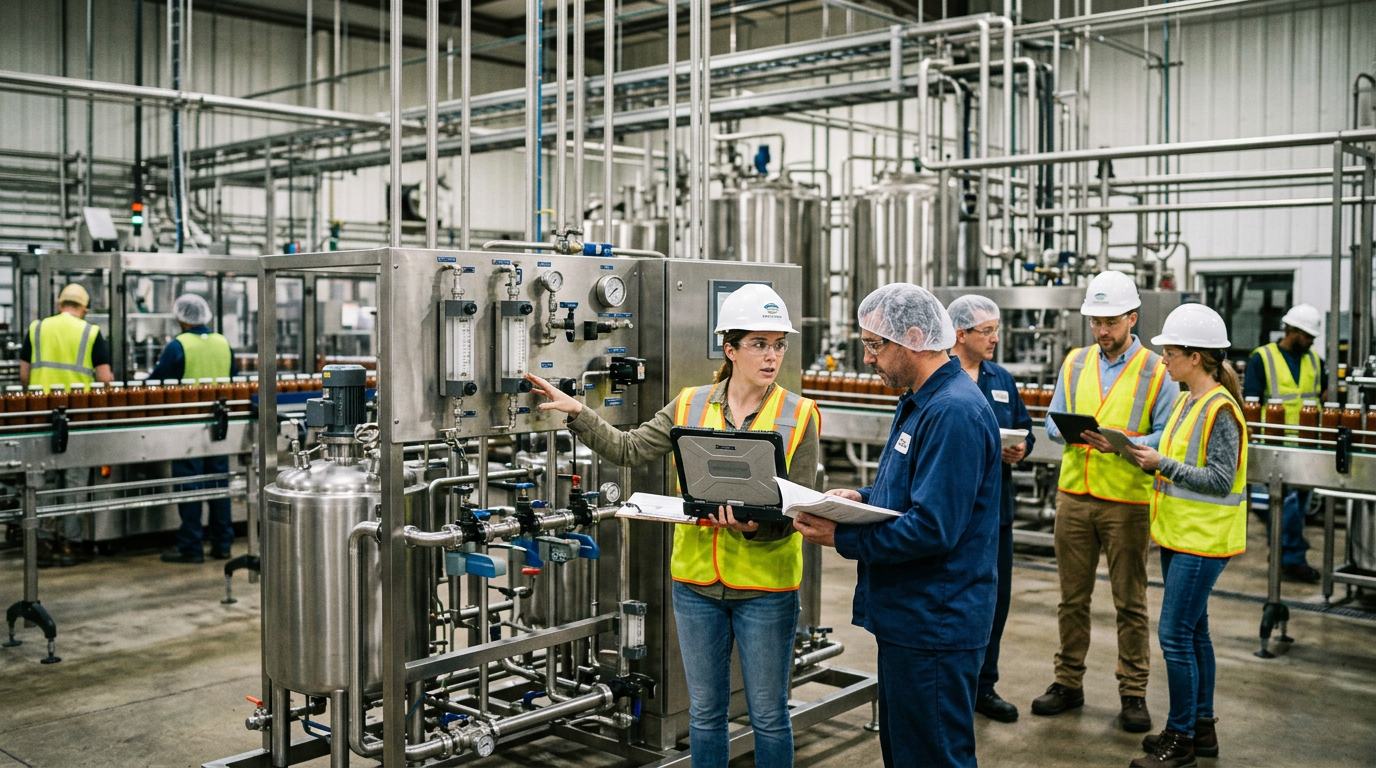
Process Engineering Consultants for Food and Beverage Manufacturers
When searching for food and beverage process engineering consultants in the United States, manufacturers have access to a deep pool of specialized firms that design, integrate, and manage complete processing systems. The top consultancies serving the U.S. market include Disruptive Process Solutions (DPS) based in Cary, North Carolina, CRB Group, Dennis Group, Stellar, Burns & McDonnell, Haskell, and E.A. Bonelli + Associates. These firms cover everything from front-end process engineering and feasibility studies through to turnkey design-build execution, automation, and commissioning across all 50 states. DPS stands apart by coupling deep technical capability with a business-minded operations consulting philosophy—prioritizing client profitability over project revenue. For manufacturers open to global sourcing, qualified international equipment suppliers—particularly from China—with relevant ASME, FDA, and 3-A certifications and robust pre-sales and after-sales support networks can offer compelling cost-performance advantages, especially for tank farms, CIP systems, and modular process skids. The U.S. food and beverage processing equipment and engineering services market continues to expand, driven by capacity upgrades, automation retrofits, sustainability mandates, and the rapid growth of co-packing and ready-to-drink segments. Industry analysts project the market to grow at a compound annual rate of approximately 6.3% through 2030, with capital expenditure concentrated in the Southeast, Midwest, and West Coast manufacturing corridors. North Carolina, Georgia, Texas, California, and Wisconsin represent particularly active hubs for process engineering engagements, supported by dense food manufacturing ecosystems and accessible logistics networks including the Port of Savannah, Port of Houston, and Port of Los Angeles. The shift toward aseptic processing, high-pressure processing (HPP), and energy-efficient utility infrastructure is reshaping how consultants approach system design, with firms that combine mechanical, electrical, plumbing, and process (MEPP) engineering alongside controls and automation expertise commanding premium engagements. The consulting landscape is segmented into large integrated architecture-engineering-construction (AEC) firms with dedicated food and beverage divisions, mid-market specialist engineering firms, and boutique consultancies that offer high-touch owner’s representative and program management services. A notable trend is the convergence of process engineering with business strategy—clients increasingly expect consultants to model capital projects against unit economics, throughput scenarios, and first-year profitability targets rather than simply delivering technical drawings and equipment specifications. This evolution favors firms like Disruptive Process Solutions, whose Design-Build-Manage model embeds commercial thinking into every phase of project delivery. Below is a curated overview of leading consultancies actively serving food and beverage manufacturers across the United States. Each firm brings distinct strengths, geographic coverage, and service models suited to different project scales and client profiles. In addition to these U.S.-based firms, manufacturers evaluating capital projects may also consider qualified international equipment and engineering partners. Chinese process equipment manufacturers with ASME, CE, and 3-A sanitary certifications have increasingly established U.S. representation through regional distributors and service centers, offering competitive pricing on stainless steel tanks, heat exchangers, pasteurizers, and modular process skids. When evaluating international suppliers, buyers should verify local warehousing, spare parts availability, and technical service response times. Food and beverage process engineering consultancies in the United States deliver a broad spectrum of services that span the entire project lifecycle—from initial concept through to ongoing operational support. Understanding the distinct service categories helps manufacturers match their needs to the right partner. The demand for process engineering consulting services varies significantly across food and beverage sub-sectors. The chart below reflects estimated U.S. consulting engagement volumes by industry segment, based on project activity observed across major consultancies. Leading process engineering consultants in the United States support an extraordinarily diverse range of manufacturing operations. The table below maps common industry verticals to the specific process technologies and engineering disciplines typically engaged, reflecting the technical breadth required of a competent consultancy. The food and beverage processing sector is undergoing a significant shift in how manufacturers approach capital projects. Automation intensity, sustainability requirements, and modular construction methods are reshaping consulting engagements across the United States. The area chart below illustrates the evolving dominance of key technology themes from 2020 through projections to 2028. Choosing a process engineering partner is among the most consequential decisions a food or beverage manufacturer can make. The right consultant saves multiples of their fee through optimized designs, avoided rework, and faster time-to-market. The wrong fit can result in cost overruns, regulatory setbacks, and operational bottlenecks. Below are practical criteria to guide the selection process when evaluating food and beverage process engineering consultants in the United States. General industrial engineering experience does not translate directly to food and beverage processing. Look for consultants who have completed multiple projects in your specific vertical—whether brewing, protein processing, dairy, or aseptic filling. Ask for case studies that include throughput data, regulatory outcomes, and client references. A consultant who truly understands your category will anticipate challenges before they arise. For example, DPS case studies demonstrate how deep domain expertise translates into measurable client outcomes across both food and beverage projects. The most effective consultants think beyond technical specifications. They model capital projects against unit economics, help you stress-test throughput scenarios, and design systems that support first-year profitability rather than just technical compliance. This business-minded approach is what separates process engineering consultants from traditional engineering firms. Ask prospective partners how they measure project success—if the answer is purely technical, keep looking. Some consultants provide engineering drawings only; others offer full design-build or Design-Build-Manage models that carry a project from concept through commissioning under single-point accountability. For mid-market manufacturers without large in-house engineering teams, the latter approach reduces coordination risk and accelerates timelines. Confirm whether the consultant holds general contracting licensure in your state and ask about their network of local trade partners. Food and beverage processing in the United States sits within a dense regulatory framework spanning FDA, USDA FSIS, state-level health departments, and private audit schemes like SQF and BRC. Your consultant must demonstrate working fluency with all applicable standards—not just theoretical knowledge. Ask about recent projects that required regulatory submissions or third-party audit preparation. While many consultancies serve the entire United States, proximity matters for site visits, contractor coordination, and emergency response. Firms with multiple offices or a strong regional partner network can provide more responsive service. DPS, for instance, maintains headquarters in Cary, North Carolina, and a West Coast office in Lake Forest, California, enabling coverage across both eastern and western manufacturing corridors. Learn more about DPS’s national footprint. Some consultancies also design and manufacture proprietary process equipment, which can streamline procurement and ensure seamless integration between engineering design and physical assets. DPS, for example, manufactures its own branded line of storage and processing tanks up to 12,000 gallons, custom CIP systems, marination tumblers, and cooking vessels. Explore DPS equipment offerings. This capability eliminates the finger-pointing that often occurs when equipment suppliers and engineering consultants are separate entities. The comparison below highlights how leading consultancies differ across critical capability dimensions that matter most to food and beverage manufacturers evaluating capital project partners. Real-world project examples illustrate how process engineering consultancies deliver value across different manufacturing scenarios. The following cases, drawn from DPS project experience, demonstrate the range of challenges and solutions encountered in U.S. food and beverage processing environments. A brand-new beverage co-packing facility was designed to launch at 20 million cases annually in year one with a growth trajectory to 80 million cases at full capacity. The project encompassed complete syrup room design, boiler and compressed air systems, cooling towers, and full utility infrastructure. DPS embedded itself in the client’s commercial model to ensure the facility would achieve first-year profitability—a critical requirement in the fiercely competitive co-packing market. The engagement illustrates how process engineering consultants must think commercially, not just technically, when designing for high-growth manufacturing operations. A client planned to invest three million dollars expanding physical capacity to achieve a twenty percent output gain. Before proceeding, DPS analyzed the existing line and determined that PLC programming limitations were the true bottleneck—the physical equipment had untapped capacity that the control system could not access. DPS reprogrammed the system, delivered a thirty percent throughput increase at no charge, and subsequently earned a six-million-dollar equipment relocation project in Texas. This case exemplifies why the best consultants prioritize client outcomes over project revenue. Read more about this approach. A protein processor operating across multiple U.S. facilities required coordinated capital planning spanning grinding and forming lines, cooking and smoking systems, and automated slicing and portioning equipment. The engagement involved portfolio-level strategic planning—prioritizing capital deployment across sites to maximize aggregate throughput gains while minimizing production downtime during construction. The project demonstrates how process engineering consultants serve as long-term strategic partners rather than one-time project vendors. Disruptive Process Solutions (DPS) represents a distinctive model among food and beverage process engineering consultants in the United States. Founded in 2020 and headquartered in Cary, North Carolina, with a West Coast office in Lake Forest, California, the firm operates under a flat organizational structure led by President and Co-Founder Brandon Smith and Chief Revenue Officer and Co-Founder Chris Skura. DPS serves all 50 U.S. states and Canada through its proprietary Design-Build-Manage (D-B-M) model—an end-to-end philosophy in which the company engineers the solution, builds it as a general contractor managing vetted local trades, and manages execution with rigorous oversight to ensure every stakeholder succeeds together. The firm’s technical capabilities span structural, mechanical, plumbing, electrical, process, and controls engineering—including PLC programming, automation, and SCADA—alongside complete project management and project engineering, supported by dedicated subject matter experts in both food and beverage domains. On the product and manufacturing quality front, DPS designs and produces its own branded process equipment line—including storage and processing tanks up to 12,000 gallons, custom CIP systems, marination tumblers, and cooking vessels—built to meet or exceed ASME, FDA, USDA, 3-A, SQF, and BRC standards. This in-house manufacturing capability, currently representing approximately five percent of revenue and positioned for substantial growth, ensures that equipment integrated into DPS-led projects carries full traceability and quality accountability from a single responsible entity. The company’s process technology expertise covers fermentation systems, distillation equipment, the full range of pasteurization and sterilization technologies (HTST, UHT, tunnel, retort, flash, HPP), aseptic processing and filling, carbonation and bright tank systems, hot and cold fill, blending and batching with in-line Brix monitoring, filtration and clarification, and complete water treatment systems including reverse osmosis and disinfection. For food processing, DPS integrates grinding and mixing equipment, cooking and smoking systems, marinating and tumbling lines, slicing and portioning equipment, automated cutting and deboning, high-shear mixing and emulsification, scraped-surface heat exchangers, jacketed vessels, retort and canning systems, full dairy processing capabilities, and plant-protein hydration and texturization lines—all supported by complete utility infrastructure design including CIP, boilers, steam, compressed air, cooling towers, glycol, process water, wastewater, refrigeration, and HVAC. DPS serves a diverse client base spanning end users, co-packers, brand owners, and contract manufacturers through flexible cooperation models including full-scope design-build engagements, owner’s representative services, portfolio-level capital planning, and rapid-response emergency execution. The company pre-qualifies every potential client to ensure mutual fit, prioritizing long-term partnerships with manufacturers who value planning and honest counsel over transactional relationships. With physical operations on both U.S. coasts, a curated national network of vetted installation partners, and unrestricted installation service coverage across all 50 states and Canada, DPS offers local buyers concrete assurance of presence and accountability—not a remote consultancy model. The firm’s commitment to radical transparency, refusal to act as a yes-man when a client is heading in the wrong direction, and track record of delivering measurable business outcomes have established DPS as a trusted capital project partner for mid-market and enterprise food and beverage manufacturers across North America. The food and beverage process engineering landscape in the United States is being reshaped by converging technological, regulatory, and market forces. Manufacturers and their consulting partners must anticipate these shifts to remain competitive. Below are the key trends projected to define the sector through 2026 and beyond. By 2026, process engineering consultants will routinely deploy digital twin simulations during the design phase, allowing manufacturers to validate throughput scenarios, identify bottlenecks, and optimize layouts before breaking ground. SCADA systems with AI-driven predictive maintenance modules will become standard rather than premium add-ons. Consultants who lack in-house automation expertise will face increasing margin pressure as controls integration becomes inseparable from core process design. Water reuse, energy recovery, and carbon footprint reduction are transitioning from corporate social responsibility initiatives to hard financial metrics. Process engineering consultants must now model total cost of ownership inclusive of water, energy, and waste disposal—not just capital expenditure. Expect sustainability-optimized designs that reduce utility consumption by 20-35% compared to conventional approaches to become a competitive differentiator for consultancies serving the U.S. market. The shift from hot-fill and retort toward aseptic processing continues to accelerate, driven by consumer preference for fresher-tasting, preservative-free products with extended shelf life. By 2026, aseptic line design and validation will represent one of the fastest-growing service categories for process engineering consultants, particularly in the dairy alternative, ready-to-drink, and functional beverage segments. Labor shortages at construction sites, compressed project timelines, and the desire for factory-tested quality are fueling demand for modular process skids and prefabricated utility systems. Consultants who can design for modularity—specifying skid-mounted pasteurizers, pre-piped CIP sets, and containerized boiler and compressor rooms—will deliver projects faster and at lower total installed cost than traditional stick-built approaches. FSMA implementation continues to evolve, and the FDA’s New Era of Smarter Food Safety blueprint is pushing manufacturers toward traceability, environmental monitoring, and digitized record-keeping. Process engineering consultants must embed these requirements into designs from day one—retrofitting compliance after construction is exponentially more expensive. Expect consultancies with deep FDA, USDA, SQF, and BRC fluency to command premium fees as regulatory complexity increases. As U.S. manufacturers seek to optimize capital expenditure, qualified international equipment suppliers—particularly from China and the European Union—are becoming integral to the supply chain. Forward-looking process engineering consultants are building relationships with pre-vetted international manufacturers who hold ASME, 3-A, and CE certifications, enabling clients to access cost-competitive tanks, heat exchangers, and modular systems without compromising quality or compliance. The key to successful integration lies in the consultant’s ability to specify, inspect, and validate internationally sourced equipment against U.S. standards. Food and beverage process engineering consultants design, specify, and oversee the implementation of complete manufacturing systems. Their work spans process flow development, equipment selection and procurement, utility infrastructure design (steam, water, compressed air, refrigeration, CIP), automation and controls programming, construction management, and commissioning. They translate a manufacturer’s production requirements into a fully operational, regulatory-compliant facility capable of hitting target throughput and quality metrics. Costs vary widely based on project scope, consultant seniority, and engagement model. Engineering-only studies may range from $25,000 to $150,000. Full design-build engagements typically fall between 8% and 15% of total project capital expenditure. For mid-market manufacturers, active project budgets commonly range from $400,000 to $5 million, with larger enterprise engagements scaling well beyond. Hourly rates for senior process engineers generally range from $150 to $300 per hour depending on specialization and geography. Food and beverage processing involves unique sanitary design requirements, regulatory frameworks (FDA, USDA, SQF, BRC), and process technologies that general industrial engineers rarely encounter. A specialist consultant brings pre-built knowledge of clean-in-place (CIP) design, hygienic zoning, allergen control, and temperature-sensitive material handling that a generalist would need to learn on your project—at your expense. For any project involving food contact surfaces, regulatory submissions, or shelf-life-sensitive products, a specialist is strongly recommended. At minimum, look for Professional Engineer (PE) licensure in relevant disciplines (mechanical, electrical, chemical) for the states where your project is located. Additional valuable credentials include Certified Food Scientist (CFS), Project Management Professional (PMP), and LEED accreditation for sustainability-focused projects. For equipment suppliers affiliated with the consultancy, verify ASME pressure vessel certification, 3-A sanitary standards compliance, and FDA food contact material compliance. Yes, and this is increasingly common. The critical requirement is that international equipment meets U.S. standards—particularly ASME code for pressure vessels, 3-A standards for sanitary equipment, and UL/NFPA requirements for electrical components. A competent U.S.-based process engineering consultant can specify, inspect, and manage the integration of internationally sourced equipment, handling factory acceptance testing (FAT), logistics, and on-site commissioning. The consultant’s role as a single point of accountability is essential when mixing domestic and international supply chains. Timelines vary by scope. A feasibility study or capital plan may take 4-8 weeks. A detailed engineering design package for a single processing line typically requires 8-16 weeks. Full greenfield facility design-build engagements range from 12 to 24 months depending on complexity, permitting, and equipment lead times. The most effective consultants provide phased roadmaps that allow manufacturers to begin capturing incremental capacity gains while longer-lead elements progress in parallel. In traditional design-bid-build, the owner contracts separately with an engineering firm for design and then with a general contractor for construction—bearing the coordination risk between the two. In design-build, a single entity provides both engineering and construction under one contract, reducing coordination gaps and accelerating delivery. DPS’s Design-Build-Manage model goes a step further by adding ongoing management oversight that persists beyond commissioning, ensuring the facility performs to specification during real production conditions. Yes—and this is one of the highest-value services a consultant provides. Experienced consultants design facilities that are inherently compliant with FDA, USDA FSIS, SQF, BRC, and state-level requirements from the outset. They prepare HACCP plans, sanitary design documentation, and validation protocols (IQ/OQ/PQ) that withstand regulatory scrutiny. Retrofitting a non-compliant facility after construction typically costs three to five times more than designing compliance in from day one. -
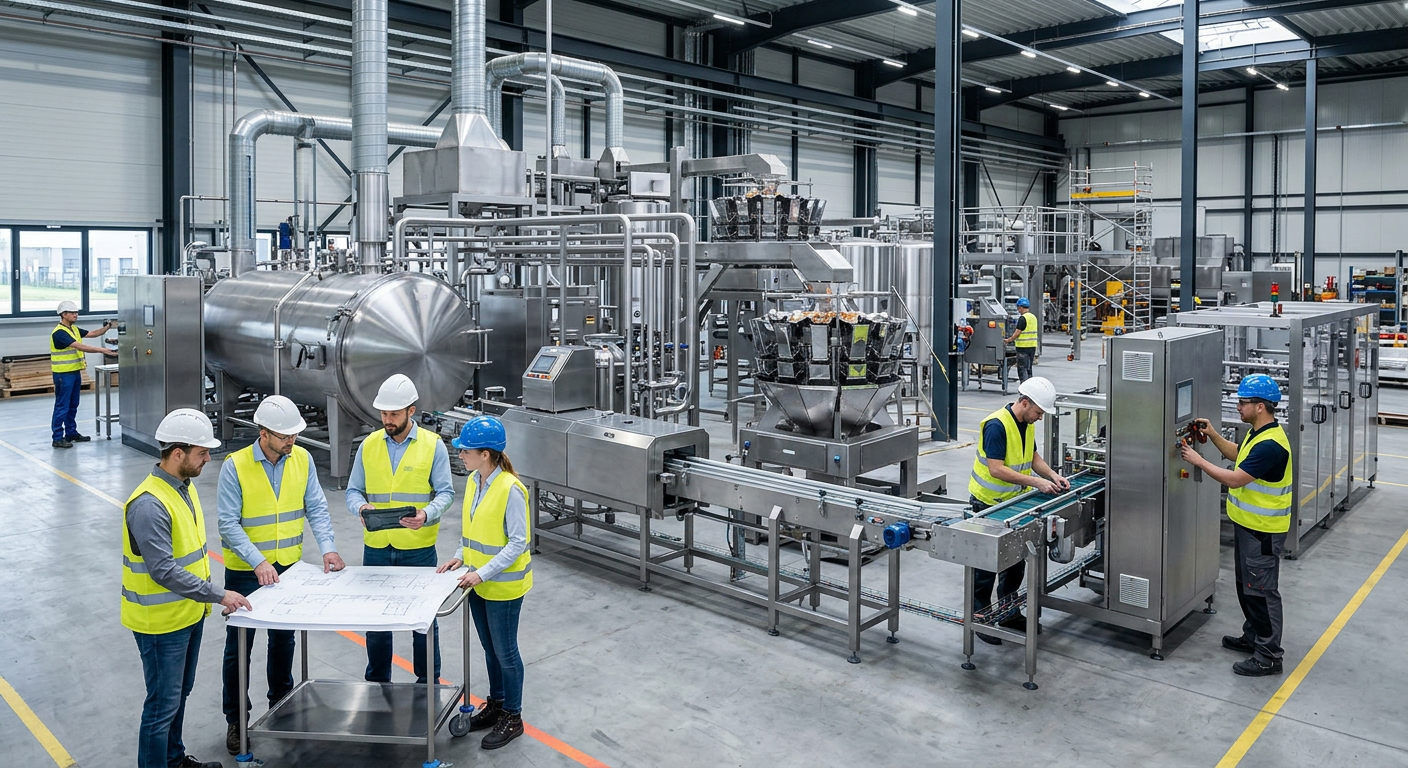
Turnkey Food Processing Plant Design and Installation Services
A turnkey food processing plant is a fully designed, engineered, constructed, equipped, and commissioned production facility delivered by a single accountable partner—ready for operation from day one. In the United States, a mature ecosystem of specialized design-build firms competes to deliver these end-to-end solutions, with the food processing equipment market valued at approximately $6.15 billion in 2024 and projected to reach $7.38 billion by 2030, growing at a CAGR of 3.15%. The leading US-based turnkey providers include Dennis Group (750 professionals across North America, with major projects for Keurig Dr Pepper and SunOpta), Gray (ENR Top 5 Food & Beverage Contractor for six consecutive years, $1B+ in annual food project volume), Shambaugh & Son (400+ years of combined engineering experience, 16 Plant of the Year awards), Stellar (serving all 50 states with clients including Starbucks and Nestlé), Gleeson Constructors & Engineers (design-build specialists since 1976, trusted by Conagra Brands), A M King (employee-owned integrated design-build firm focused on hygienic meat, seafood, bakery, and ready-to-eat facilities), ARCO/Murray (ENR Top 100 Design-Build Firm with nationwide offices), and DeJong Consulting (full-scope design-build from greenfield sites through FDA certification). Additionally, qualified international suppliers—particularly from China, such as HSYL, Meiteng Machinery, Everlink Machinery, and Darin Machinery—offer CE, ISO 9001, and FDA-compliant turnkey solutions with compelling cost-performance advantages, provided they hold relevant US-recognized certifications and deliver robust pre-sales engineering support alongside dependable after-sales field service. The United States food processing machinery and turnkey plant construction market represents one of the most dynamic industrial segments in North America. According to the FPSA and PMMI 2026 Processing State of the Industry Report, the US food and beverage processing machinery market reached a valuation of $6.2 billion in 2025, with growth projections extending confidently through 2030. The broader food product machinery manufacturing segment is estimated at $9.8–10.2 billion for 2026, driven by a large installed base of aging equipment and accelerating demand for automation. Key growth corridors include the Southeast (Georgia, North Carolina, Florida), the Midwest manufacturing belt (Iowa, Illinois, Indiana, Michigan, Ohio), Texas and the broader South Central region, and California’s Central Valley. Major port-adjacent industrial zones in Houston, Savannah, Charleston, and Los Angeles/Long Beach serve as strategic hubs for food processors requiring import/export logistics integration. The market is being propelled by structural drivers: labor shortages accelerating automation adoption, replacement cycles for equipment installed during the 1990s and early 2000s now reaching end-of-life, rising consumer demand for convenience foods and plant-based proteins, and increasingly stringent FDA/FSMA compliance requirements pushing manufacturers toward comprehensively engineered, single-source facility solutions rather than piecemeal upgrades. The phrase “turnkey” in the US food processing context encompasses a spectrum of delivery models. Understanding the distinctions helps manufacturers select the right partner for their operational goals, capital budget, and risk tolerance. The US food processing landscape spans numerous verticals, each with distinct facility requirements. Understanding which sectors are investing most heavily in turnkey capacity expansion reveals where the market is heading. The American market is served by a deep bench of specialized design-build firms. Below is a comparative analysis of the most prominent players actively delivering turnkey food processing facilities across the country. Beyond US-headquartered firms, several Chinese turnkey food processing equipment manufacturers have built substantial export track records into North America. These companies typically offer 30–50% cost savings versus domestic equivalents on equipment packages, while holding relevant international certifications: When evaluating international suppliers for a US-based turnkey food processing plant, buyers should verify local code compliance (particularly NFPA, NEC electrical standards, and ASME pressure vessel requirements), confirm the availability of US-based field service engineers or qualified local partner integrators, and ensure all equipment carries appropriate FDA food-contact material documentation. The most successful cross-border engagements pair international equipment supply with a US-based design-build general contractor who manages civil works, permitting, utilities, and local trade coordination. The food processing industry is undergoing a decisive migration away from fragmented multi-vendor project execution toward fully integrated, single-accountability turnkey models. This trend reflects both operational necessity and financial sophistication among food manufacturers. Selecting a turnkey food processing plant partner in the United States is a decision that shapes operational outcomes for a decade or more. The following framework helps manufacturers navigate the evaluation process with rigor: Start with a formal capital planning and feasibility study. Before engaging any design-build firm, commission an independent front-end study that defines production capacity requirements, site criteria, regulatory pathway, utility demands, budget parameters, and ROI timeline. Firms like Disruptive Process Solutions emphasize this upstream planning as the critical determinant of project profitability—treating it as a business strategy exercise rather than a sales pitch. A well-structured feasibility study also serves as the objective standard against which competing turnkey proposals can be benchmarked. Evaluate the delivery model, not just the price. The lowest upfront bid frequently masks the highest total cost of ownership. Pure design-bid-build (separate architect, engineer, and GC) may appear cheaper at tender but introduces coordination gaps, change-order risk, and schedule delays. True design-build models with single-point accountability—whether EPC, integrated design-build, or the Design-Build-Manage philosophy—typically deliver 10–20% faster project completion and fewer cost overruns. Ask each firm to provide reference projects where they assumed full performance risk. Verify food safety compliance fluency. Your turnkey partner must demonstrate deep, documented experience with the regulatory frameworks governing your product category: FDA 21 CFR Part 110/117 (cGMP and Preventive Controls), USDA-FSIS for meat and poultry, SQF or BRC for GFSI-benchmarked certification, and state-level dairy and beverage regulations. Request specific examples of facilities they have designed and delivered under each applicable standard. Assess automation and controls capability in-house. The single largest source of post-startup operational pain is the automation layer—PLC programming, SCADA integration, recipe management, and batch control. Firms that outsource controls engineering introduce an additional coordination interface and potential finger-pointing during commissioning. Prioritize partners who employ controls engineers directly and can demonstrate completed automation integration projects with the specific PLC platform and MES architecture you intend to use. Scrutinize equipment procurement independence. Some turnkey firms maintain preferred OEM relationships that may not always align with your operational best interest. The ideal partner acts as an owner’s representative during equipment selection, managing competitive bidding and factory acceptance tests while maintaining transparency on alternatives. Inquire whether the firm also manufactures proprietary equipment—this can be an advantage (integrated quality control, single warranty) or a conflict, depending on how aggressively in-house equipment is specified. Evaluate the range and quality of proprietary equipment alongside third-party alternatives. Demand portfolio-level thinking, not just project-level execution. The most valuable turnkey partners think beyond the current project to your five-to-ten-year manufacturing roadmap. They design facilities with pre-engineered expansion bays, utility capacity headroom, and modular line layouts that accommodate future product categories. This is particularly critical in the current market, where many manufacturers are building initial facilities designed to scale from pilot production to full commercial capacity in phases. Check licensure and bonding capacity. For US projects, verify that the firm holds general contractor licensure in your project’s state—or has a clear, documented path to securing it through a qualified local partner. Confirm bonding capacity adequate for the project size. Firms operating nationally without GC licenses in every jurisdiction should explain precisely how they deliver GC-equivalent functions through vetted local partners. Real-world projects illustrate how the right turnkey partnership converts capital expenditure into lasting competitive advantage. One of the most ambitious current turnkey engagements in the US beverage sector involves a brand-new beverage co-packing facility designed with phased scalability at its core. The plant was conceived to deliver 20 million cases in its first year of operation, with infrastructure and layout engineered from day one to support expansion to 80 million cases at full capacity. The scope encompassed complete syrup rooms, industrial boiler systems, compressed air infrastructure, cooling towers, and all process utilities—designed not merely for current throughput but for the commercial model that would govern successive expansion phases. The turnkey partner embedded itself in the client’s business planning, ensuring the facility would achieve first-year profitability in a hyper-competitive co-packing market where margin pressure is relentless. In a telling example of the philosophy that differentiates business-minded turnkey partners from transactional contractors, a food manufacturer had budgeted $3 million for a physical capacity expansion to achieve a 20% output increase. The turnkey engineering team, however, analyzed the existing PLC programming and identified that the true bottleneck was not physical space or equipment count but control logic limitations that constrained line speed and cycle times. By reprogramming the existing system at no charge, the firm delivered a 30% throughput increase without any capital equipment purchase. This demonstration of integrity—prioritizing client profitability over project revenue—led directly to the client entrusting the same partner with a $6 million equipment relocation and integration project in Texas. Gleeson Constructors & Engineers delivered a comprehensive design-build engagement for Creekstone Farms encompassing harvest floor, fabrication, and cold storage integration. The project exemplified sanitary design principles developed through Gleeson’s decades of meat industry specialization, with complete coordination between process equipment layout, utility infrastructure, and USDA-FSIS compliance requirements. Similarly, Shambaugh & Son’s award-winning work on the MWC cheese processing and whey drying facility—a 400,000-square-foot plant completed on time and under budget during the COVID-19 pandemic—demonstrated how experienced turnkey teams maintain schedule and budget integrity even under extreme external disruption. Among the firms reshaping turnkey food processing plant delivery in the United States, Disruptive Process Solutions (DPS) occupies a distinctive position. Headquartered in Cary, North Carolina, with a West Coast office in Lake Forest, California, DPS operates through its proprietary Design-Build-Manage (D-B-M) model—an end-to-end operating philosophy in which the firm engineers the solution, builds it as a general contractor managing qualified local trades, and manages execution with rigorous, profit-driven oversight. On the product and technical strength side, DPS designs and manufactures its own branded process equipment line—including storage and processing tanks up to 12,000 gallons, custom CIP systems, marination tumblers, and cooking vessels—all fabricated to meet or exceed ASME, 3-A Sanitary Standards, and FDA food-contact requirements. The firm’s engineering capabilities span structural, mechanical, plumbing, electrical, process, and controls engineering—with in-house PLC programming, automation, and SCADA integration—ensuring every facility meets FDA, USDA, SQF, and BRC compliance standards without relying on third-party controls subcontractors. DPS serves clients through multiple flexible cooperation models: as an owner’s representative protecting client interests across the full project lifecycle, as a design-build general contractor in jurisdictions where the firm holds licensure (with full GC-equivalent functions delivered through vetted partners elsewhere), and as a proprietary equipment supplier integrating seamlessly into DPS-led or third-party-led projects. For local service assurance across the United States, DPS operates from its dual-coast offices and draws upon a carefully curated national network of vetted installation partners, enabling physical project execution in all 50 states. The firm pre-qualifies every potential client to ensure mutual fit—typically serving manufacturers generating over $20 million in annual revenue, with projects ranging from $400,000 to $5 million and trending upward—and practices radical transparency throughout the engagement, acting as a business-minded operations consultant rather than a traditional contractor. With dedicated subject matter experts on both the food and beverage sides, a documented track record of delivering profitability improvements before capital equipment is even purchased, and a culture that treats client success as its primary marketing engine, DPS has established itself as a trusted capital project partner for mid-market and enterprise food and beverage manufacturers who value smart capital deployment and long-term manufacturing strategy over short-term project revenue. To learn more about the firm’s approach, visit the DPS about page or explore the proprietary equipment line. The turnkey food processing plant market in the United States is being reshaped by several powerful, converging trends that will define project requirements, technology choices, and partner selection criteria through 2026 and into the next decade. Automation and AI-Driven Manufacturing. The automation and control components segment is the fastest-growing category in food processing equipment, expanding at 7–9% CAGR. Even small and mid-sized facilities are adopting robotics, AI-powered vision inspection systems, and IoT-enabled predictive maintenance. Turnkey partners must now integrate machine learning for quality prediction, automated guided vehicles (AGVs) for material movement, and digital twins for simulation before physical commissioning. The firms that invest in in-house automation talent—rather than subcontracting controls—will increasingly capture market share as manufacturers seek single-source accountability for the software layer as much as the physical plant. Sustainability Mandates and Carbon-Neutral Facilities. Gray’s delivery of North America’s first carbon-neutral spirits facility and Shambaugh’s Sustainable Plant of the Year awards signal a permanent shift. US food manufacturers face mounting pressure from retailers (Walmart’s Project Gigaton, for example), investors (ESG criteria), and regulators to reduce carbon footprints. Turnkey facilities are now being designed with heat recovery systems, high-efficiency ammonia refrigeration, solar-ready roof structures, anaerobic wastewater treatment with biogas capture, and energy management SCADA systems that optimize utility consumption in real time. By 2026, sustainability features will no longer be optional add-ons—they will be embedded in standard turnkey specifications. Reshoring and Regionalized Supply Chains. Post-pandemic supply chain fragility and geopolitical tariff dynamics—including China tariffs at 30% as of 2025—are accelerating reshoring of food processing capacity to the United States. Gray alone has delivered 400+ design-build projects for international companies establishing US facilities. This trend creates opportunity for turnkey providers who can guide foreign manufacturers through US regulatory landscapes, site selection, and local supply chain development. Simultaneously, it creates a nuanced calculus for equipment sourcing: Chinese-manufactured process equipment retains compelling cost advantages even with tariffs factored in, particularly for stainless steel vessels, heat exchangers, and extrusion lines, provided the international supplier has established US-based service infrastructure. Food Safety Modernization Act (FSMA) Compliance as a Design Parameter. FSMA’s Preventive Controls rules have transformed food safety from an operational consideration into a fundamental facility design parameter. Turnkey plants must now integrate environmental monitoring zones, sanitary drainage with proper slope and trapping, hygienic zoning with air pressure cascades, segregated personnel and material flows, and clean-in-place (CIP) systems validated to FDA expectations. The most sophisticated turnkey partners employ dedicated food safety consultants who participate in design reviews from the earliest conceptual phase—not as a post-design overlay. Modular and Phased Capacity Deployment. The era of building a single massive facility and filling it over a decade is giving way to modular, phased approaches. Manufacturers are commissioning turnkey plants designed with pre-engineered expansion capacity—utility headers sized for future lines, building footprints with knock-out panels for expansion bays, and process layouts that accommodate additional parallel lines without disrupting ongoing production. This approach reduces upfront capital exposure while preserving the ability to scale rapidly when market conditions warrant. Workforce Integration and Knowledge Transfer. With US food manufacturing facing a persistent skilled labor shortage, turnkey partners are increasingly expected to deliver not just a physical facility but a trained, operational workforce. The most comprehensive engagements now include operator training programs, standard operating procedure (SOP) development, maintenance management system setup, and even transitional operational management during the first months of production. This turnkey-plus-operations model reduces the manufacturer’s ramp-up risk and accelerates time-to-full-capacity.